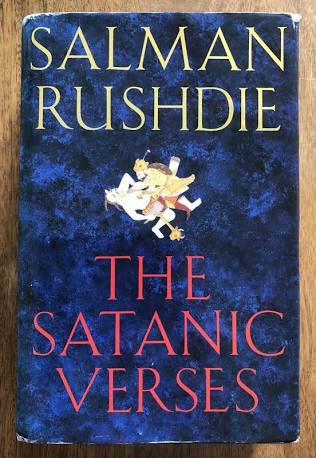
Salman Rushdie: The Satanic Verses: A Novel; Henry Holt, New York, 1997 (1988).
NEW YORK, NEW YORK – DECEMBER 05: Salman Rushdie speaks onstage at The Center for Fiction 2023 Annual Awards Benefit at Cipriani 25 Broadway on December 05, 2023 in New York City. (Photo by Ilya S. Savenok/Getty Images for The Center for Fiction)
Complex high octane novel which almost cost Rushdie his life on three separate occasions and did cost the life of his Japanese translator. The attacks were due to the fatwa declared against Rushdie in February 1989 by the late Shia Muslim Iranian President the Ayaotollah Khomeini. The reason for the fatwa was that Khomeini believed that the novel contained blasphemous material about Islam and the prophet Muhammad. Although the President eventually distanced himself from the fatwa it has never been lifted.
Rushdie’s novel centres on two humans with angelic powers both of whom were the only survivors of a major aircraft explosion. The two characters were both Indian born but spent most of their lives after childhood as British citizens. Gibreel Farishta was an Indian superstar actor and allegedly the “good” angel. Saladin Chamcha also worked in the film industry in the technical area and was allegedly the “bad” angel.
The novel centres on the lives and loves of these two characters including their personal interactions with each other. The novel paints a rather unhappy picture of the lives of Indian nationals trying to make a go of life in late C20th London alongside the historical material on Islam.
Rushdie clearly has a wide grasp of Indian and British society and a far-reaching knowledge of English literature which he makes use of on a regular basis. There are passages in the novel which could almost be regarded as lists of things literary, social behaviour, gang behaviour and several other political, artistic and humorous happenings. These events are too numerous and complex for the reader to spend much time trying to sort out what is happening. I think Rushdie wants us to move on and generally just get the gist of each situation. Someone who has lived on the darker side of British Indian relations might have more clues about what is happening.
I read and enjoyed Rushdie’s powerful prizewinning Midnight’s Children some years ago but I cannot recommend this novel. The high powered sexual imagery is, I believe, unnecessary for his purpose. Some of the complexity of his “lists” and crazy event images looks more like “see how much I know about literature, London’s underground and Indian behaviour in Britain”. The Islamic history is powerfully written and interesting in its own right but doesn’t seem to have any clear link with the rest of the narrative. There is an important story about religion hidden in this book but in my view Rushdie has wasted a good opportunity. 3 Stars.
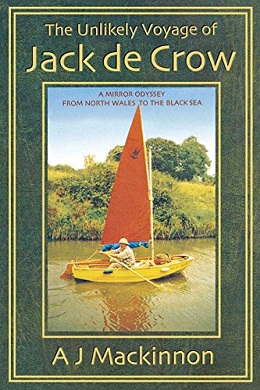
Review of A.J. Mackinnon: The Unlikely Voyage of Jack de Crowe, p/b, Melbourne, Black Inc., 2009
A.J. Mackinnon is a multi-talented school master, raconteur, world traveller, poet, mathematician , tin whistler, magician and courageous sailor. The Jack de Crowe was a small dinghy Mackinnon sailed through most of the canals in England and then sailed single handed across the English Channel to France and on through Germany, Austria, Slovakia, Romania, the former Yugoslavia, Bulgaria and all the way to the Black Sea. This novel is the story of his adventures and is a remarkable read.
Mackinnon tells of back-breaking rowing, literally hundreds of locks, near shipwrecks and collisions, storms and pirates, generous hosts, hunger and near starvation, beautiful sites and unpleasant and dangerous muddy boat traps. That’s just to name a few of the adventures in this novel.
Assisting him in these heroics come along a vast array of generous folk unknown to him who supply warm beds where needed, copious amounts of food and wine, helpful repair work after much damage to his boat from time to time and many other folk who simply came into his life or offered sage advice.
Mackinnon’s story is written with deep humour, but also demonstrates the frequent challenges to life and limb he endured through his determination to take such a journey unaided. For readers who love boats and understand the rigours and mechanics of dinghy sailing this book will provide a feast of interest and ingenuity. For those of us who like a good yarn there are stretches in the book which are quite technical and at times test the reader’s patience. Nevertheless Mackinnon’s achievement is so amazingly breathtaking that the book is hard to put down in spite of the occasional technicalities. 5 stars.
Geraldine Brooks: Nine Parts of Desire:The Hidden World of Islamic Women, p/b, Sydney, Doubleday/Anchor Books,1994.
Geraldine Brooks’ extraordinary analysis of women in Islam was based on her six years as a Western reporter, under the most challenging of circumstances and during events of considerable danger. Now thirty six years later, some things in some countries have changed but this amazing story still provides an exceptional and closely informed insight into the mystery and the challenge of Islam in many countries around the world. Reading this narrative in 2003 at, the height of the Israel-Hamas war simply underlines the horror and trauma of wars of faith and nationality.
The distortion of Islamic teaching resulting in genital mutilation of women including clitoridectomy and pre-wedding hymen replacement is difficult to read about as is the hunting down of writers including Nawal Saadawi and Farag Foda. In addition the inequality between the freedoms of men and those of women in Islam is equally disturbing. On the other hand there are many attractions in the teaching of Islam which appeal to people of many nations, making Islam one of the most popular of all religious faiths.
Geraldine Brooks covers a range of issues including the importance of women being veiled in public, wedding regulations, changes from Muhammad’s original teaching, the many converts to Islam, women as Jihadist warriors, the complexity of Jordan’s King Hussein and his marriage to an American woman – Queen Lisa Halaby, Islamic radicalism, the risk of refusing the veil, the rape and torture of nations like the Kurds, the challenge of Islamic female athletes competing for the Olympics, Islamic dancers, and many other issues.
This is a disturbing and deeply challenging work from a person who has spent six years in the front line of Islamic and Western debate. 5 stars and rising
Salman Rushdie: The Satanic Verses: A Novel; Henry Holt, New York, 1997 (1988).
NEW YORK, NY – DECEMBER 11: Salman Rushdie attends the Django Unchained NY premiere at Ziegfeld Theatre on December 11, 2012 in New York City. (Photo by Cindy Ord/WireImage)
Complex high octane novel which almost costRushdie his life on three separate occasions and did cost the life of his Japanese translator. The attacks were due to the fatwa declared against Rushdie in February 1989 by the late Shia Muslim Iranian President the Ayaotollah Khomeini. The reason for the fatwa was that Khomeini believed that the novel contained blasphemous material about Islam and the prophet Muhammad. Although the President eventually distanced himself from the fatwa it has never been lifted.
Rushdie’s novel centres on two humans with angelic powers both of whom were the only survivors of a major aircraft explosion. The two characters were both Indian born but spent most of their lives after childhood as British citizens. Gibreel Farishta was an Indian superstar actor and allegedly the “good” angel. Saladin Chamcha also worked in the film industry in the technical area and was allegedly the “bad” angel.
The novel centres on the lives and loves of these two characters including their personal interactions with each other. The novel paints a rather unhappy picture of the lives of Indian nationals trying to make a go of life in late C20th London alongside the historical material on Islam.
Rushdie clearly has a wide grasp of Indian and British society and a far-reaching knowledge of English literature which he makes use of on a regular basis. There are passages in the novel which could almost be regarded as lists of things literary, social behaviour, gang behaviour and several other political, artistic and humorous happenings. These events are too numerous and complex for the reader to spend much time trying to sort out what is happening. I think Rushdie wants us to move on and generally just get the gist of each situation. Someone who has lived on the darker side of British Indian relations might have more clues about what is happening.
I read and enjoyed Rushdie’s powerful prizewinning Midnight’s Children some years ago but I cannot recommend this novel. The high powered sexual imagery is, I believe, unnecessary for his purpose. Some of the complexity of his “lists” and crazy event images looks more like “see how much I know about literature, London’s underground and Indian behaviour in Britain”. The Islamic history is powerfully written and interesting in its own right but doesn’t seem to have any clear link with the rest of the narrative. There is an important story about religion hidden in this book but in my view Rushdie has wasted a good opportunity. 3 Stars.
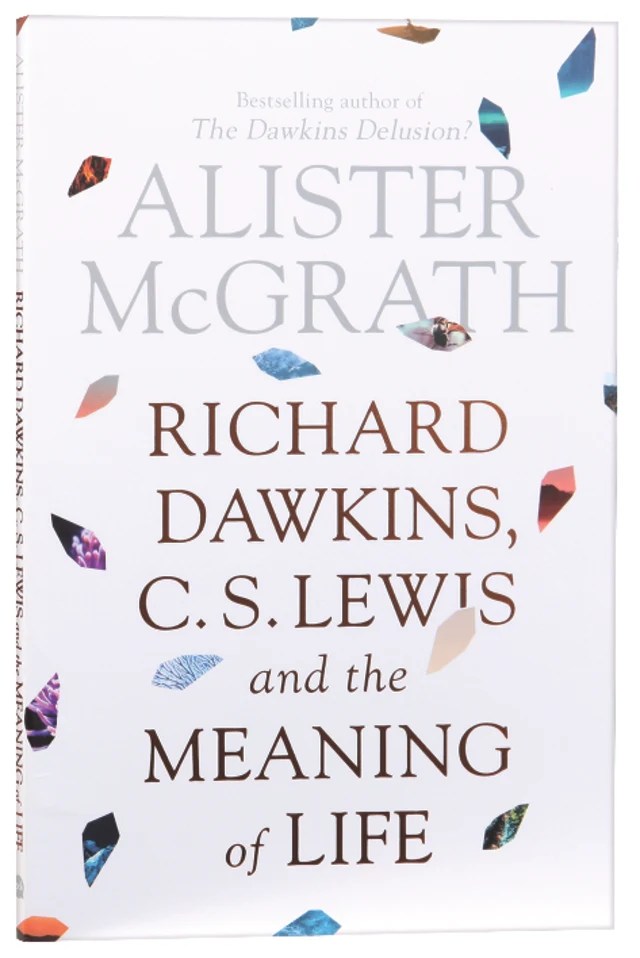
Alister McGrath: Richard Dawkins, C.S. Lewis and the Meaning of Life, p/b, London, SPCK, 2019
Alister McGrath is the Andreas Idreos Professor of Science and Religion at Oxford University and Director of the Ian Ramsey Centre for Science and Religion. He has written a vast array of outstanding books on Christian Theology, Church History and the relationship between Christian Faith and Science. His output includes his monumental three volume A Scientific Theology, his Doctoral Thesis A History of the Doctrine of Justification, his outstanding must read Christianity’s Dangerous Idea on the Reformation, and his very helpful The Christian Theology Reader in which he provides substantial readings from every major theologian from Justin Martyr to the present day along with a thorough analysis of their key ideas and useful questions for study.
Alongside these massive theological tomes McGrath’s little (70 page) paperback on Dawkins, Lewis and the Meaning of Life seemed to me a bit trivial after some years of crunching through his heavyweight thought. On the contrary I found the four chapters of this little book demanding, thought provoking and at times unsettling. At the outset a reader might assume that McGrath would be very critical of Dawkins’ outspoken critique of Christian faith and very praiseworthy of Lewis’s well known and very popular Christian books. This is not the case as McGrath puts some tough questions and criticisms to both these writers and challenges the reader to think deeply about what we really do believe about our lives, their future and purpose and what is the meaning of our existence on this tiny planet hidden in the maelstrom of billions of other stars and planets.
McGrath demonstrates that both writers are men of faith holding committed positions that cannot be proved right, but which they clearly regard as justified and reasonable. (p.19) McGrath also points out that both psychology and philosophy show that human beings have a tendency to believe more than the evidence actually warrants. (pp38-40). McGrath challenges us to think through just how we can show our beliefs to be justified. Don’t read this book if you don’t like your Christian faith being challenged. Read the book if you want to consider deeply the meaning of your life and faith. 5 stars.
Colson Whitehead is a popular American writer especially well known for his story of The Underground Railway involving black Americans escaping from Southern USA before the American Civil War.
Harlem Shuffle is a rollicking story of crime and criminality in Harlem New York. Family man Ray Carney runs a highly successful furniture shop in Harlem but was not immune from accepting the odd bits and pieces of stolen property and moving them on at a profit. Whitehead’s novel is in some respects a difficult read as the terminology is unique to an urban underground of criminality. I did find this material difficult at first but the reader gradually gets used to the language and style.
Harlem Shuffle does not hide the brutality and easy death involved in the Harlem underground but also manages to inject a degree of humour into the narrative. The reader soon identifies with Carney given that the behaviour of some of his contacts is completely ruthless and outrageous. The book is a hefty read and not for the faint-hearted. It certainly shines a light on a whole underground most of us know exists but have little interest in interrogating too deeply. In many ways it is quite a disturbing read. 4 stars
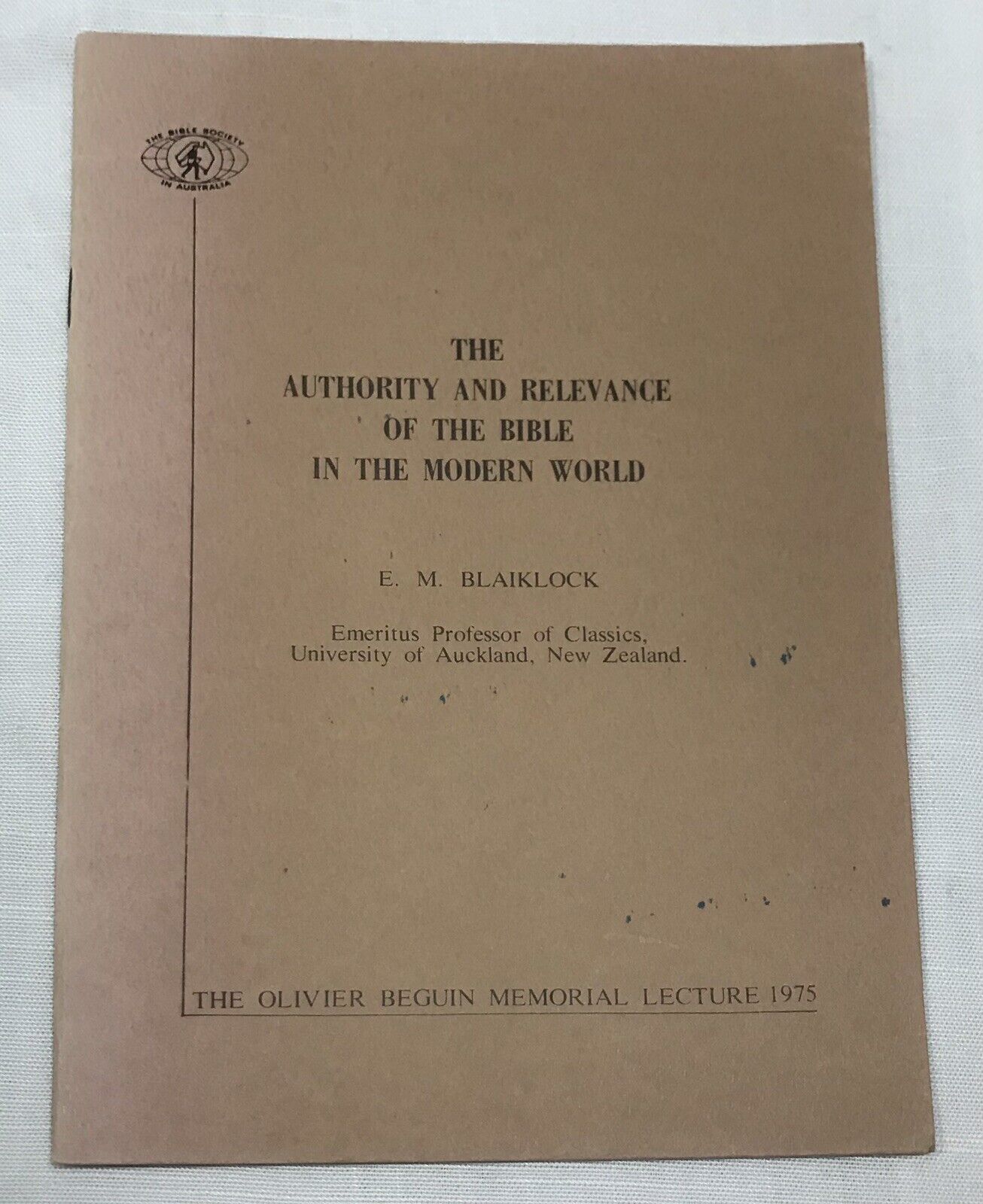
E. M. Blaiklock: The Authority and Relevance of the Bible in the Modern World: The Olivier Beguin Memorial Lecture 1975, p/b. Bible Society, Melbourne, 1975
Edward Musgrave Blaiklock lectured in Latin, Greek and Biblical History for 42 years at the University of Auckland and for 21 of those years he held the Chair of Classics. Having emigrated to New Zealand with his family when he was six years old. Blaiklock was highly regarded as one of Auckland’s greatest sons and became the first Public Orator of Auckland, a post he held for ten years. Writing under the name of Grammaticus for the Weekly News, the Sunday Herald and the New Zealand Herald for over forty years without missing an edition. His list of academic publications is vast and his knowledge of Latin, Greek, Biblical History and Archaeology has few peers. Blaiklock died in 1983 but his many academic works are still widely sort after.
Blaiklock’s major essay The Authority and Relevance of the Bible in the Modern World was given in 1975 but its cutting analysis is still frequently sought after as are many of his books and articles including his Commentary on Acts and his works on The Century of the New Testament , The Male Characters of Euripides and Biblical Archaeology are widely sort after, fifty years after his death. Blaiklock’s writing, on the surface silky smooth and easy to read, amazes the reader with his depth of knowledge and his ability to make quite difficult concepts very accessible to the reader. Anyone who in the C21st is thinking that the Bible is completely irrelevant to our daily pre-occupations would I believe be forced to think again if they were to read this extraordinary essay.
It is rare to find an academic with the communication skills to maintain a post in a national daily for forty years at the same time being quite at ease with ancient history, Greek and Latin authors and an exceptional understanding of New Testament Greek and Ancient History. This remarkable piece of historical analysis is readily available online and will richly repay anyone who takes the time to read it, especially if they were previously an atheist! 5 stars.
James Graham Ballard: Empire of the Sun, p/b, London, Harper Collins, 1993 (1984)
J G Ballard (Jim) was a young child living in Shanghai with his parents when the Japanese attack on Pearl Harbour took place on 7 December 1941 (8 December 1941 in Shanghai because of the time difference across the Pacific Date Line).
In the chaos of the Japanese entering the second world war on Germany’s side Jim was separated from his parents as all British citizens were immediately interned. Initially Jim survived by eating left over food and supplies from his family home and later by breaking into other homes in his area. After various dangerous near misses and assaults Jim finally handed himself over to the Japanese and was interned for three years in the Lunghus Civilian Assembly Centre.
This compelling novel details his own privations almost starving to death alongside the chaos of the Japanese war machine mingled with China’s own internal battles led by tensions between Nationalist Chiang Kai Shek and the Chinese communist party. Ballard powerfully describes the starvation and methods of survival of those held in Japanese internment camps, the death marches, the profiteers and self sacrifice of missionaries and others who cared for others in the midst of their own misery and hunger.
Ballard was eventually reunited with his parents and went on to become a copywriter and reporter before joining the RAF in Canada, later becoming a scientific journal editor and eventually a full time writer of over 22 books. Empire of the Sun was often set as a senior text in Australian secondary schools in the 1970s, introducing young Australians to the horrors of world war trauma. It is a novel which leaves an indelible impression on the mind. 5 stars and rising.
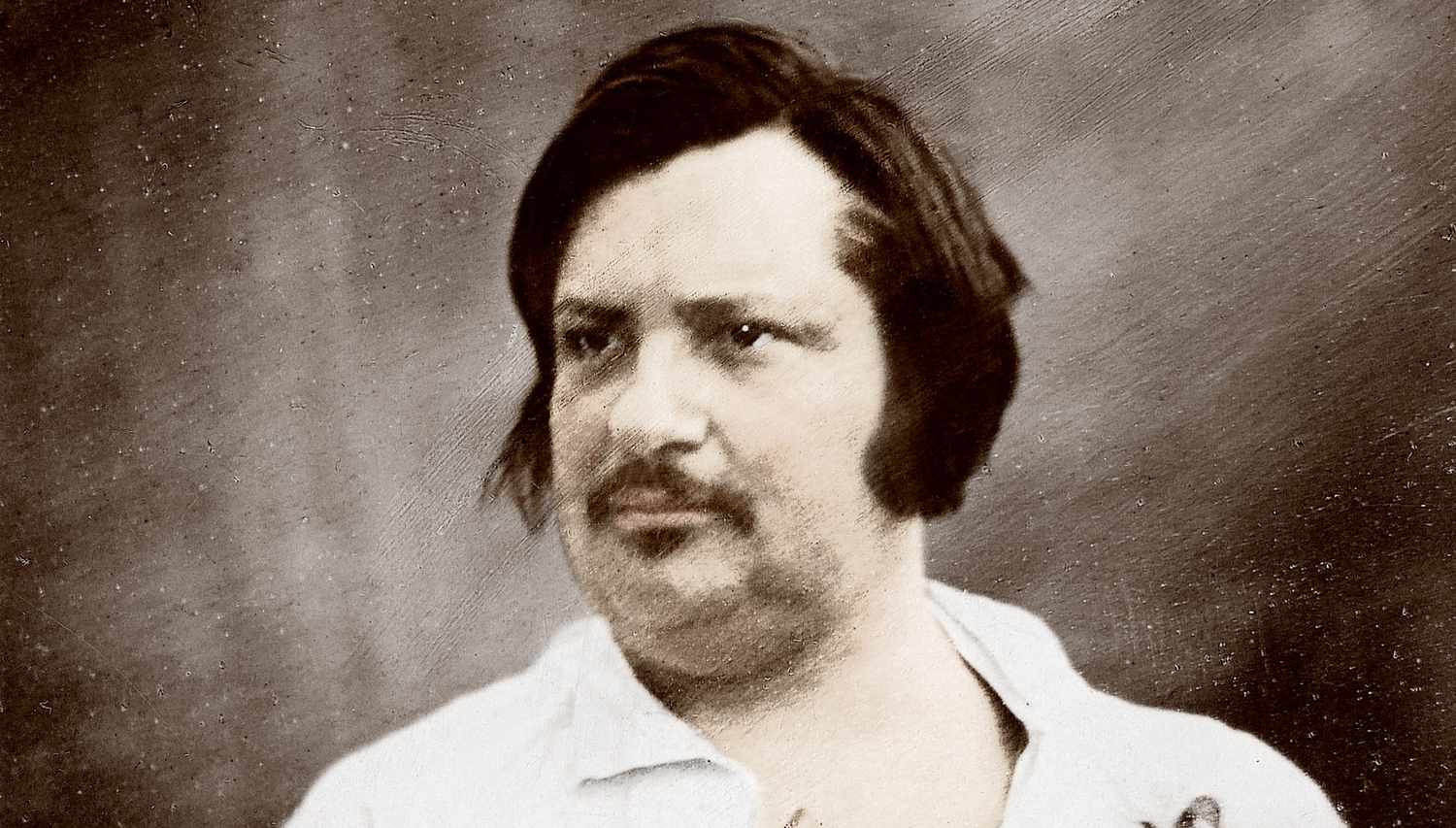
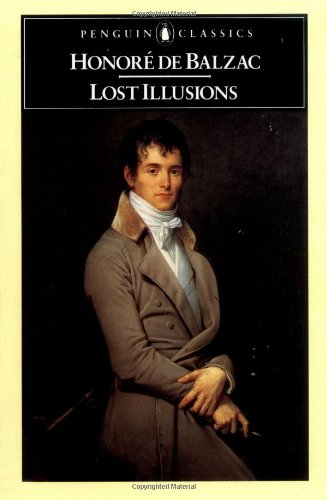
Honore’ De Balzac: Lost Illusions: Trans & Intro Herbert J. Hunt, p/b, England, Penguin, 1987, (1837-43).
Balzac was a prolific C19th French author producing over ninety novels to which he gave the comprehensive term The Human Comedy. These extraordinary works included studies of French manners, philosophy, Parisian, military and country life in remarkable detail.
Lost Illusions is a large novel in three parts consisting of the chaotic life of Lucien Chardon, born of a plebeian father and an aristocratic mother, a poet who tries unsuccessfully to make a name for himself in Paris. Lucien’s story is based to some extent on his knowledge of the writer Jules Sandeau. Alongside this hectic story Balzac includes Scenes of Parisian Life and Scenes of Provincial Life. The thread which ties this lengthy work together is the friendship between Lucien and provincial printer David Sechard. Balzac wrote a second story about Lucien’s second attempt to make it in Parisian society encouraged by the mysterious Spanish ecclesiastic and diplomat ‘Carlos Herrera’. This long sequel to Lost Illusions is entitled Splendour and Misery of Courtesans or in the Penguin translation, A Harlot High and Low.
During my Year 12 French class many years ago I was supposed to have read Balzac’s Pere Goriot in French, which was not an achievement that went very well. As a result I have had a dread of reading Balzac ever since and I regret that I have not until now read Balzac in English. Herbert J. Hunt’s translation is superb and the trials, successes and deep trauma of Lucien’s life is indeed hard to put down. Lost Illusions is a genuine classic and in many turns one both feels for and hates the remarkable Lucien. 5 stars.
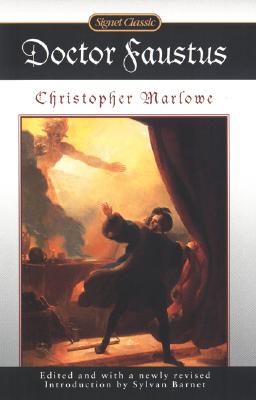
Christopher Marlowe: The Tragical History of the Life and Death ofDoctor Faustus: Ed. & Intro: Sylvan Barnet, p/b, New York, Signet Classic, 1969 (1616)
Christopher Marlowe tended to live on the wild side himself, Graduating from Cambridge, working for the British Government in Europe intrigues and leading a lively life on the streets in Britain whilst producing some brilliant plays. He finally lost his life in a street fight at an eating house after a dispute over the bill.
Editor Sylvan Barnet notes that The Historia von D. Iohan Fausten was published anonymously in German in 1587 and describes the career of a man who gave the devil his soul in exchange for twenty-four years of earthly power, and who at last after performing miraculous feats and low practical jokes, was carried of to Hell. She further notes that An English translation of this work was published in 1592 as The History of the damnable life, and deserured death of Doctor John Faustus, Newly imprinted, and in convenient places imperfect matter attended…and translated into English by P. F. Gent[leman]. Barnett considers that Marlowe based his play on this edition although an additional story from John Foxe’s Acts and Monuments has been added. Barnet’s 1969 edition contains additional essays on The Tragic Form by Richard B. Sewall, Five-Act Structure in Doctor Faustus by G.K. Hunter and other notes on whether or not Dr. Faustus is a Christian tragedy as well as the way the play was presented at Stratford-On-Avon in the early C17th.
Marlowe’s story is a rollicking yarn as Faustus gets tangled up in all sorts of outrageous events and actions including popes, emperors and anyone else who gets in his way. He has 24 years to enjoy himself before Lucifer and his faithful sidekick Mephistopheles finally claim their victim. There are plenty of comic interludes in the play and indeed Dr Faustus causes significant havoc and fun wherever he travels. Nevertheless the fateful ending is severe and grim indeed and one can imagine an early C17th audience feeling the horror of the sad and final act.
Whilst Dr Faustus can be seen simply as a morality play it is also a real question whether Marlowe intended the play to challenge the stranglehold that Christian faith had in Europe until the gradual infusion of scientific investigations and translations of ancient texts from the C13th onwards. Thinkers like Roger Bacon and Robert Grosseteste and many others began to challenge the Christian world view. Such thinkers paved the way for the Renaissance and the genuine challenge to spiritual as opposed to scientific forms of analysis of human life, history and science. There are certainly many direct anti-papal incidents on centre stage in Marlowe’s play.
One thing is certain, the human mind will always be hungry to prolong life and to explore any possible golden key to the mystery of ongoing human life. 5 stars.
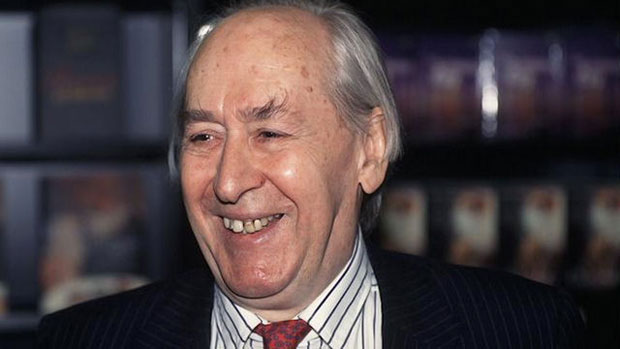
Robert Shore: Andy Warhol, h/b, London, Laurence King Publishing, 2020
Journalist Robert Shore.
Andy Warhol
Journalist Robert Shore has produced a thorough and masterful summary of the complex world of commercial artist, photographer and film maker Andy Warhol. Ward died in 1987 from complications after a successful gall bladder operation.
Warhol was born in Ruthenia in the Carpathian Mountains on the border of Russia and Ukraine. His family migrated to the USA and he grew up in Pittsburgh in a Central European ghetto, regularly attending St John Chrysostom Church where they listened to services in Old Slavonic. His father was a construction worker often away from home and his mother was of European peasant stock, eccentric and superstitious and wearing peasant dress but also a talented singer and floral artist.
Warhol was a sickly child eventually contracting St Vitus Dance, a disorder of the Central Nervous System which left him with problems of trembling and shaking as well as a skin condition which made him look pale and blotchy.
He was addicted to the cinema and his childhood bedroom was surrounded by autographed photographs of Hollywood stars, especially Shirley Temple. At school Warhol’s drawing skills were soon spotted, earning him a free Saturday art training at the Carnegie Institute each Saturday. He eventually enrolled at the Carnegie Institute of Technology and his talents spread to dance and window dressing eventually obtaining part time work in Pittsburgh where he became a connoisseur of fashion magazines and the printed page.
From these raw beginnings Warhol developed into perhaps the most well known and highly skilled commercial artist of all time creating a vast Factory space in New York which attracted the edgy, rock and roll stars, the edgy artistics, the wayout, the far way out and the wacky with a strong emphasis on the creation of a homosexual community laced with vast quantities of every kind of drug and amphetamine use.
It was in this centre that the famous paintings of Campbells’ tomato soup cans and other icons were made. It was also in this centre that Valerie Solanas walked out of the sixth floor into the factory and pulled the trigger of a .32 calibre automatic pistol, firing it twice at Warhol, felling him to the floor. Warhol was pronounced dead at the Columbus hospital but somehow managed to pull through.
Warhol eventually drifted from commercial art becoming known worldwide for his offbeat, outrageous and frequently pornographic film work and his photography of the rich and famous all over the world including a session with Mao Tse Tung!
In his later years he lived more quietly in a large house with intimate friends but his photographic and artwork still dominated the edgy scene from Hollywood to New York and overseas. He died in 1968 in hospital after a successful operation removing his gall bladder. Robert Shore’s concise and clear analysis of every aspect of Warhol’s complex oeuvre along with 22 hard to find photographs of Warhol with the rich and famous is thorough, concise and clear. This is a very fine biography of one of the modern art world’s most complex superstars.
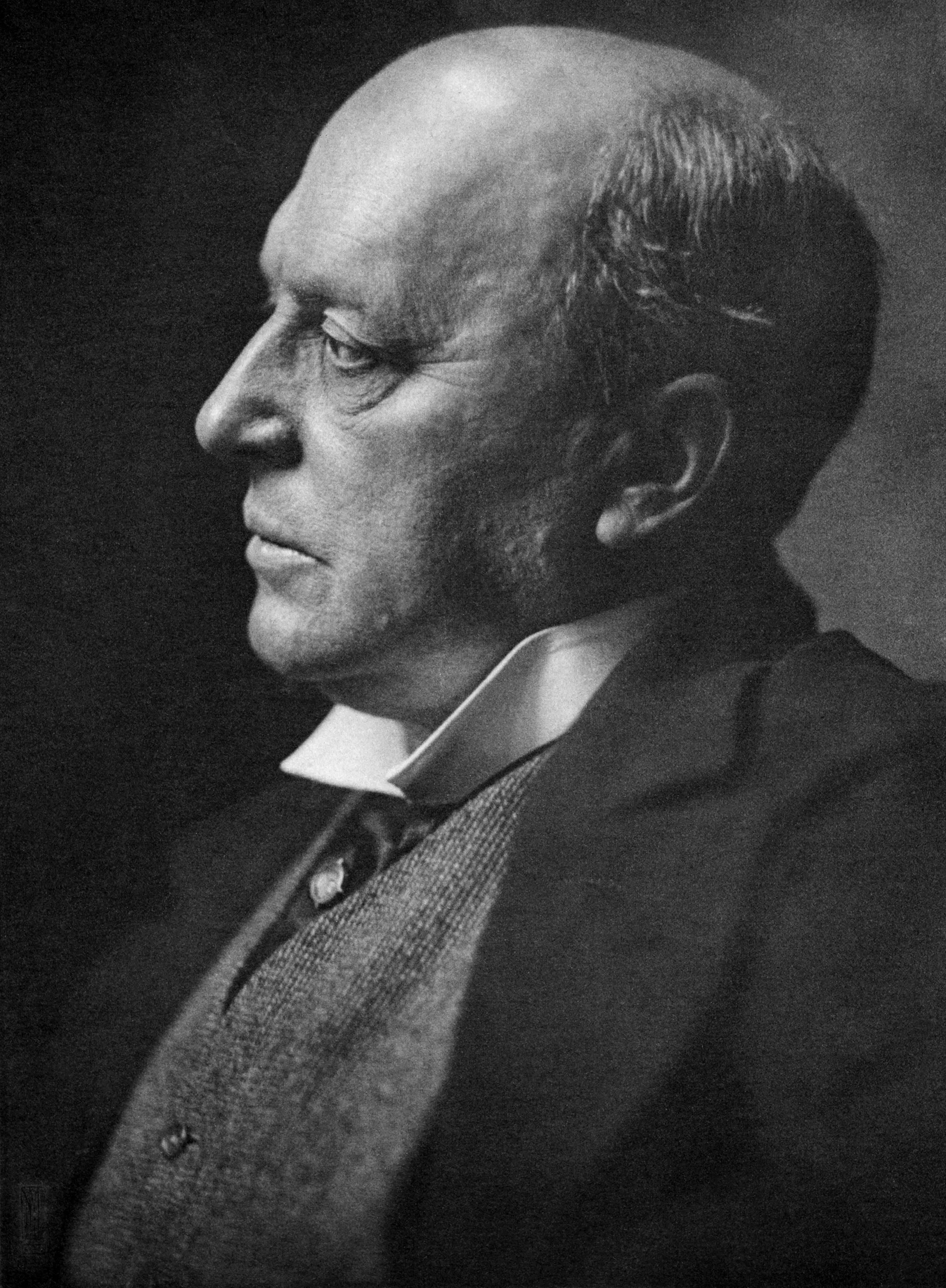
Henry James: The Ambassadors: h/b, London, Heron Books, 1968. [1902].
American Henry James (1843 -1916) was the brother of highly regarded psychologist William James and his many novels focus on the machinations of the human mind and how individuals make decisions and lead their lives.
The Ambassadors is a story told completely through the lens of retired 60 something American literary editor named Strether. Having lost his wife and only son earlier in life, Strether has developed a strong relationship with the Company’s Managing Director Mrs Newsome and has agreed to travel to France to locate her son to persuade him to return to the USA to take up the management of the company. Mrs Newsome had developed a view that her son Chad had been misbehaving in France and needed her firm hand. At the same time Strether has persuaded old friend and retired stick in the mud and quite famous lawyer Mr Waymarsh of Connecticut to accompany him.
Early in the narrative in England Strether meets up with attractive single lady Maria Gastrey who is based in Paris and becomes a wise and trusted friend on his journey and task to meet Chad and bring him back to the US. Once Strether gets to Paris and finds Chad he quickly realises that Mrs Newsome’s fears about Chad have been misplaced. Chad has in fact developed a very successful career and some firm and helpful friendships including especially aristocratic Madame de Viannet and her beautiful daughter Jeanne. Madame de Viannet has played a major role in reordering Chad’s life and behaviour and turning him into a first class operator as well as a very elegant and agreeable young man.
Strether’s support of Chad does not impress Mrs Newsome or Mr Waymarsh who “wakes up” in Paris and joins the anti-Chad lobby. Mrs Newsome sends reinforcements in the form of married family members the Pococks who remain unpersuaded that Chad is a reformed character. Thus the scene is set for a complex series of events which lie at the heart of the novel, all seen through the thought process of Strether. Many surprises are in store for the reader!
Our Book club members uniformly disliked this book (except me) and only three of them completed the novel!
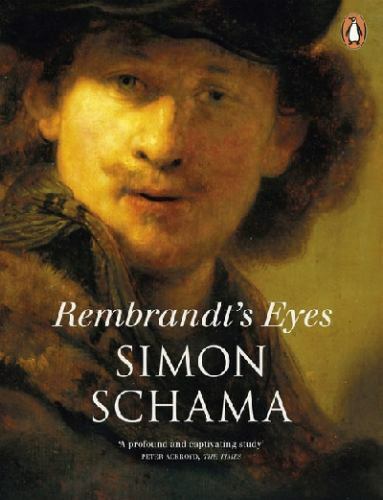
Review of Simon Schama: Rembrandt’s Eyes: p/b, London, Penguin, 2000.
Simon Schama is an amazing polymath and historian of art and European culture. Born in Britain of Jewish parents Schama’s particular expertise is in the history of the Jews but his detailed knowledge of Dutch French, British and American history also has few peers. He is extraordinarily erudite and his detailed wisdom and research has at least one commentator calling him a walking thesaurus.
Rembrandt’s Eyes is a lavishly produced and exceptionally detailed account of the lives of two artists, Rubens and Rembrandt. It is a massive read of well over 700 pages with beautifully reproduced reproductions of all the major works of these two exceptional artists. Alongside their stories is the traumatic and tragic outworking of the C17th thirty years warfare between Catholic Spain and Protestant Netherlands with other European nations including Britain playing intermittent roles on both sides depending on where national gains can be made.
The constant destructive horror of Protestant/Catholic warfare in C17th Europe makes for profoundly disturbing reading alongside the desperate search of European Jews for a safe haven which is rarely long lasting. It is difficult to read of Catholic/Protestant division on the one hand and of equally bitter and hard fought divisions between Protestant denominations of various traditions and leaders and especially the punishments handed out to losers on both sides.
The lives of Rubens and Rembrandt also make for thought provoking reading with their exceptional and brilliant successes and the difficult and demanding requirements of their masters. Rubens finally ended his life with considerable power and wealth while Rembrandt ended his life in poverty whilst history will record him as perhaps the finest artist of them all. The name “Rembrandt’s Eyes” refers to Rembrandt’s exceptional and extraordinary care that he takes with the eyes of the figures he paints.
I have been profoundly moved by Schama’s analysis of this tragic time in Christian internecine theological development and equally I have been stunned by the complexity and demanding nature of the artistic enterprise. The exceptional gifts that artists bring to our senses and our world has the capacity to change the way we look at things and there is no doubt in my mind that the study of Art can richly deepen our understanding of Christian faith. 5 stars!
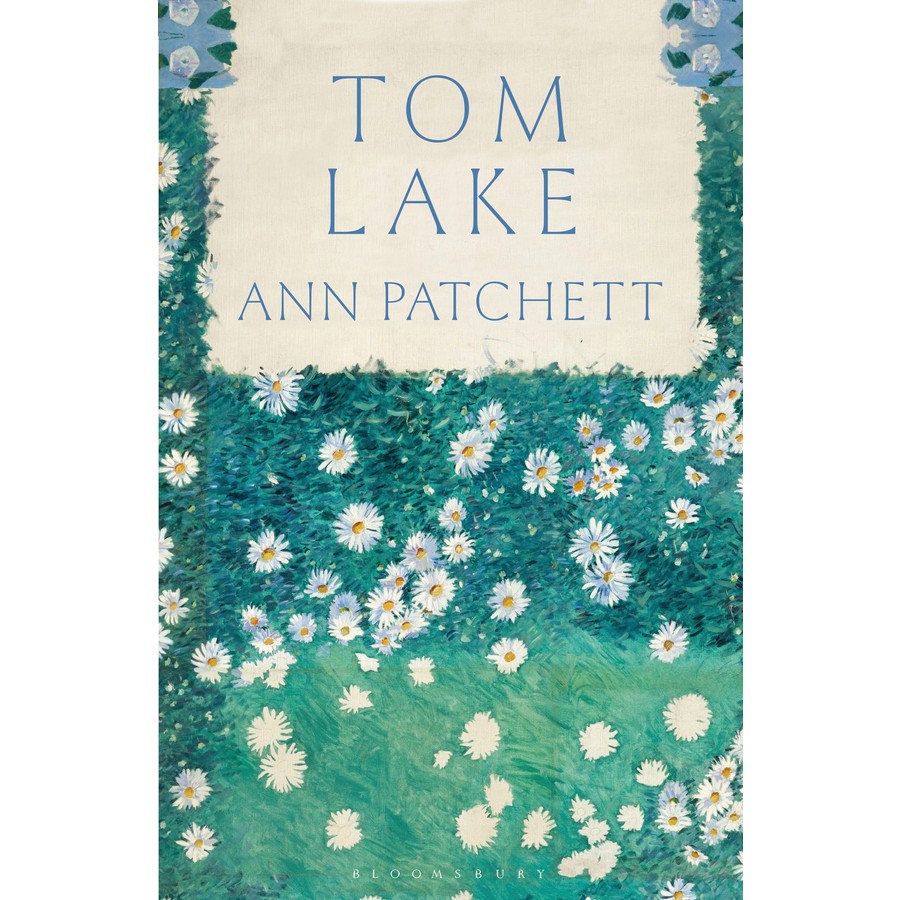
Ann Patchett: Tom Lake: p/b, New York, Bloomsbury, 2023.
Eighth novel by well regarded American novelist Ann Patchett. The novel traces the two speed life of Lara, her husband and three daughters. Lara’s first love was drama at school and this lead her to the stage and eventually to a key role in a major Hollywood movie. In her drama and movie career Lara meets and falls in love with budding actor Peter Juke. After a tennis accident and her own sense that she was somewhat of a one trick pony, Lara leaves the film world for a series of less demanding careers until she meets and eventually marries former director and cherry picker Sam Nelson. Between them they raise three girls and during lulls in the cherry picking the girls persuade their mother to tell them the story of her stardom and her marriage.
I have to own that I was reluctant to read this novel, having found her previous novel The Dutch House somewhat static and uneventful. I was pleasantly surprised by the pace and energy of this novel and the surprising twists and turns of Lara’s life. I became keen to find out the ongoing story and the novel had many surprises without requiring too much energy or challenge to read. 4 stars.
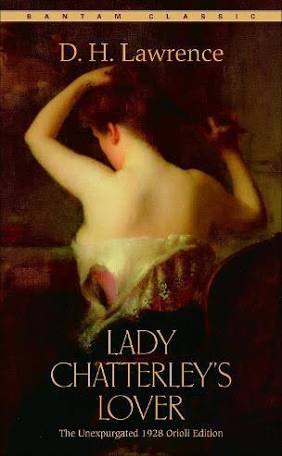
D.H. Lawrence: Lady Chatterley’s Lover: The unexpurgated 1928 Orioli Edition; Preface, Lawrence Durrell; Intro. Ronald Friesland. This edition includes Lawrence’s extended essay, A Propos of Lady Chatterley’s Lover. p/b, New York, Bantam Books,1982, (1928).
I was too young and inexperienced when I read Lawrence’s The Rainbow in my first year of Melbourne Uni Arts, aged 17. I understood little of the novel and was very critical of it. Later in life, married with two children, I read Sons and Lovers and Women in Love and found the latter especially to be one of the most powerful, sensuous and meaningful novels I have ever read and rate it certainly in my top five novels of all time.
It has taken me to the ripe old age of 74 to read Lady Chatterley’s Lover, not because of any objection, but simply the vast catalogue of reading material that comes along with teaching for fifty years and so many new books to savour.
I enjoyed Lady Chatterley very much and the key characters, Connie, Sir Clifford, Mrs Bolton and the magisterial game-keeper Mellors will stay with me for a long time. The famous naughty words, as Durrell’s essay notes, have lost much of their power to horrify since 1928. This enables a reader to enjoy the gradual unfolding of the relationship between the keeper and the Lady of the House with its emergent romance, halting arguments, powerful passion, and thought provoking realism about their situation.
The novel is also an account of a struggling England after World War 1, with the coal industry exploding but also in trouble, the tension between aristocrat and the majority poor, and the gradual unfolding of a more modern world with sporty cars and new inventions daily. Some of this material, although historically interesting, tends to turn the novel in places into a cultural analysis.
The descriptive power of the summer holiday in Paris and Venice with its catalogue of misbehaviour, ennui, torturous heat and languid nothingness is depicted with all Lawrence’s insight and picture writing. Lawrences’s extended essay about the book and its scandals and his view of the short comings of the English, makes interesting reading. Today’s modern England with cultures from all the world have no doubt done a lot to enlarge the emotional and romantic world of England in 2023. I would give this novel 4 stars.
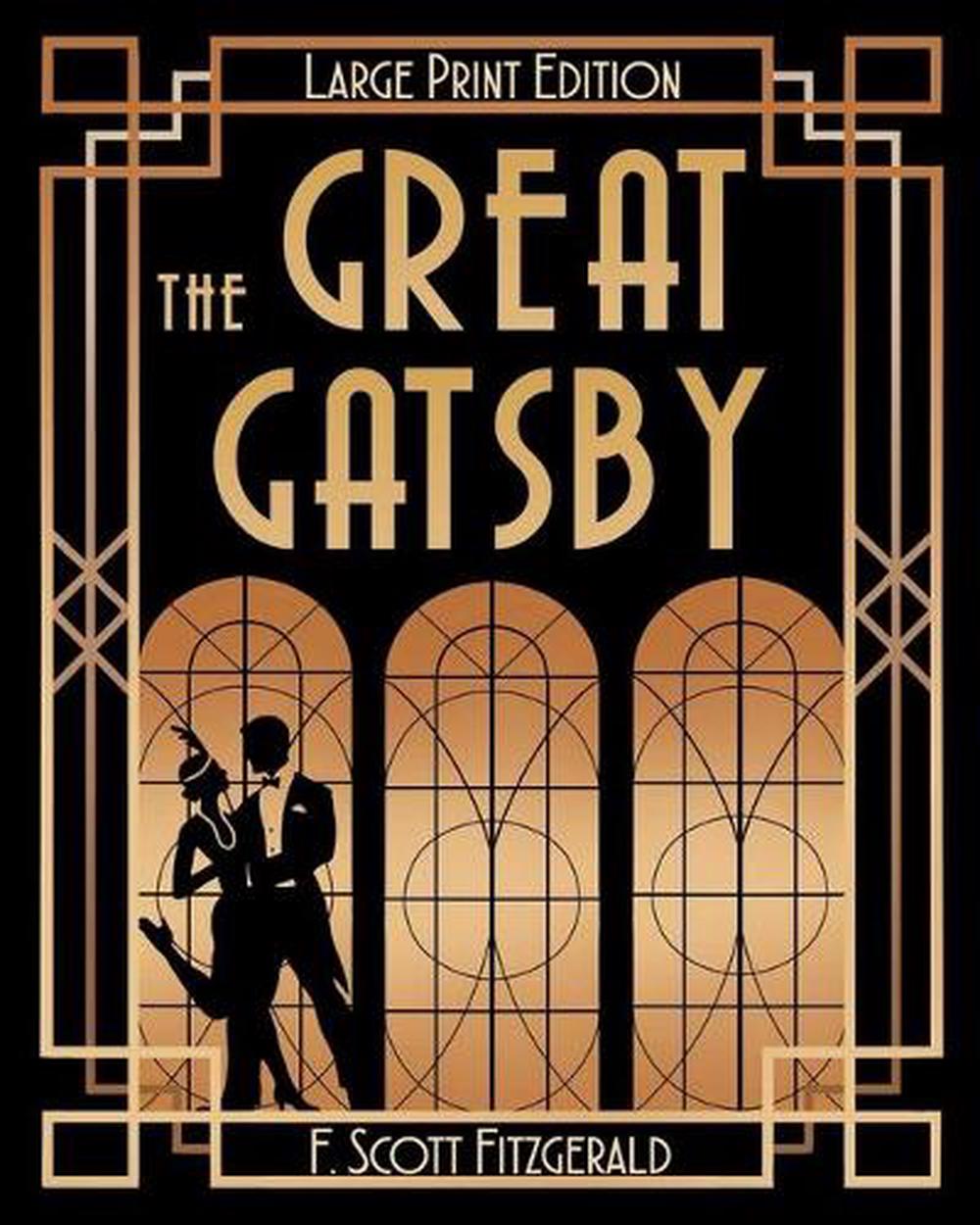
F. Scott Fitzgerald: The Great Gatsby: London,Vintage Books, 1910 (1925).
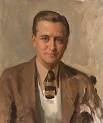
F Scott Fitzgerald
Undoubtedly the best of F. Scott Fitzgerald’s four novels set in the nineteen twenties, Fitzgerald has left us a never to be forgotten masterpiece. I have read this book three times and watched Baz Lurman’s amazing movie the same number of times.
The book is better than the movie with the powerful scene of Gatsby’s funeral,one of the triumphs of literature omitted from Lurman’s film.
In one sense the story is just about the fraught and uncertain wealth of the Anglo-American twenties, with its charleston, devil may care postwar freedom, money and eventually bust. In another sense it is a delicately sensuous love story.
The narrator Nick Caraway takes us on his own journey from the relatively safe and secure West to the fast moving and chaotic reality of life in New York. The magical story of James Gatz from the West who became Jay Gatsby, arguably the richest man in the East based on cleverly marketed illegal bonds, becomes a strangely heroic tale of poor boy makes good and gets the girl of his dreams (almost!)
Gatsby falls in love with upper class Daisy Duckman in his youth before being called to the war. When he returns with no money or prospects she turns to safer shores and marries the unfaithful Tom Buchanan. Nick Carraway, who happens to rent a small house right next door to Gatsby’s mansion, gets to know Gatsby and tells his story at the same time as (almost) falling in love with Daisy’s friend Jordan Baker.
Fitzgerald and his wife Zelda lived this 1920’s life itself and and Fitzgerald creates the power and danger of it with imperious skill, joy and terror. The Great Gatsby is one of the truely great works of English Literature. 5 stars and rising.
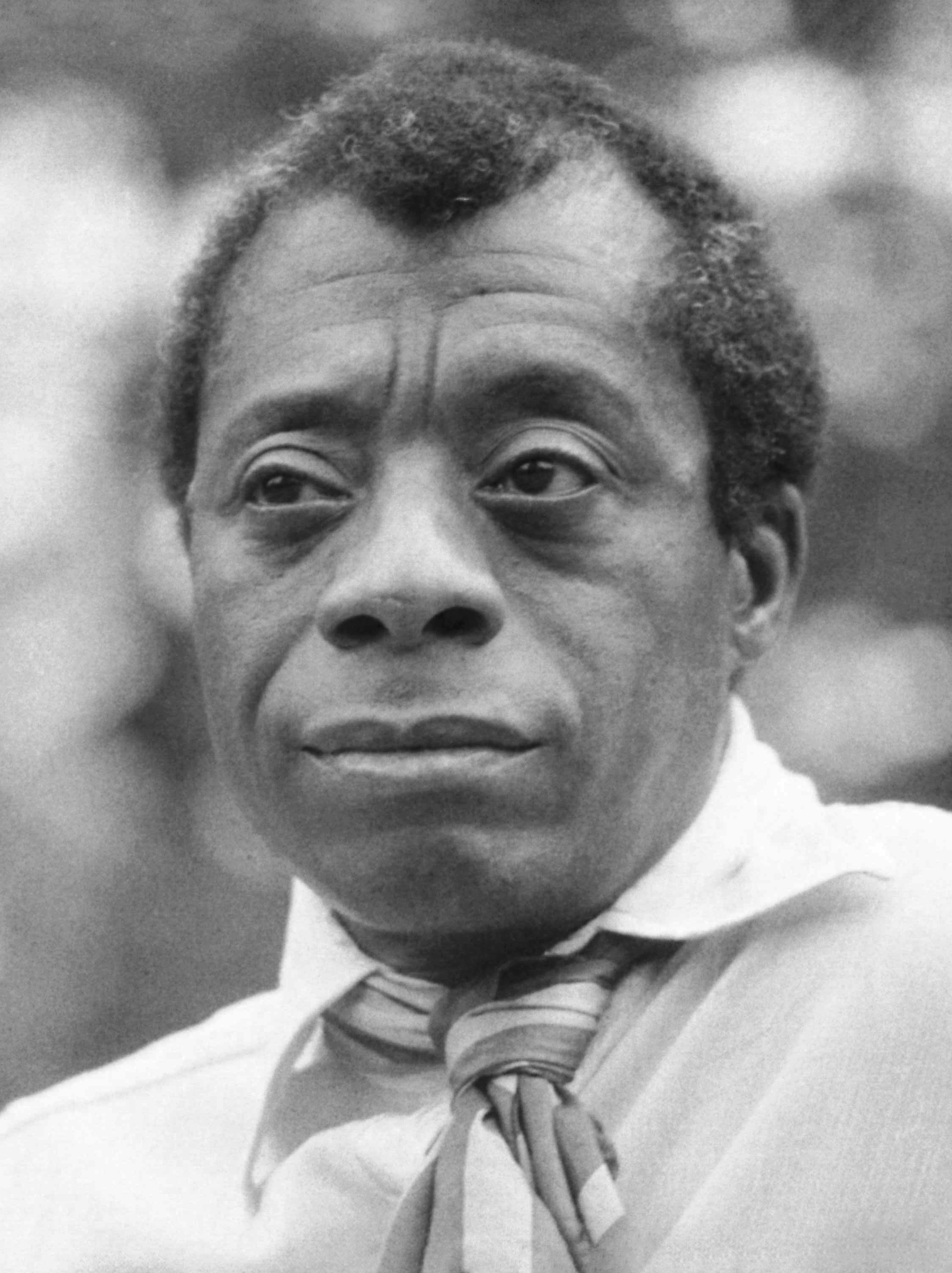
James Baldwin: Go Tell it on the Mountain, p/b, London, Corgi, 1968 (1954).
I read Go Tell it on the Mountain as a teenager and never forgot the mix of African American spirituality, vigorous worship and a degree of hypocrisy alongside commitment.The story is set against an American world which though freed from slavery was still mired in racial anger, disadvantage and division. Fifty six years later I wanted to read this powerful story again in 2023, still disturbed by racial divisions in both the USA and Australia. The book has lost none of its power. I was unaware of its semi-autobiographical nature until reading more about the author very recently.
There are several strong characters in this novel, none more so than successful preacher Gabriel Grimes whose powerful message gained admiration but whose manic behaviour towards his own family brought only anger and disarray. Gabriel, in spite of his holy name, was brutally vicious with his male children and seems unable to find any genuine repentance at any point in the novel. His first wife, Deborah had been gang raped as a teenager and was unable to bear children, dying childless.
His marriage to Elizabeth was almost accidental. She had escaped the rigidity of her powerful aunt who had looked after her after the death of her mother. She travelled north to start a new life and fell in love with a young poverty stricken Richard. They lived happily together in unmarried poverty, until Richard was tangled up in a false accusation of robbery and imprisoned. Although found to be innocent the trauma destroyed him and he suicided before Elizabeth could tell him they were pregnant. Gabriel had also travelled north for a new start and they met through Gabriel’s sister Florence and soon after were married.
The basis of the novel is the story of their family life totally dominated by the church. The children consisted of John (who was of course Richard’s son and the key player in the narrative); Roy, a rebel, both loved and persecuted by his father and a sister who does not appear in the narrative. The tension between John and his father is the central story of the novel.
Baldwin writes with impressive power and vigour and the narrative remains in the mind after many years. His writings have earned him many significant awards. He died in 1987. 5 stars.
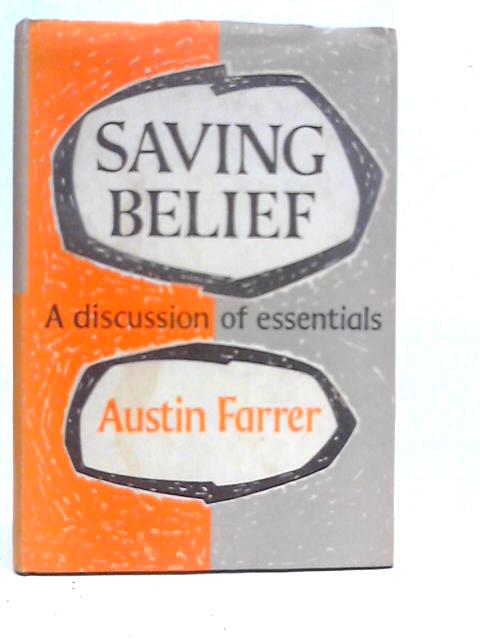
Austin Farrer: Saving Belief: A Discussion of Essentials: h/b,London, Hodder & Stoughton, 1964
Austin Farrer was a major C20th English theologian and philosopher in the high church Anglo-Catholic tradition, in spite of being the son of a Baptist Minister. He was for twenty five years the Warden of Keble College in Oxford and wrote a large number of philosophical and theological works. His closest friend was C S Lewis and he ministered to Lewis at his death bed. Saving Belief was his most accessible work but still demands hard thinking from his readers. No longer in print, Saving Belief is readily accessible second hand on line.
Farrer suggests that Christian faith can only come from hearing about God underlying the importance of Christians reaching out to others about their Christian faith. Farrer suggests that a virtuous and dutiful lifestyle, thinking about faith and/or considering the beauty of creation and the universe might move a person towards faith but that the scandal of faith is that belief in God must be personal. “God” as an explanation or a hypothesis to be tested will not work. There needs to be an openness, acceptance and sympathy towards faith for belief to be formed in a person.
Farrer argues that the basis of theology comes down to a belief that human existence demands a superhuman creator. Acknowledging God’s existence is not the faith that saves. It is not enough to believe in the existence of God. The Devil believes and trembles he argues, citing the Epistle of James.
Farrer’s helpful book has chapters on Providence and Evil (the world is not created perfect, p47), Creed and History, Sin and Redemption, Law and Spirit and a very helpful final chapter on Heaven and Hell. Saving Belief is a small, neat and thoroughly demanding read which will encourage and help believers, make seekers want to know more and might even challenge unbelievers to give faith a second thought. 5 stars.
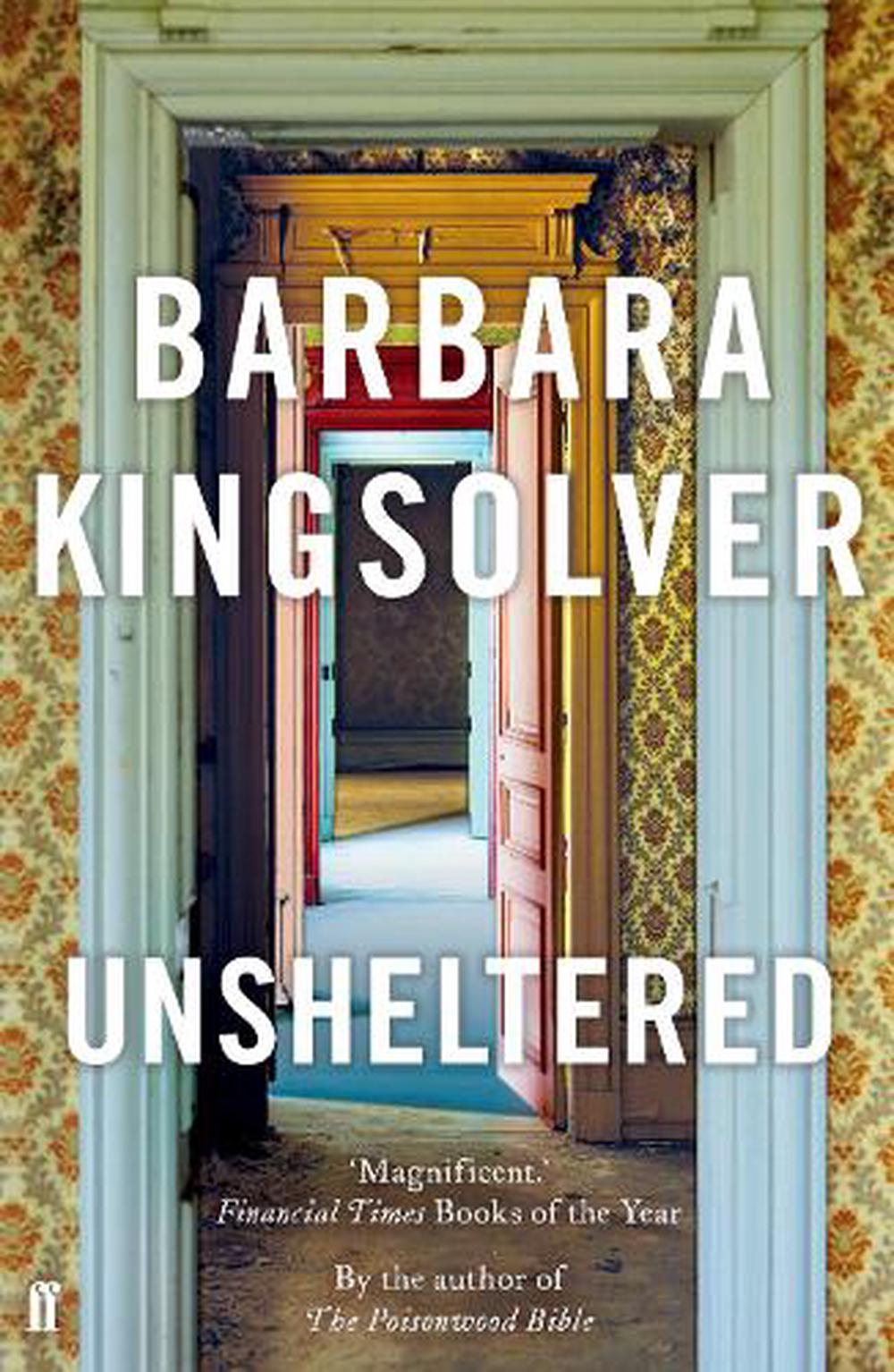
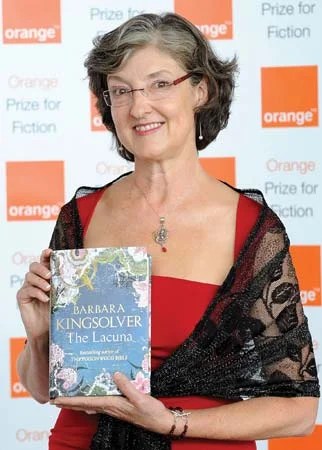
Barbara Kingsolver: Unsheltered, p/b, 2018, London, Faber & Faber.
Clever partly historical novel which describes the lives of two couples and their families about 150 years apart. Willa and her Greek science teacher husband Iano have two children and having moved house for employment find themselves the unlucky owners of a home which proves to be unredeemable.
At the same time both their twenty something children find themselves in difficulty and need to return home to live. Along with their seriously ill grandfather on a breathing machine and a new baby of one of their children, the couple struggle to make ends meet as their house gradually disintegrates.
Meanwhile in the 1870’s Science teacher Thatcher and his beautiful wife Rose are living in the same house 130 years earlier, along with his equally attractive teenage daughter Polly. At his school Thatcher is caught up in the scandal of Charles Darwin and his new theories of biological evolution which he passionately supports.
Thatcher’s convinced Darwinism is strongly opposed by his Headmaster who becomes determined to destroy Thatcher’s name and career. At the same time Thatcher meets the remarkable Dr. Mary Treat (1830-1923), a naturalist and a key contributor to Darwin’s work through her scientific collections, explorations and experiments.
The two scientists become soul mates as the marriage begins to fail.
Double story novels with some connection seem to be a current fad with Geraldine Brooks’ novel Horse a typical example. Kingsolver even commences each chapter of one family with the last sentence of the previous family’s story. These days I have trouble keeping up with all the characters in one novel let alone two novels side by side, so I found the structure difficult to cope with at first.
As a sometime biologist myself I found the Treat/Darwin connection fascinating and well told. The opening story line with its lessons about twenty somethings having the answers to all the world’s problems felt more like a series of school lessons at times and became a bit tedious. I gave this novel 4 stars.
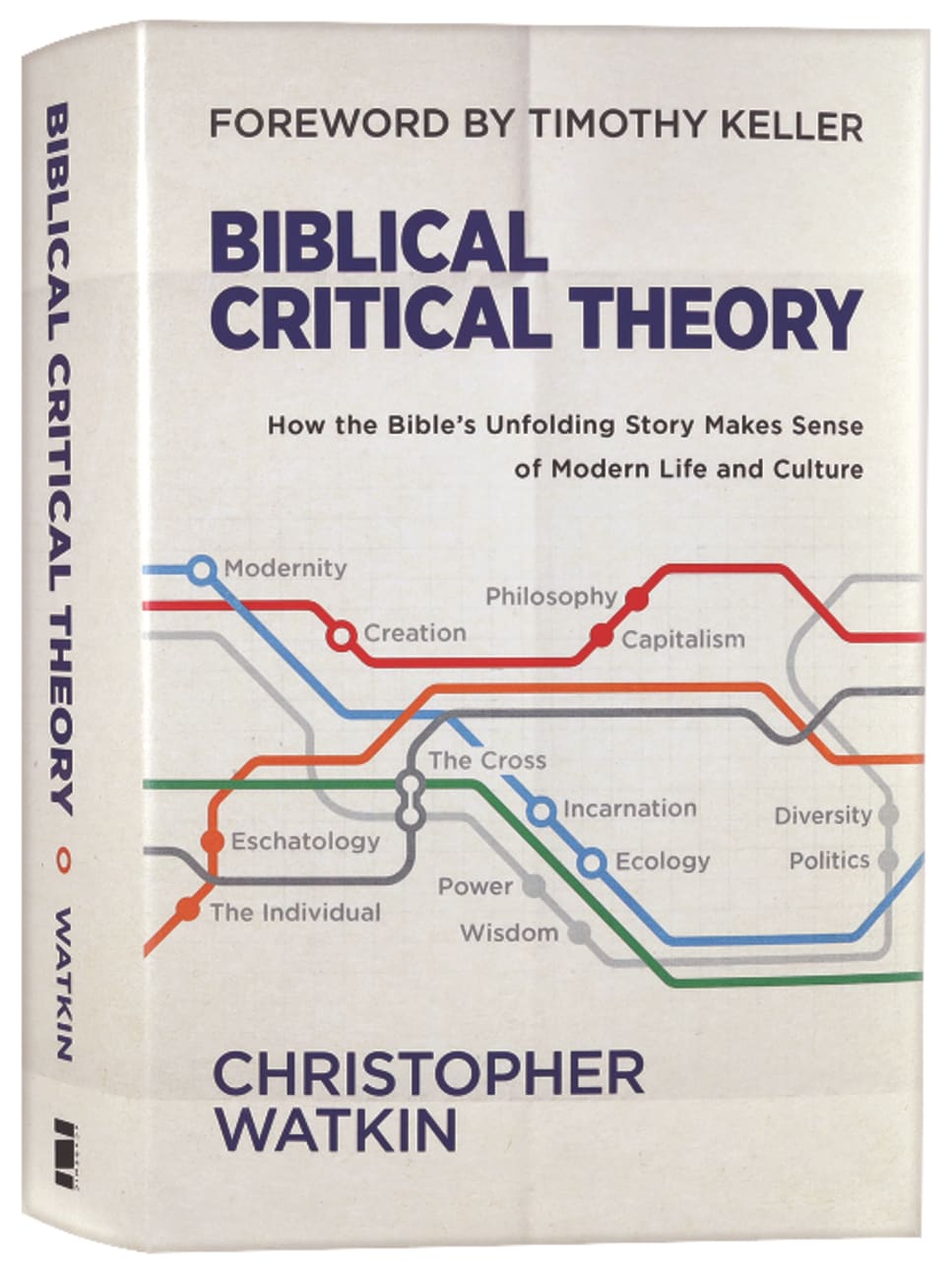
Christopher Watkin: Biblical Critical Theory: How the Bible’s Unfolding Story Makes Sense of Modern Life and Culture, Foreword by Tim Keller, h/b, 648 pp including full bibliography and Index, Grand Rapids, Zondervan Academic, 2022.
Dr Christopher Watkin is Associate Professor in French Studies at Monash University in Melbourne and has an international reputation in the area of modern and contemporary European thought, Atheism and the relationship between the Bible and Philosophy.
A critical theory is any approach to political philosophy that focuses on society and culture to attempt to reveal, critique, and challenge power structures.
Watkin has modelled this major work of Christian and philosophical thinking on Augustine’s magisterial The City of God in 426 C.E. The City of God analyses C4th Roman culture alongside a grand sweep of Biblical literature from Genesis to Revelation.
Watkin’s work is equally monumental and demanding. In 28 dynamic chapters Watkin introduces his readers to a wide range of theological, philosophical and Biblical ideas including Trinity, Creation, Humanity, Sin and Society, The Cross, Resurrection, Eschatology, Identity, Culture, and a host of other topics which include all the major events of the Biblical story from Genesis to Revelation.
A major feature of this work is Watkin’s introduction to the fierce assault of philosophic thinking on to the Biblical narrative, challenging many of the assumptions which moderns have assumed to be taken for granted.
His targets include Marx, Heidegger, Foucault, Russell, Kierkegaard, Nietzsche, Camus and many others.
Watkin’s reply to the philosophical attack is well supported by an equally articulate collection of sympathetic and Christian thinkers including David Bentley Hart, Terry Eagletion, Colin Gunton, C S Lewis, Leslie Newbigin, Bonhoeffer, Pascal, Alvin Plantinga, Jaques Ellul, Chesterton, Midgely and many others too numerous to name.
Each chapter finishes with a series of helpful Study Questions and suggestions for further thought and action so this monumental study would make an excellent small group study series.
A distinctive and helpful feature of Watkin’s approach is his use of diagrams. One very common example is the use of diagrams with two opposing ideas in their own squares, neither of which are capable of moving forward. Watkin then adds to the diagram a Biblical or Christian solution which diagonally cuts across both squares to provide a way forward. These diagrams themselves would make excellent discussion starters.
Biblical Critical Theory is an intimidating and challenging read and would not do for someone coming new to theological or philosophic discussion. Thoughtful Christians however will rejoice that here at last is a book which not only challenges but unpicks and defeats many of the controlling thought centres which dominate C21st Western thinkers. New attacks on Christian faith in this post-Christian era require equally valid and newly formulated Christian responses and here Watkin has delivered in Spades. Watkin has written an amazing book which will be frequently referred to in theological training and conversation for many years to come. 5 stars and rising.
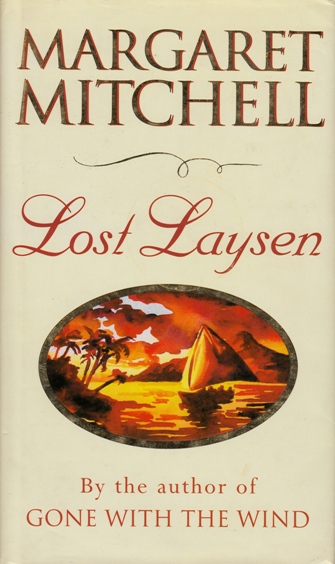
Margaret Mitchell: Lost Laysen, Ed. Debra Freer, h/b, New York, Scribner, 1996
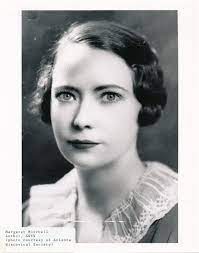
Lost Laysen is a relatively recently discovered novelette written by Margaret Mitchell when she three months short of sixteen years old. For many years it was thought that Mitchell had written only one novel, the extraordinary American civil war novel, Gone With the Wind. Mitchell had many beaux in her life and one constant was a school friend Henry Love Angel along with four other particular male friends. One of these was Red Upshaw whom she married in 1922. This was an unsuccessful marriage and she eventually divorced him and married John Marsh, another school friend. Throughout all this time Mitchell’s friendship with Henry Love Angel was very strong.
Mitchell died in 1948, killed in a car accident crossing a road in Peachtree Street, Atlanta, Georgia. Her will stated that all of her literary works, letters, journals manuscripts including most of the original pages from Gone With the Wind were to be systematically incinerated. Unbeknown to her many fans and anyone else, Henry Love Angel had kept many souvenirs of their close relationship including over thirty photographs and the gift of the manuscript of her teenage novel Lost Laysen.
Henry Love Angel took his friendship, and the knowledge of his photographs and novelette manuscript with him to his grave but his son Henry Angel Junior saw towards the end of his life a financial opportunity in the material and approached The Road to Tara Museum of Atlanta, Georgia. Debra Freer, a Margaret Mitchell historian, was asked to validate the material and the Museum duly unveiled Henry Love Angel’s legacy of his friendship with Mitchell and her novelette in April 1995.
The story of Lost Laysen tells of a friendship between would be missionary Courtney Ross and a rough and ready fighting sailor Billy Duncan who met on a trading ship sailing in the South Pacific near the mythical island of Laysen and the subsequent tragedy that unfolds. For a fifteen year old, Lost Laysen is an impressive yarn which keeps the reader occupied and keen to see the outcome!
To be fair the most interesting part of this book is the many now published photographs taken by Henry Love Angel of Margaret Mitchell and their many love letters and the material put together by Debra Freer. This material beautifully reproduced with authentic photographs of letters, gives a delightful picture of Margaret Mitchell, the socially active and dynamic 1920’s flapper who eventually came to write one of the most popular novels of all time, Gone With the Wind.
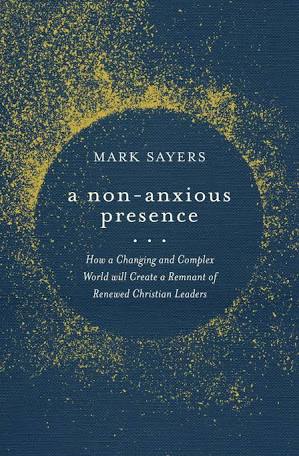
Mark Sayers, author of “A Non-Anxious Presence”
Mark Sayers, Pastor of Red Church in Blackburn South and Nunawading and a partner in Uber Ministries has written a challenging analysis of the impact of COVID19 on many church congregations and leaders. In a world where Google replaces Pastor and Screens replace disciples the world has entered a “Gray Zone”. (that’s a US spelling of grey!) It is not the end or the start of an Era, it is a grey zone of uncertainty. Grey zones exist in the overlap of two eras, making life confusing and contradictory. Shifts in urbanisation and consumption, technology and competition, ageing and labour are affecting all countries.
In a huge comparison Sayers compares the total destruction of Krakatoa after probably the earth’s largest ever earthquake with the extreme rapidity of change in our own day. In Krakatoa new growth eventually came. Sayers writes that the current Western world’s preoccupation with “continual consumption,ever-present anxiety, and self-focus” also demonstrates a hunger for renewal. The result is that Christian leaders facing an anxious world can become paralysed.
Sayers notes that not long ago Christian leaders of super large churches and influential Christian organisations were the leaders and influencers. Today media influencers have far more sway shaping the views and thoughts of the Christian world. The result is “that a secular autopilot version of Christian leadership takes hold, where we lead like practical atheists, with God as an afterthought.”(Sayers, p.53) Further Sayers writes “The modern world promises progress and perfection without God. Leaders therefore presume that dependence on God is optional” (p.56)
Sayers notes that “with no agreed-upon defining story or shared values, identity becomes something the participant in a networked society must search for themselves.” (p.83). Sayers also notes that we are coming to the end of the American Century. China will surpass the United States in terms of gross domestic product in the next decade. Sayers quotes George Town University Professor of International Affairs Charles Kupchan: the next world will have no centre of gravity. It will be no one’s world. (p87)
Sayers analyses Social media’s immense access across the internet which enables dynamic activists to apply real pressure on large organisations including the church through online feedback to advance their goals. This tactic, called cancel culture “can exclude opponents from the network resulting in a privatised form of censorship” he writes. (p94) Such digital networks can become a primary influence on folk, more important than their church network.
American political scientist Edward Friedman writes about today’s “herd instinct swamped by chronic anxiety”. People no longer act rationally and the more aggressive members, with a perpetually argumentative stance will start to rule. “In this brutal world humour, satire and irony are lost. Everything becomes at best a slight, at worst a direct assault. Sayers notes that “Conflict, sexual activity, and even violence become normative forms of social engagement,”(p.99)
Friedman has proposed a novel and radical leadership solution. Instead of leadership being found in those with charisma, drive, intelligence, training, or achievements, Friedman argues that “the most vital attribute to lead, especially in anxious human environments and systems, was a non-anxious presence. Retreating to our comfort zones insulates us from development. Increasing individualism and a dizzying diversity of opinion in the West contrasts strongly with the complete lack of individualism in China and many Islamic states. On the other hand grey zones are our wilderness. It is in the wilderness that God gave Christ the power to conquer Satan. It was in the wilderness that Israel’s leaders learned obedience to God. Sayers suggests “The Wilderness is where God woos us!” (p.119)
Sayers further notes that character and maturity in leadership are more important than comfort or ease. There will be many events and situations that will be outside of our control and yesterday’s management model will not work today. “We do not need superhuman resilience and we don’t want spiritually stagnant leaders on the couch buried in their phones. We must vanquish the infective foe of anxiety,” Sayers writes.
But of course we can only be non-anxious presences with God’s presence. Sayers quotes Dag Hammdkjold whose rule was that “we need humility to experience reality.” St Paul said when I am weak then I am strong. (2 Corinthians 12:10) and Sayers notes that “we certainly do not need an addiction to approval.” There will always be pressure in leadership. Without pressure there would be no development and no holiness.
Here is a book on leadership that should be read carefully. It will particularly help leaders who are feeling a bit down and defeated. I warmly commend it. 5 stars.
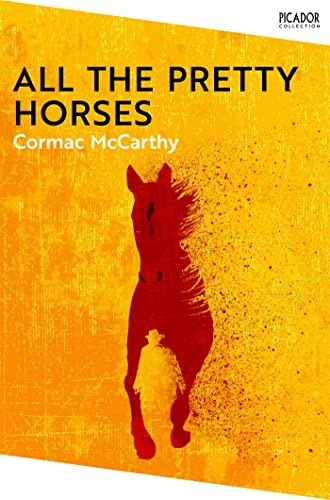
Cormac McCarthy: All The Pretty Horses: p/b, New York, Picador, 2022 (1993)
Hard hitting novel involving sixteen year old John Brady Cole who grew up on his grandfather’s cattle ranch outside of Saint Angelo Texas. When his grandfather sells the ranch Cole sets off with his friend Lacey Rawlings to find work on a horse breeding ranch in Mexico. Trouble soon arrives when they are joined by thirteen year old Jimmy Blevins, a runaway with a taste for killing people. After losing his horse in a thunder storm and stealing it back Blevins leaves them to hide in the mountains. Eventually Cole and Rawlings find work on a wealthy horse stud where Cole falls deeply in love with the Mexican owner’s daughter Alejandra and a life that gets more and more complicated and particularly dangerous as Blevins re-enters the narrative.
There is a great deal of blood and death in this writing as in most McCarthy novels. These grim passages would not be to every reader’s taste, authentically told though they may be. The description of the Mexican foothills, mountains and plains is remarkable. McCarthy won significant acclaim for this work and indeed the novel totally engages the reader as events go from bad to near impossible. I found this novel violent, romantic and powerfully written all at once. For folks not fluent in Spanish significant sections of dialogue have to be guessed at and the online translation guide is by no means complete. This novel is part of a trio so I will reserve judgment until I can get through the remaining two volumes. 4 stars so far.
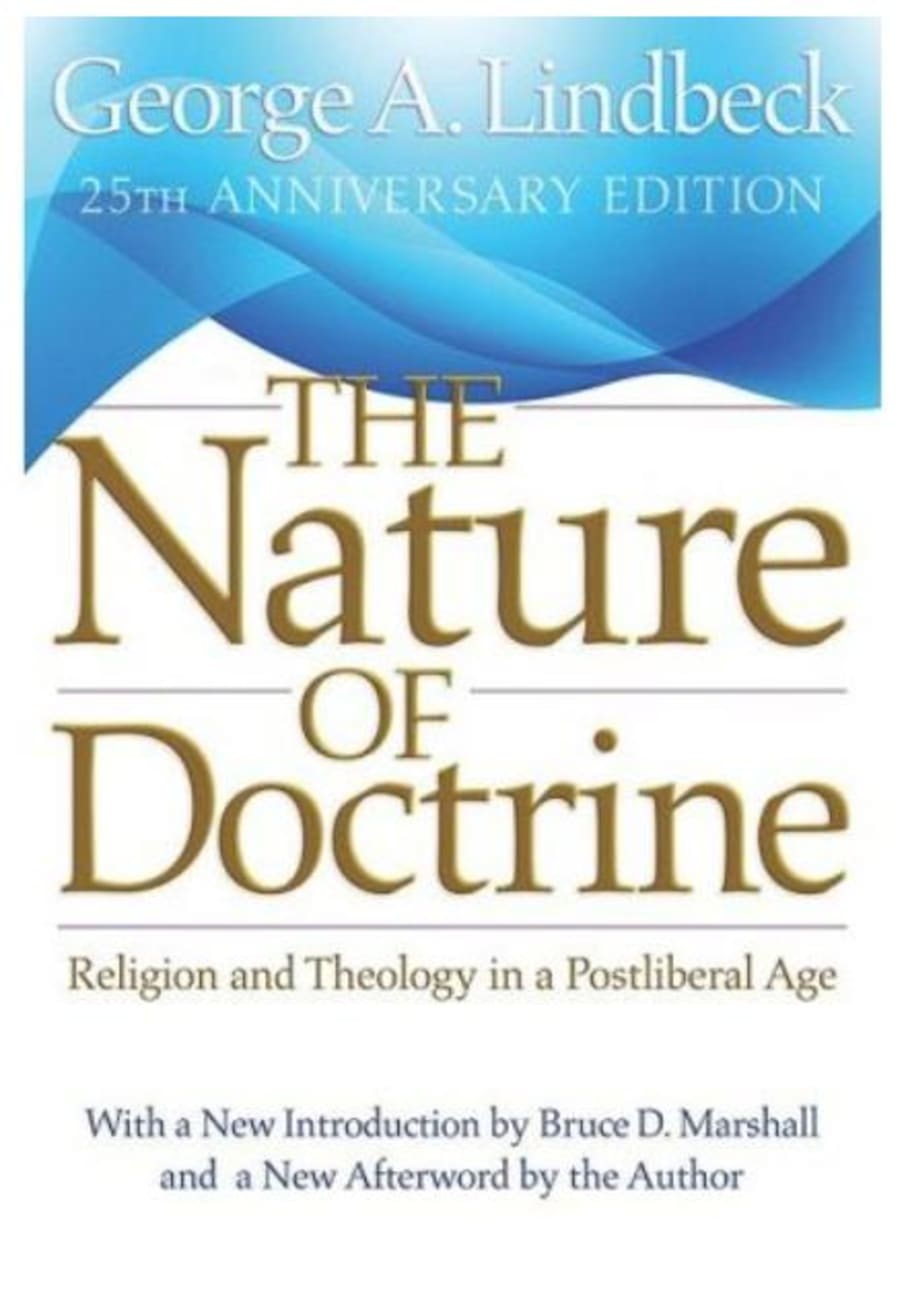
George A. Lindbeck: The Nature of Doctrine: Religion and Theology in a Postliberal Age, 25th Anniversary Edition with a new Introduction by Bruce Marshall and a new Afterword by the author.
Lutheran Theologian and ecumenist George Lindbeck, who died in 2018 at 94, was a child of Lutheran missionaries in China and Korea and played a major role as a delegate observer in the Second Vatican Council. His major theological work, The Nature of Doctrine, is a penetrating study of the future of Christianity in a post-Christian era. First published in1984 Lindbeck’s book has to my knowledge ever been out of print. As a delegate to the Second Vatican Council 1962-65, Lindbeck has spent a theological lifetime grappling with divisions within the Christian faith and exploring whether the Christian faith will even survive in the C21st.
Lindbeck provides a pathway through the classical propositional approach to Christianity; the experiential/expressive Christianity of evangelicalism, and the attempts by Catholic theologians Karl Rahner and Bernard Lonegan to combine both approaches in a cultural and linguistic approach to Christian theology which might reach out usefully to folk in other world faiths. Lindbeck’s work reaches out also to a C21st Post-Christian society asking why modernity cannot also be religious, particularly reaching out to Islamic and Buddhist approaches to faith in a modern world order.
Lindbeck respects the countervailing traditional tendencies of C20th scholars like G.K. Chesterton, C.S. Lewis and Malcolm Muggeridge as well as the neo-orthodoxy of Karl Barth and even some key ideas about faith found in Wittgenstein’s influence. Nevertheless Lindbeck, against all odds, argues strongly for his cultural-linguistic alternative. Lindbeck cites Rahner’s notion that devout followers of other faiths could be regarded as “anonymous Christians”. (p.43) Rahner also proposes that dying itself be pictured as the point at which every human being is ultimately and expressly confronted by the gospel, by the crucified and risen Lord. It is only then that the final decision is made for or against Christ. (p.45). I myself am personally attracted to this idea also.
Lindbeck notes that theology and doctrine are assertions based ultimately on faith (p61) and Evangelicals would add, on New Testament history. Much discussion on these matters hinges on the nature of doctrines, how they are formulated and how they are expressed (p.66). In Christian faith formation the experiential dimension is more important than hard core doctrines. Practical doctrines like “the law of love” carry more weight than discussion about ontological truths (p.71) and then there are “accidental doctrines” like Sunday or Christmas. (p.72)
The standard doctrines like those of Nicaea and Chalcedon have worn well, but later R.C. Marian doctrines like the Immaculate conception, the Assumption of Mary and Papal infallibility cause big problems for non Roman Catholics.(p82f) especially since many of the Popes throughout history have been morally corrupt. As for the doctrine of the Trinity itself it is beyond formulation and comprehension ..it just is! (p.92). Lindbeck finds support from Wittgenstein who notes that there is a way of grasping a rule which is not an interpretation, but is exhibited in what we call ‘obeying the rule’ and ‘going against it’ in actual cases!..interpretations by themselves do not determine meaning. (p97).
In a concluding chapter Lindbeck argues that the marks of good theology are faithfulness, applicability and intelligibility. (p.98). All the major world faiths have relatively fixed canons of writing that they treat as exemplary or normative (p102). For Christians to know how to live we need to know about God’s Being from the text of Scripture but in the end it is difficult to “know” God. Post liberal “intratextuality” (p.108) may help some moderns interpret the Biblical text but in the end theology must be practical and empirically defensible. (p.111).
Post-Liberals start with a vision of the kingdom of God in a quest for transcendence and selfhood but the responsibility for the wider society is more important than personal fulfilment. (p.113) Service rather than domination is the best course for Christians. Credibility comes from good performance…there is still hope (p.116). We need to absorb the universe into a Biblical world is LIndbeck’s final word. Thinking about Christian doctrine is hard work. The Nature of Doctrine will help you do this but it could also confuse you. Enter this world with care! 4 stars.
Barbara Kingsolver: Unsheltered, p/b, 2018, London, Faber & Faber.
Clever partly historical novel which describes the lives of two couples and their families about 150 years apart. Willa and her Greek science teacher husband Iano have two children and having moved house for employment find themselves the unlucky owners of a home which proves to be unredeemable.
At the same time both their twenty something children find themselves in difficulty and need to return home to live. Along with their seriously ill grandfather on a breathing machine and a new baby of one of their children, the couple struggle to make ends meet as their house gradually disintegrates.
Meanwhile in the 1870’s Science teacher Thatcher and his beautiful wife Rose are living in the same house 130 years earlier, along with his equally attractive teenage daughter Polly. At his school Thatcher is caught up in the scandal of Charles Darwin and his new theories of biological evolution which he passionately supports.
Thatcher’s convinced Darwinism is strongly opposed by his Headmaster who becomes determined to destroy Thatcher’s name and career. At the same time Thatcher meets the remarkable Dr. Mary Treat (1830-1923), a naturalist and a key contributor to Darwin’s work through her scientific collections, explorations and experiments.
The two scientists become soul mates as the marriage begins to fail.
Double story novels with some connection seem to be a current fad with Geraldine Brooks’ novel Horse a typical example. Kingsolver even commences each chapter of one family with the last sentence of the previous family’s story. These days I have trouble keeping up with all the characters in one novel let alone two novels side by side, so I found the structure difficult to cope with at first.
As a sometime biologist myself I found the Treat/Darwin connection fascinating and well told. The opening story line with its lessons about twenty somethings having the answers to all the world’s problems felt more like a series of school lessons at times and became a bit tedious. I gave this novel 4 stars.
Flavius Josephus: The Antiquities of the Jews, Trans. from Greek, by William Whiston, h/b, USA, Hendrickson, 1987 (1736).
Josephus was a child of a significant priestly Jewish family and grew up in the turmoil of Roman occupation of Israel. Born in A.D. 37 and dying near the end of the C1st A.D. Josephus was a key military leader in Israel’s fateful war of independence from the Roman war machine which resulted eventually in the destruction of the Jewish temple in 70A.D. In spite of the horrific defeat, slaughter and surrender, the captured Josephus managed to become directly acquainted with and gained the favour of the Roman leader Vespasian. When Vespasian eventually became emperor in A.D. 69 Josephus was officially freed and eventually was able to return to Rome with Titus, Vespasian’s son and future Emperor. Josephus settled in Rome as a client of the emperor on an imperial pension, eventually gaining the rights of a Roman citizen and adopting the emperor’s family name, Flavius. From this point on he began his literary endeavours.
Josephus’ Antiquities is a monster read, 514 pages printed in small print with two columns on each page! This work tells the history of the people of Israel, commencing with extracts from the Book of Genesis. Josephus then takes the reader through the Old Testament narrative of the history of Israel from God’s covenant with Abraham, the Exodus from Egypt, the period of the judges and first kings including David and leading the reader to the destruction of the first temple and the Israelite sojourn in Babylon, their release under the Persians and the challenges they faced with occupation from in turn the Egyptians, the Seleucids, and finally the Romans. Josephus does not deal with the wars and destruction of Jerusalem in The Antiquities as he had covered this period in a previous book, The Wars of the Jews, or, The Destruction of Jerusalem.
The reader obtains regular detailed additional footnoted commentaries on various events from the translator, William Whiston who was himself not just a scholar of the Greek language, but a mathematician, philosopher and theological scholar of some note. Readers need to make up their own mind about the veracity and value of Whiston’s additional comments! An additional historian often quoted helpfully in his footnotes is Dean Humphrey Prideaux who wrote in 1845 a well regarded 2 volume History of the Jews and Neighbouring Nations and the Connection between the Old and New Testaments!
In spite of the size of Josephus’ work I think thoughtful Christian readers will enjoy The Antiquities of the Jews. Its story of the faithfulness of Jewish believers through two millennia to 70 A.D.and, three hundred years after Whiston’s translation, we in our generation still see the Jews today, after another two millennia of trauma, fighting to stay alive on the same piece of dirt in the State of Israel. In addition there are occasional references to figures from our New Testament including Jesus Christ, John the Baptist, James the Brother of Jesus and of course Pontius Pilate and the Jewish leaders in Jerusalem. I can honestly say I enjoyed reading The Antiquities of the Jews. 5 stars.
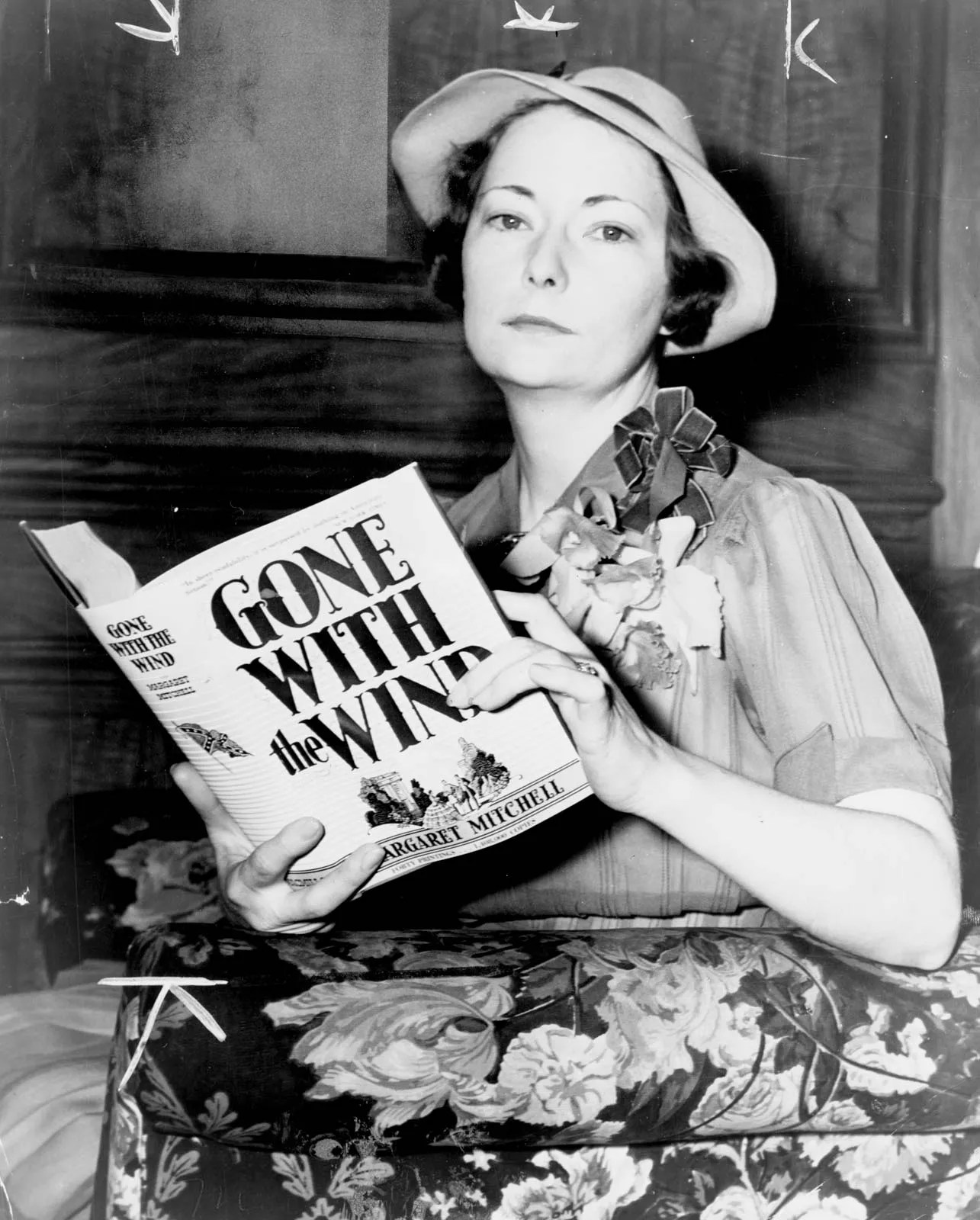
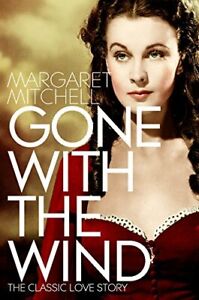
Margaret Mitchell: Gone With the Wind, p/b, New York, Avon Books, 1964 (1936)
Powerful narrative of a three-way love triangle set in the context of the C19th American Civil War over the abolition of the Slave Trade and the rights of black Americans. Scarlet O’Hara, the spoilt first child of a wealthy Irish American Coffee planter in Georgia, is thwarted in love when her first love Ashley Wilkes announces his engagement to his cousin, the ever sweet and adoring Melanie. Made into a memorable film starring Clark Gable and Vivien Leigh Gone with the Wind one of the old time great love stories.
At a vast garden party just before the war at which the engagement is announced Scarlet has a violent and losing fight in a library with Ashley which happens to have been seen by the suave Rhett Butler who also has his eye on Scarlet. The civil war changes the lives of every Southern State in the South East as Scarlet’s house Tara is taken over by Yankees and she flees to family in Atlanta where both Scarlet and Melanie found initial security while Ashley went to the war. Rhett Butler manages to inveigle himself into Scarlet’s life so the love triangle continues against the background of horrifying accounts of the four year progress of the Civil War.
This extremely lengthy novel was enjoyed by our club members although not all were able to finish the 1024 pages in my paperback edition. Mitchell paints a too glossy account of the happy lives of black African slaves but her analysis of the horrors of the war and the impact on the Southern States is powerful and accurate. 5 stars.
Review of Jane Austen: Shorter Works, Intro, Richard Church; Decorations, Joan Hassal:
h/b, London, The Folio Society, 1975 ( writing from 1787-1817)
Jane Austen I am sure will always remain in my list of favourite authors and although six acclaimed novels is a considerable achievement indeed, one always hopes for more. From the age of 11 Austen was writing Juvenalia, and even in these fragments the gift of future genius can be seen emerging.
Her adult writing can be said to have begun with the incomplete The Watsons (1803) and the epistolary Lady Susan (1805). All of Austen’s delicate shades of meaning, deft and witty conversation and surprising twists that force the reader to continue reading are already found in these works. Her last work Sanditon written in 1817(only one chapter completed) has recently been reproduced as a major television series. The dedicated lover of anything Jane Austen will be unable to put these varied pieces down. Austen’s ability to commit the reader to find out “how things will work out” forces the reader to keep on keeping on. Austen even created a very humorous if not always accurate history of England with a particular leaning towards Catholicism as well as Mary Queen of Scots. Her complete minor novels: Lesley Castle/Evelyn/Frederick and Elfrida/Jack and Alice/Edgar and Emma/Henry and Eliza/ and The Three Sisters, all offer Austen gems, humour, surprise and wonder. This is a collection to savour and remind ourselves that for character, wit, sangfroid and style she still has no equal…even after 236 years!
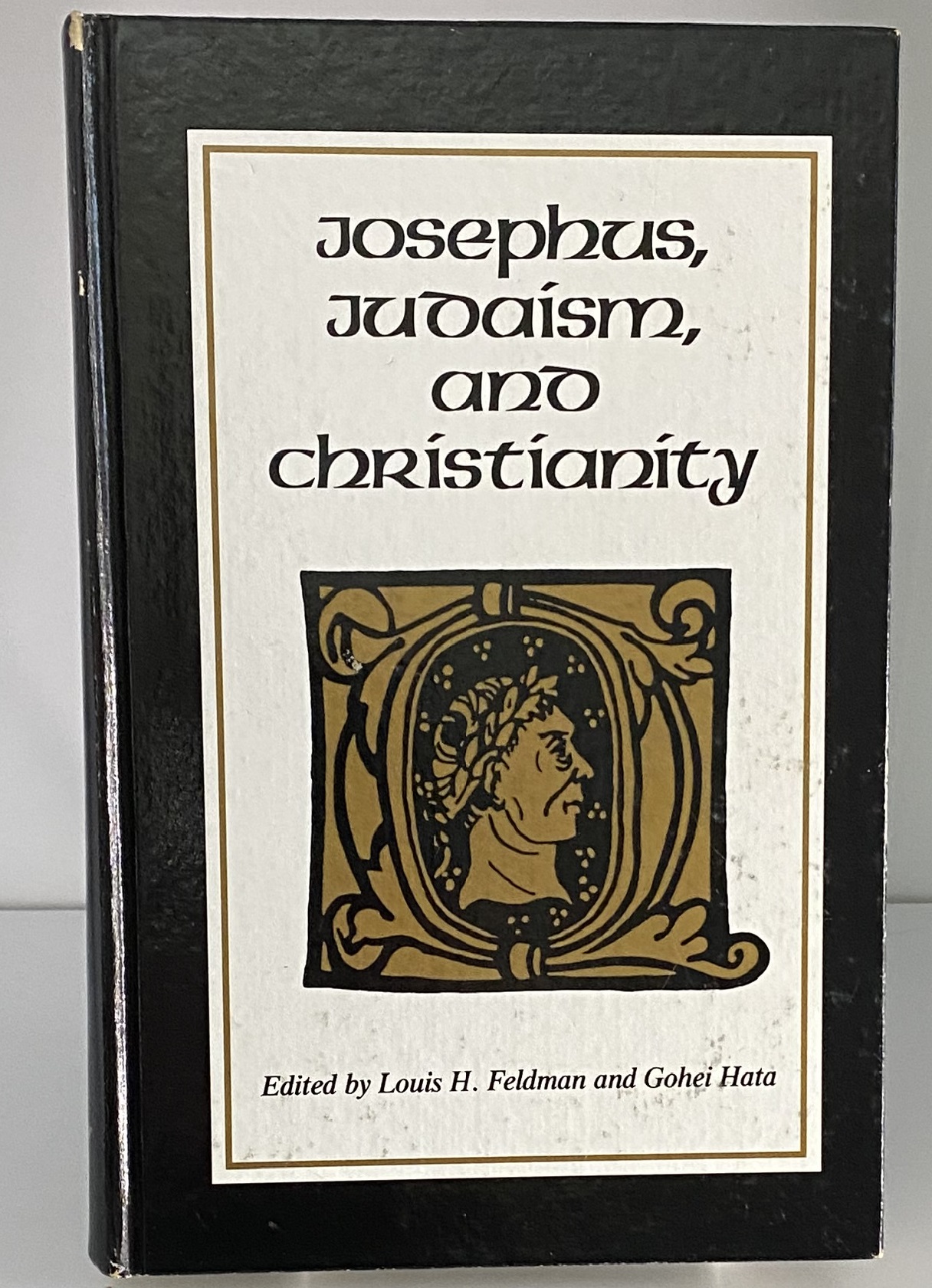
Ed. Louis H. Feldman and Gohei Hata: Josephus, The Bible and History, h/b, Detroit, Wayne State University Press, 1989
This book is a series of essays connected with the extraordinary and controversial life and writings of Flavius Josephus, who lived in the First Century A.D. Josephus’ extensive writings [The Antiquities of the Jews, The Wars of the Jews, Against Apion, The Life of Flavius Josephus and An Extract of Josephus’ Discourse to the Greeks,]are, apart from the Old Testament the major source of our knowledge of the history of the Jews from the reign of Antiochus Epiphanes (B.C.E 175-163) to the destruction of the Temple by the Romans in A.D. 70 and the fall of Masada in A.D. 73. There is no comparable source for determining the setting of late inter-testamental and New Testament Times, so Josephus’ work is absolutely critical for our understanding of Judaism in the period of Jesus’ life and death and the period of the writing of the New Testament.
In addition Josephus is also a most important source of our knowledge of the biblical canon and text, since our earliest complete manuscripts of the Bible, at least in the Hebrew, are a millenium later. In addition Josephus is indispensable for our understanding of the political, social, economic, and religious background of the rise of Christianity and of the other sects of the era, as well as of Jewry and the Diaspora.
Josephus is also our most important literary guide to the geography, topography, and monuments of Palestine so that modern day archeologists are as reliant on Josephus as they are on their spades and other techniques. Further than this Josephus is most important as a historian of the Graeco-Roman Republic and on the first century of the Roman Empire.
These essays provide detailed analysis of and criticism of Josephus’ writings written by major C20 historians and Jewish scholars. A brief summary of the issues discussed in these essays follows:
Sid Z. Leiman writes about Josephus and the Canon of the Old Testament. Josephus’ canon corresponds very closely with the twenty four book canon of the Jewish Talmud which was being put together at the start of the third century Common Era, commencing at first with the Mishnah.
Louis Feldman’s essay is a comparison between Josephus’ Antiquities of the Jews and the late C2nd Biblical Antiquities of Pseudo-Philo One of the interesting results of this comparison is that Josephus is clearly writing to the Greek speaking community of Judea and the Roman Empire as a recommendation of the Jewish faith. Feldman notes that Josephus’ Antiquities [history] of the Jews omits such embarassing episodes as Jacob’s cunning in tricking Laban out of his good sheep flocks, the Judah-Tamar rape episode, Moses’ slaying of the Egyptian, Miriam’s leprosy, Moses’ angry striking of the rock to obtain water, the story of the brazen serpent held up to cure those bitten by serpents, the building of the golden calf, and his creation of the story of Moses as a General employed by the Egyptians against the Ethiopians.
Eugene Ulrich’s study on Josephus’ text for the Books of Samuel demonstrates clearly that Josephus’ work was very largely based on the Greek text of the Old Testament as his source, rather than the Hebrew text at least in relation to the Books of Samuel.
André Pelletier discusses the importance of Josephus’ use of the term Septuagint for the Greek version of the Old Testament and the validity of the so-called Letter of Aristeas.
Isaiah M. Gafni writes about Josephus’ description of the Hasmonean uprising and demonstrates that Josephus is totally reliant on the Book of 1 Maccabees until the portion devoted to Simon, where Josephus clearly uses a different source. He also suggests that Josephus did not hesitate to invent facts for the purpose of making his text more interesting to his Greek audience.
Joseph Sievers writes about Josephus’ useful treatment of significant female figures in the Hasmonean Dynasty about whom we would otherwise know very little.
Ben Zion Wacholder demonstrates Josephus’ use of the pagan historian Nicholas of Damascus, as did Strabo and Socrates. He was a tutor for the children of Antony and Cleopatra, became a friend of Augustus and was Herod’s chief advisor. Josephus particularly relied on Nicholas for chapters 13 -17 of Antiquities.
Günther Baumbach discusses Josphesus’ writing about the Sadducees, concluding that his few references to the Sadducees at least prompts the question as to whether prejudice played a role.
Clemens Thoma writes about The High Priesthood in the Judgment of Josephus, an area that Josephus knew well from his own status as an aristocratic chief priest theologian and ambitious politician. This background explains Josephus’ deep interest in the rituals, cult proceedings and functions of the Jewish priesthood in this work on the Antiquities.
Valentin Nikiprowetzky deals with Josephus’ treatment of the Revolutionary Parties and the notion of the “zealous” or “jealous” state of mind which lead these leaders to oppose the Romans as enemies of God, an approach which Josephus himself did not approve of.
Shimon Applebaum writes about Josephus and the Economic Causes of the Jewish War.
Heinz Kreissig offers A Marxist View of Josephus’ Account of the Jewish War.
Zeev Safrai writes a Description of the Land of Israel in Josephus’ works. As noted earlier much of this material has no parallel elsewhere so the reliability of this material is difficult to test.
Benjamin Mazar discusses Josephus in the light of Archaeological Excavations in Jerusalem and questions whether the 7th Book of The Wars of the Jews” which contains the story of the destruction of Jerusalem and the Masada story were not written by someone else.
The final essay by Louis H. Feldman is entitled A Selective Critical Bibliography of Josephus. This monumental and exacting analysis runs to 120 pages and contains a forbidding analysis of academic work relating to Josephus, written with clarity and care and indicating areas for further study.
Feldman and Hata’s achievement in putting these essays together has provided scholars interested in Josephus with every possible guidance and further exploration. It is an impressive volume indeed. 5 stars.
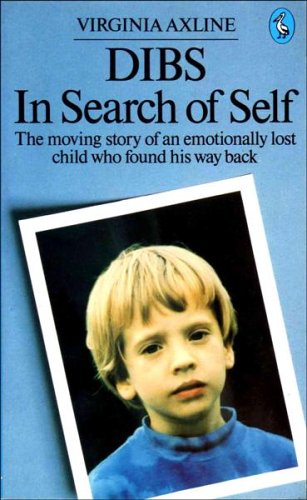
Virginia Axline: Dibs: In Search of Self, p/b, Ringwood, Penguin, 1975 (1964)
Dibs: In Search of Self Is a psychological study of a young child [Dibs is a made up name] of exceptional intelligence who was badly misunderstood by his parents but through careful psychological therapy was able to live a profoundly rich and significant life.
The story is told word for word by the therapist Axline from recordings made during the therapy sessions. Although initially this description of their relationship can be unsettling and a little boring the impact of the therapy on the child leads the reader forward with increasing interest. It is a story that many misunderstood children, whether or not of high intelligence, will relate to in terms of their relationship with their own parents.
Dibs: In Search of Self was set for many years in the senior years of Victorian secondary schools but although I had heard about the book it was never set in my years at school so I have read it for the first time now in 2023. Now, sixty years on the novel still leaves a powerful effect on the reader and is a reminder to parents to think carefully about how they respond to their children. It is also probably a book which helped a lot of students to understand some of their own parents reactions to them in the home.
I thoroughly enjoyed reading this book and as an ageing and increasingly grumpy old man I found some tips for myself that I am sure will help me in the challenging years ahead! 5 stars.
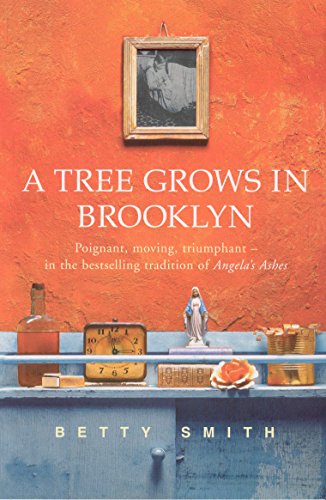
Betty Smith: A Tree Grows in Brooklyn, p/b, London, Arrow Books, 1992 (1944).
Beautifully written and delightfully engaging book written by American Betty Smith in 1944 (1896-1972) and never out of print since. Smith tells the story of an Irish-American family living in poverty in Brooklyn, a borough of New York City populated in the early C20th by European immigrants seeking a new life. The story tells the coming of age of Francie Nolan. Her Irish born family, brother Neely, mother Katie who scrubbed floors for a living, and their father Johnny who was an occasional night club singer and a drunk lived happily in a small rented house and got by. There is nothing romanticised in this narrative…all the ups and downs of family/street/school life are described without embellishment or over dramatics. Katie has strict standards in spite of their humble existence and Francie, ten years older than Neely, has the additional support of Katie’s unmarried sister Sissy, who is far more street-wise and keeps an eye out for Francie.
The story creates an accurate and detailed account of Edwardian life from a poor child’s point of view with all its creativity and bustling New York action eventually leaning towards the first world war. The tree which grows in Brooklyn is a cut down tree with roots growing deep from a street grating and surviving and even flowering. It is an image of Francie, facing a tough life and still getting by and even thriving but it is told without sentimentality and exaggeration. It is hard to put describe the pull of this book for the reader. The writing is taut, realistic, clever, real, and compelling. It is the sort of book you are sorry when it is finished and I for one, do not find many books like that these days. 5 stars and rising.






















 Theological, Cultural and Educational Reflections