Running around with Royalty at Buckingham Palace, London

Saturday 15th August

Today we went with Naomi Woolley, Ann’s niece currently working in England, to visit the Queen in Buckingham Palace London.

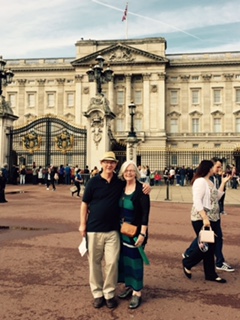
Ann and Richard at the front of the West face of Buckingham Palace
Ann finally makes it to Buckingham Palace, a childhood dream.

It was a unique experience, as every other palace we have visited on this tour has been a historic palace with no current royal residents. Buckingham Palace is quite the opposite …it is a full time working palace and has only been open to the public since the Great fire at Windsor Castle in 1993 and still only open for six weeks in Summer while the Queen is on vacation at Balmoral in Scotland.  Actually the Queen was in London today because it is “Victory Over Japan” Day and special services of commemoration were held. She was not, however, at the Palace to welcome us personally!  So it is a working Palace with over 450 staff, 67 000 formal visitors each year and this not counting  the 400 000 annual visitors like us who pour into the place for six weeks every year in the Summer.

Since no photography of any kind, flash or no flash, is permitted in the Palace you won’t be bored by my poor snaps of 19 State rooms out of the 775 rooms in the Palace! We entered by the official entrance where visiting Presidents/Kings/Queens etc enter which is actually a quite demure wooden set of doors.

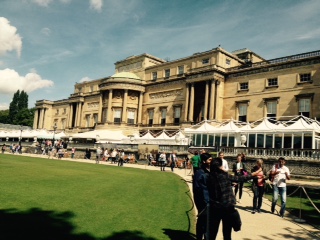
East view of Buckingham Palace from the lawns
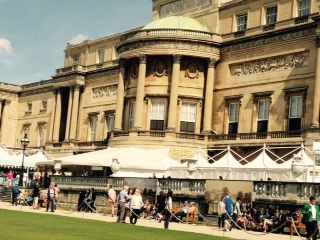
Wider view of the East face of Buckingham Palace
Naomi and Ann outside the Australia Gate before entry to the West face of Buckingham Palace

I have been wondering how BP would stand up against the Topkapi Palace in Istanbul, the Vatican Palace outside Rome,  The Doge’s Palace in Venice, The Ducal Palace in Mantua, The Pitti Palace in Florence, all of which we have seen on this tour.  I was impressed by the uniform stylish and neo-classical (or Renaissance Revival) completeness of everything we were shown.  I cannot vouch for the other 754 rooms but the 19 we saw were simply stunning,,,in finish, in design  (architect John Nash from July 1822), in quality of furnishings/vases/tapestries/ in selection of paintings from the 20 000 in the Royal collection,  in the extraordinary sculptures by Canova and many C19th classical sculptors and by the obvious pleasure, pride, courtesy, energy and commitment shown by the staff who greeted us at every turn.

One particular pleasure is that whilst your ticketed entry is at a particular time, once in the Palace you can take as much time as you like and no 0ne bothers, within reason, how long you stay. It is neo-classical in style and there is lots of gilt and red carpet but nothing is over the top and everything is there for a purpose and not just for decoration with the exception of the long gallery filled with significant paintings with Van Dyke,  court painter to Charles 1 for nine years, particularly well represented but also Rembrandt, many fine Dutch paintings, the inevitable Canaletto, and many more too numerous to mention.  I would have liked to see the chapel and library but these are not part of the State apartments tour.

A major highlight this year for the public was a presentation of how the main dining room is set up for a State dinner for 170 guests given by the Queen for a Head of State on the first evening of a visit to the UK.  The gold plated cutlery, the instruments used to measure distances between chairs, cutlery etc, clever videos to show how the food is prepared, flowers prepared, courses presented, drinks chosen and served and so on.

Major features include several stunning drawing rooms, music rooms with pianofortes and grand pianos, the throne room, the ball room/banquet room, the amazing three level staircase leading guests ever upwards, displays of medals presented and videos of how it is done.

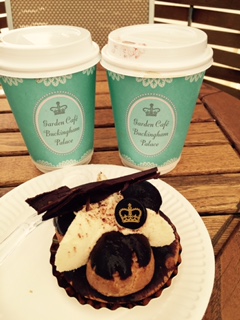
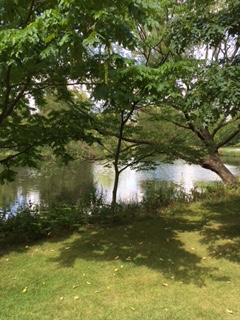
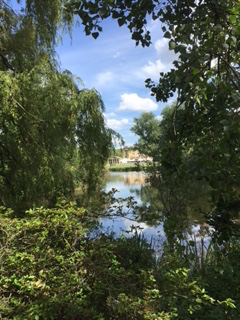
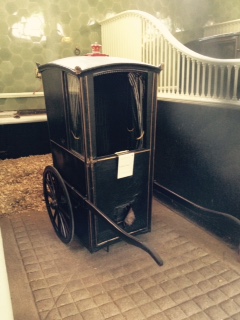
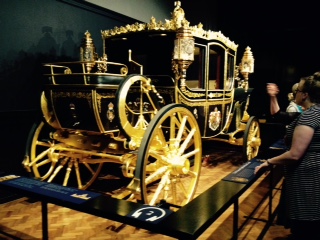
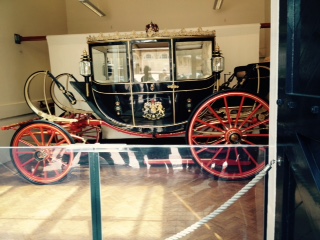
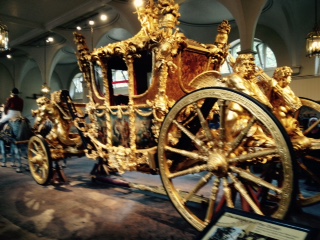
In addition we were able to stroll through the beautifully maintained gardens replete with all kinds of beautiful ducks on the lake, squirrels, and wonderful winding views. Later on we were able to visit the Mews  (from mewing up=to cage up) where the Royal carriages/launettes/hansom cabs/phaetons/rolls/daimlers/bentleys/jags are kept all polished up and even some beautiful carriage horses looked after. We were also treated to a right royal lunch although we had to pay for it.

A right Royal repast at Buckingham Palace!
Part of the tranquil lake and garden at Buckingham Palace ...squirrels and ducks a plenty
Part of the tranquil lake and garden at Buckingham Palace …squirrels and ducks a plenty
and again, the garden
Sedan Car from the Mews at Buckingham Palace
The brand new Diamond Jubilee Coach with all mod cons ..an extraordinary feat of construction
The Scottish State Coach
THE golden
THE golden “Coronation” coach …C18th but still going

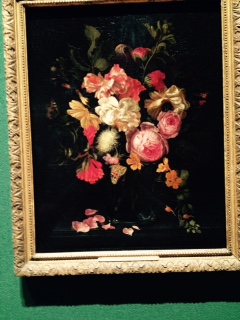
Finally we were able to visit the Queen’s Gallery which is a fairly new and beautifully designed and presented exhibition space for unique displays of the various Royal collections. The current theme is “Paradise is a Garden” and it was spectacular indeed with many memorial paintings, drawings, sculptures and porcelain including delicate Faberge flower jewellery to die for.

Dutch still life from the Queen's Gallery
Dutch still life from the Queen’s Gallery
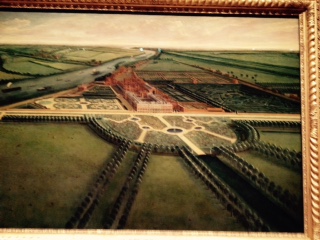
Amazing early painting of Hampton Court prior to the suburbs!
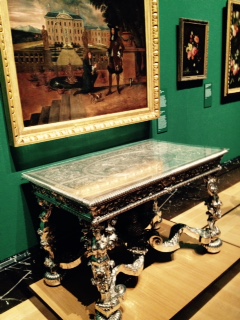
Silver table in the Queen's gallery
Silver table in the Queen’s gallery
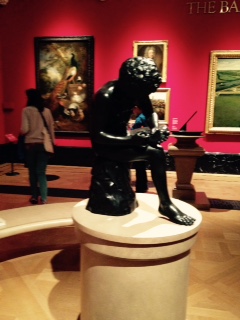
Boy with a thorn cast for the Royal collection from the original we saw at Rome in the Capitoline Museum

This was a very full day’s work and our tired feet were glad to jump on the underground and travel quickly “home” to the Barbican for a break at 5.15pm!

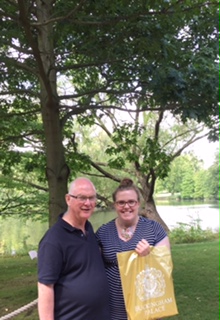
Richard and Naomi with spoils from the Royal Shoppe!
A very tired Richard and Naomi with spoils from the Royal Shoppe!

Scintillating Soanes Museum, Wondrous Wallace Collection and Luxurious Liberty Shopping in London.

Friday 14th August

On our first full day in London we met Ann’s niece Naomi Woolley on the steps of St Paul’s Cathedral where she had trained into from Surrey. We were able to hand over a belated birthday present and it was wonderful to see her again.

Ann catches up with her niece Naomi Woolley on the steps of St Paul's Cathedral London
Ann catches up with her niece Naomi Woolley on the steps of St Paul’s Cathedral London

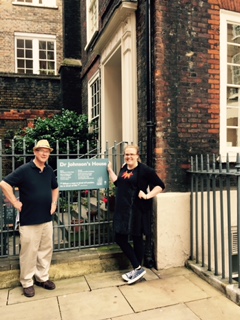
We walked from St Paul’s down Ludgate Hill Road and up the Chancery Lane to the Lincoln Fields Inn past Dr Samuel Johnson’s house. Johnson’s famous quote “that if a man is tired of London he is tired of life” I think makes a lot of sense. There is something for everyone in London town! Johnson’s work on the English Dictionary, his voluminous writings on the poets and just about everything else makes him a very formidable Englishman indeed. Even his cat is immortalised in a statue outside his house.

Richard and Naomi outside Dr Johnson's House near Lincoln Fields Inn in London
Richard and Naomi outside Dr Johnson’s House near Lincoln Fields Inn in London

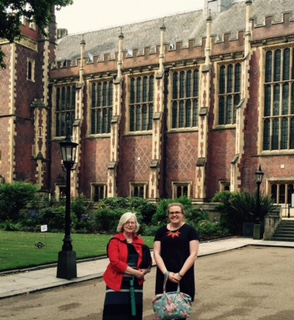
We wandered around the Lincoln Fields Inn gardens surrounded by extraordinary Elizabethan architecture of the Treasury Building and their very own chapel open to the public and finally found our way to the whimsical museum of Dr John Soanes,  significant neo-classical architect, Professor of Architecture at the Royal Academy from 1836, eccentric collector and very generous man whose trust allows visitors to see his collection for free.

Ann and Naomi in the gardens surrounding the impressive neo-Gothic Treasury Building in Lincoln Fields Inn
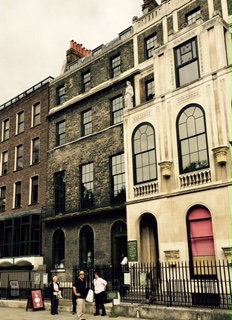
Sir John Soanes house near Lincoln Fields Inn in London. Eccentric and eclectic collection from an C18th super architect and teacher

Soanes house on four levels is an absolute marvel of curious oddities, very significant ancient vases, clocks and 10 000  books in many languages, thousands of his own drawings,  wonderful sculptures, and architectural casts from Greece and Rome scattered about in a unique way which defies description and as photography of any kind is forbidden so you will have to go and see it yourself! It is our second visit here and you could go twenty times and still see something new. His collection of paintings  including three Canalettos, the complete original collection of Hogarth’s The Raike’s Progress, and many original Piranesi prints including the Colosseum. Soanes had an architectural vision for the rebuilding of London but many of his suggestions were not accepted. This place is altogether one of my favourite places to be in London. Even the staff are “quaint”.

After a quick Italian lunch we ventured on the underground to Manchester Square to see the Wallace Collection. My (Richard’s) beginning on the London underground was inauspicious (others would say “bloody stupid”) putting my oyster card into the automatic ticket machine which immediately gobbled it up and jammed the system. Luckily there were some helpful railway folk nearby with keys to unlock the jaws and release my precious oyster card.

The Wallace Collection (which is also amazingly, free due to a bequest and many generous supporters) is contained within the family house of four generations (Hertford House and garden) in the middle of otherwise busy and  very urban London. The collection was formed over five generations of Marqueses of Hereford (Seymour-Conways). The fourth Marquis had an illegitemate son Richard (also an important collector) who went to live in France and for reasons unknown  changed his surname name to Wallace and after his death his wife bequeathed the collection and house to the nation insisting that it be called the Wallace Collection.

There are many amazing  private art collections including the Frick collection in New York, the Rothschild Collection in England, The Getty collection in California and the man in The Golden Woman who paid over a million for the Klimt painting. Amongst these private collections the Wallace Collection must rate very highly indeed.

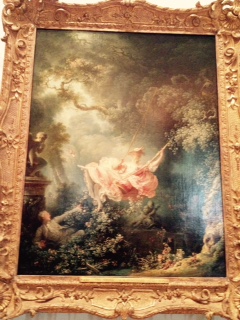
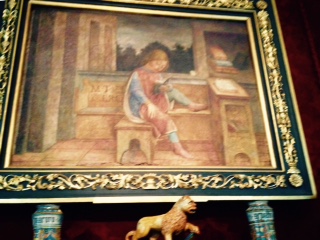
The collection of paintings is stunning including Fragonard’s The Swing, Foppa, The Young Cicero Reading, Gainsborough’s Mrs Robinson, Boucher’s  Madame Pompadour, Rembrandt’s Titus, His Son, van Dyck’s Paris, and many other fine works by Rubens, Delacroix, Canaletto, Pisano, Del Sarto and on and on. In addition there is a huge collection of arms and armoury, a vast collection of Sevres porcelain, Amazing collections of Bouille cabinet and book cases and other early French and English cabinets, an extensive collection of miniatures and gold trinket boxes, a substantial Napoleonic collection, a huge Maiolica collection and no doubt I have omitted much.  Hertford House also has a study centre and library and is a hive of artistic and intellectual activity.

Fragonard: The Swing in the Wallace Collection, Hertford House London
Foppa: Cicero as a child painting in the Wallace Collection Hertford House London
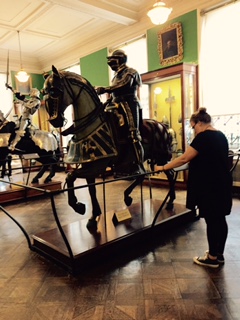
Naomi looking for a knight in shining armour at the armoury section of the Wallace Collection at Hertford House in Manchester Square London

We finished the day at Ann’s favourite London store Liberty in Regent St with all its glorious Liberty fabrics and vast array of fashion outfits and household bits and pieces over six floors.

Fashion store Liberty's take on Gainsborough and Reynolds' portraiture
Fashion store Liberty’s take on Gainsborough and Reynolds’ portraiture
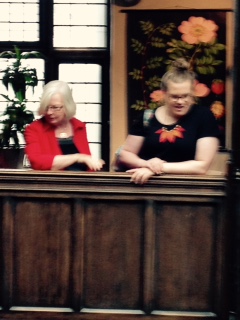
Two fashionistas observe Liberty proceedings from the sixth floor gallery
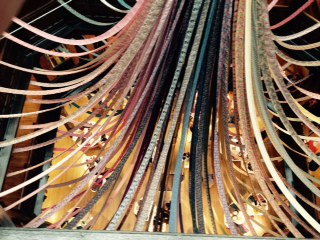
Liberty's floral and fabric display projecting through six floors of retail excitement
Liberty’s floral and fabric display projecting through six floors of retail excitement
the lower half of the Liberty fabric display
Ann and Naomi hard at it discussing their next quilting project
Ann and Naomi hard at it discussing their next quilting project at Liberty

By then it was raining and we joined the peak hour train rush home.at Oxford Circus subway…an experience matched only in my experience by Rome Termini and Tokyo’s subway! We were happy to be in our own ‘home’ cooking for ourselves in our Barbican apartment.

Larking around in London

Thursday 13 August

Today we left Paris Nord at 9.15am on the Eurostar (which is distinctly showing its age!) for London to arrive at 10.30am having gained an hour on the way. It was rather chilling to see the “war ” frontier at Calais with high fences absolutely everywhere and military vehicles patrolling the whole countryside.  We have not experienced the refugee crisis directly even in Greece because it is concentrated on the islands. Calais was quiet at 10.00am this morning but no doubt hots up at night. The truth is that with international communication now allowing everyone to see how everyone else is doing lots of third world folk imagine that a European lifestyle is far preferable to the poverty and lack of opportunity they currently experience. This time around it was interesting to see so many begging for food and money in France and so far, admittedly only one half day!, no one begging in England.

We spent the day nesting in our Barbican apartment which is rather cosy but has a stove top, dishwasher, reasonable size refrigerator and three chairs, a luxury for us. We shopped at Tesco and I quite enjoyed cooking lunch today and dinner this evening for the first time in six weeks!  The Barbican is an interesting area..theatres, art, housing estates and right opposite accommodation for those who can least afford to live in modern British society. It is an interesting mix.

Our apartment is 15 minutes walk from St Paul’s Cathedral, arguably the finest neo-classical building in the world and surely Christopher Wren’s most significant achievement. It is also in Aldersgate St …the very street in which John Wesley in Volume 1 of his Journal wrote that he felt “strangely warmed” and encountered the reality of the Holy Spirit in his life. Wesley became such an extraordinary preacher, churchman, New Testament commentator and missionary that it is fair to say England and its people were genuinely changed because of his dynamic ministry and mission.  His brother Charles wrote some of the hymns which will surely be sung in heaven and are still sung today 250 years later. “And can it be that I should gain an interest in my Saviour’s blood…i rose, went forth, and followed Thee.”  Words many of us will never forget.

Aldersgate St in London where he are living for five days. Here John Wesley was converted and thus began the ministry and mission of one of God's most faithful and committed servants. Here also his brother Charles probably wrote some of the Christian faith's best loved hymns.
Aldersgate St in London where we are living for five days. Here John Wesley was converted and thus began the ministry and mission of one of God’s most faithful and committed servants. Here also his brother Charles probably wrote some of the Christian faith’s best loved hymns.
Ann hugging up in London's 19 degree Summer rainy day with St Paul's in the distance
Ann rugging up in London’s 19 degree Summer rainy day with St Paul’s in the distance
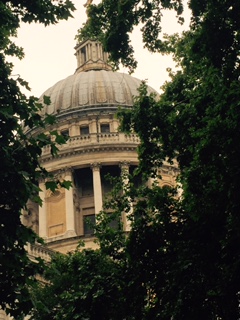
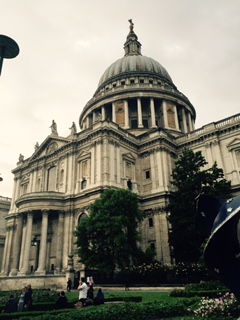
Christopher Wren's St Paul's Cathedral in London. What a mighty neo-classical dome from one of the world's greatest ever architects.
Christopher Wren’s St Paul’s Cathedral in London. What a mighty neo-classical dome from one of the world’s greatest ever architects.
Another view of St Paul's Cathedral London
Another view of St Paul’s Cathedral London
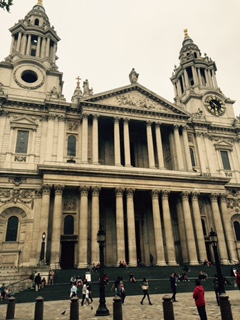
Part of the west front of St Paul's Cathedral London
Part of the west front of St Paul’s Cathedral London
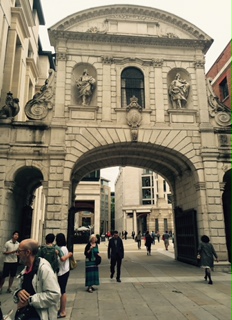
The Temple Bar ..the only original gate of old London Town which is still standing.

This end of London on the other hand  is full of young men in the law in suits strutting their stuff, being busy and hitting the beer hard at 5,30pm in the many bars. All standing, all talking! Even the occasional woman! We noticed the lack of smoking, the lack of tourists! and the smart outfits because the weather was distinctly cool (19 degrees) after all the European heat and we had a significant amount of rain (for which we were poorly prepared) and Kent had flooding.  We ventured out to buy our Oyster card, get the week’s groceries and find some medical advice for Ann we could understand.

We are looking forward to wandering the streets of London and catching up with Ann’s niece Naomi who is currently living in Surrey and working in Windsor.

Fantabulous Fontainebleau and Serious St Denis Cathedral

Tuesday 12th August

Our final full day in Europe (not counting UK) today and a 34 degree day to finish with in Paris. We were up and about early to get first a local bus to Gare de Lyon and then the 40 minutes direct train to the Royal palace of Fontainebleu or the Chateau de Fontainebleu.

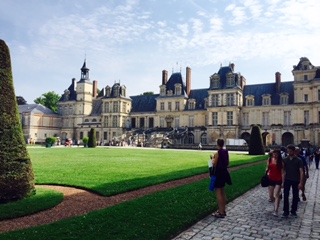
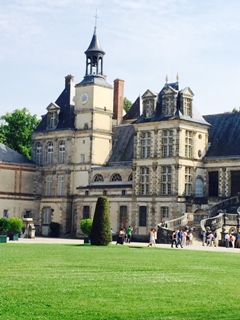
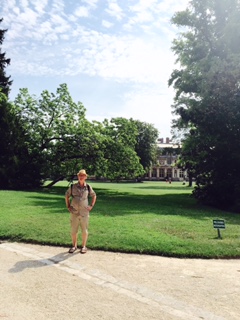
Fontainebleu Chateau has been a royal palace since the C12th and its grounds, buildings and gardens, like Versailles cannot be comprehended in one of shots. It is less dramatic than some European palaces but very ordered and dignified
Another view of the exteror of Fontenebleu Chateau

The Chateau was continuosly in royal hands from the C12th to the fall of Napoleon 111 in 1870. The major periods of development were the Renaissance revival under King Francis 1; substantial building work by Henry 1V in the C17th In the C19th some galleries were added to under Louis XV and in the C19th, although the furniture and fittings were destroyed in the Revolution, Napoleon made it an imperial residence and had it refurnished.

To say the least it is a vast complex in wonderful gardens of diverse nature. The self taken tour (once you get through the very slow queue..Richard’s fifth!) is ordered and excellent.  The reality is that many of the rooms have had various uses over 800 years and the Government has made certain that the tour is coherent and gives sufficient information to cover the whole series of periods. Napoleon’s two wives Josephine de Beauharnais and Marie Louise had a lot to do with furnishing the Chateau and Marie Antoinette also had some designs to add although not living long enough to enjoy them!  Anne of Austria, married for years to Louis X111 also had sumptuous living spaces at Fortainebleu. The highly moral Madame de Maintenon also had apartments at Fontainebleu and an influence on one of the two chapels, a very severe classical chapel unlike the decorative Trinity Chapel built during the Renaissance.

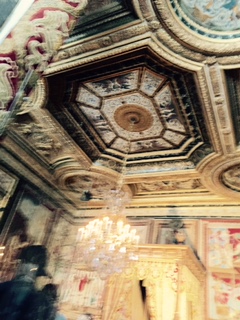
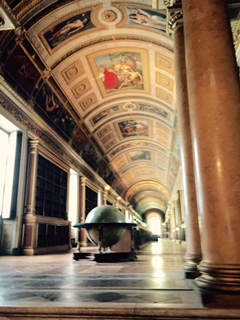
Painted and sculptured ceilings to match the best of Italian Renaissance palaces
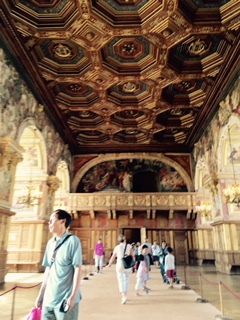
Fontainebleau amazing ballroom and gallery
Astounding library which disappears into the distance with leather bound volumes. Richard was happy here
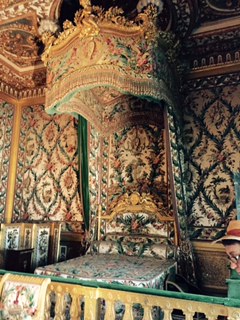
Fabulous bed designed by Marie Antoinette but never used by her!
Severe chapel at Fontainebleau built under the influence of Madame Maintenon, a committed Christian and influence on the king
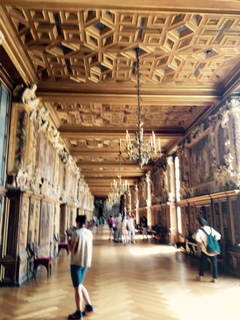
The Long Hall at Fontainebleu ...full of exceptional tapestries
The Long Hall at Fontainebleu …full of intricately carved wood panelling across all walls and ceilings. Quiet unusual
Part of the Diane Gardens full of beautiful deciduous trees just starting to lose their leaves
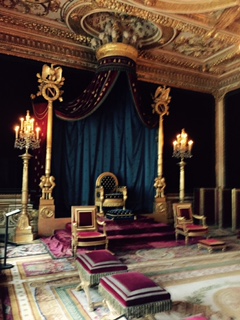
The Throne Room at Fontainebleau. Kings were not crowned here but at Rheims Cathedral however many royals administered from Fontainebleu and preferred it to Versailles and Paris
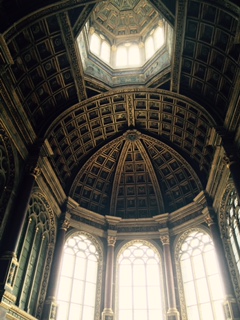
Very large and classically Renaissance Trinity chapel built in the C16th

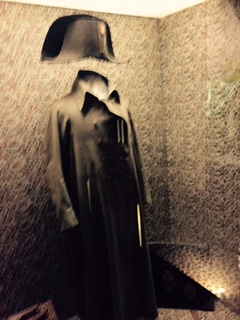
A highlight of Fontainebleau is a complete wing devoted to a museum of Napoleon, his family and descendants,belongings even his camp tent, equipment and his famous coat and hat!

Napoleon's campaign tent and sleeping tent. Cleverly a whole room in the museum of Napoleon is set up like a Campaign tent with all his genuine equipment preserved
Napoleon’s campaign tent and sleeping tent. Cleverly a whole room in the museum of Napoleon is set up like a Campaign tent with all his genuine equipment preserved
The iconic hat and army coat of Napoleon!

After invading and conquering Italy, Napoleon held the Pope hostage at Fontainebleau for two years and forced him to sign a concordat…an interesting time for the papacy.  The Palace is a return to the complex frescoed and carved ceilings of Italy and the furnishings are marked in particular by some absolutely astonishing clocks of all shapes and sizes and the vast and very well curated tapestries. As you can imagine my favourite room was the vast library which we did not have access to but could see its length and quality.

Arriving back in Paris hot and bothered at about 4.15pm I persuaded Ann to make one last adventure in Europe chasing down the remarkable Basilica Cathedral of St Denis in the south of Paris which closed at 6.00pm with last entry 5.45pm What seemed to be a relatively simple exercise on the underground proved (why am I surprised?) to be nothing of the sort. Firstly we had no underground pass and had to negotiate a ticket machine to get individual tickets and the line to St Denis was a direct line from Montparnasse our “own” station.  This is all fine and we are enjoying the underground stops only to look up at the bouncing ball on the train wall to see that the Basilica stop is not functioning for the two “summer” weeks of August. It was the one station rubbed out!  We jumped off at the next station and found no taxis ..time now about 5.15pm. We hunted around for buses (most had no drivers and were just parked, but one turned up as we hunted and was going to St Denis (thank you Lord). Buses are slow! by the time we jumped off it was 5.30 and still no cathedral in actual sight though plenty of signs. We tumbled along as rapidly as both our deteriorating backs would let us and waded through lanes and shopping centres getting hotter on the scent finally putting a foot in the door at 5.47pm and sweet talking the gate -keeper with a sob story about coming from Australia to enable us to have a look around.

Ancient St Denis cathedral, the West front. No real towers and looking a little lop-sided.

It is a hugely historic cathedral. Christians worshipped there from the C5th and from the C10th to the C18th nearly  all of the French Kings and Queens and indeed some Emperors of the Holy Roman Emperor including Charles V have been buried there. It is arguable the first Gothic church with mediaeval Abbot Suger “inventing” some of the support systems to enable the enormous height of the columns to achieve a much taller and more graceful effect thant the old round arch Romanesque churches.  There  are no real towers or spires and the Rose window in the truncated crossing is quite low (and all the more wonderfully amazing because you can see it close up). The beautiful royal tombs  are laid out all around the East end of the building behind the fairly simple altar and there is, as ever, beautiful stained glass. It is a magic space.

St Denis Rose window in the very small Crossing. Huge to look at because relatively close to eye level instead of, as usual up in the gods. The entrancing stained glass cannot be seen in normal photography. There is much other glorious stained glass from various periods in the Cathedral
Abbot Suger who substantially altered the church in the C14th added many features that were later to become Gothic necessities and which enabled the extreme height of later buildings elsewhere. Suger is credited with the origination of Gothic style but of course this is contested.
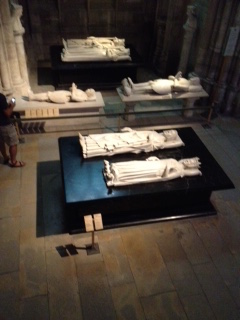
The most dominating part of the interior are the very fine marble tombs of many of the Kings of France from the C11th to the C18th all around the side of the sanctuary (which was under restoration) and the East end of the Church. They are everwhere and some obviously very costly but all in similar style and not
The most dominating part of the interior are the very fine marble tombs of many of the Kings of France from the C11th to the C18th all around the side of the sanctuary (which was under restoration) and the East end of the Church. They are everwhere and some obviously very costly but all in similar style and not “flashy” or objectionable like the Medici chapels. It is a very peaceful burial place (unlike, I am sure their own lives!)
This is the tomb of Charles V Emperor of the Holy Roman Empire
Allegedly the tomb of Clovis the C5th
Allegedly the tomb of Clovis the C5th “king” who melded all the Frankish tribes together into a political and powerful unity, effectively creating “France”. Are these his bones? Who knows?
Various tombs of the kings and queens of France sleeping peacefully??

Our adventure did not end there of couse because we now had neither train nor bus to get back to the hotel.  We found first a tram to take us to a rail junction then a helpful person not a machine to sell us tickets to get back to Montparnasse with one train change. Arriving at an unfamiliar platform at huge Montparnasse I think it took us 25 minutes to get out of the station into clean air. So ends our adventures in Europe. The British Isles await tomorrow!

People watching in Paris

Paris  University of Descartes and the start of the Enlightenment
Paris University of Descartes and the start of the Enlightenment

Tuesday 11th August

Today we had an early start farewelling Blois. It was a last minute decision to stay in Blois because our previous location fell over towards the end of our planning but we feel privileged to have come to understand the city with its aristocratic past and ancient beauty. Curiously my only brush with the wrong side of the road in Europe came five minutes from dropping off the Fiat 500 at Avis, last night taking a left hand turn into a major road in Blois and not seeing that it was a divided main street. Luckily for us two guardian angels in fleuro gear working alongside the road bravely stood out into some serious traffic coming straight at us and waved them down enabled me  to crawl bashfully to the side and get off the road. It was a healthy reminder not to get too cocky as I think was beginning to happen and again we were very conscious that someone is looking after us even when we do something really silly!  So we farewelled our Fiat 500 and prepared for Paris.

We took  the TGV train this morning from Tours to Paris after an early local train to Tours.  In Paris our hotel was an easy walk from MontParnasse Station (thank you Moranda from HellowWorld Belgrave!)  Having put our luggage in storage we had a (very) early lunch and took a bus directly to the Louvre only to have our first fair dinkum National Lampoon’s Vacation Wally’s World experience. There were no queues…yes the Louvre was closed on Tuesdays! It is the two week Summer vacation currently in France so Paris especially in the morning was a ghost town but the Louvre was closed all day so we had to regroup.

We walked off shell shocked, ( unlike Mr Grisling in National Lampoons we decided not to break into the Louvre!) across the beautiful Seine River with all its tourist boats and barges and became very muddled trying to find our way to the Hotel des Invalides and Napoleon’s tomb which we eventually found not far from the new Rodin museum which has been built since we were last in Paris.

Ann as the Seine of the crime in gay Paris
Ann at the Seine of the crime in gay Paris
Arrived in Paris!
Arrived in Paris!
The Eiffel tower can be seen from everywhere.
Paris, Eiffel tower, Tuileries gardens and cannons.
Wally's World is closed! National Lampoon's Vacation comes to the Louvre and none is there because it's closed on Tuesdays (at the moment1)
Wally’s World is closed! National Lampoon’s Vacation comes to the Louvre and none is there because it’s closed on Tuesdays (at the moment1)

Napoleon’s tomb and the Church of the Dome in which it is placed had a distinctly Medici tomb feel about if for us. Napoleon Bonaparte certainly did a great deal for France in culture, modernisation, leadership and government after the Revolution apart from being a heroic military leader even if his grasp exceeded his reach or whatever the proverb is. But this tomb goes a bit far in my view and to have its location created as effectively a Baroque church with altar and candlesticks and much gilt and marble was not to my personal taste.

Napoleon's tomb in the Church of the Dome at the Hospital des Invalides Paris
Napoleon’s tomb in the Church of the Dome at the Hospital des Invalides Paris
Baroque Altar and baldachino behind Napoleon's Tomb at the Church of the Dome. Napoleon probably would have approved. It is not to my taste!
Baroque Altar and baldachino behind Napoleon’s Tomb at the Church of the Dome. Napoleon probably would have approved. It is not to my taste!
Amazing frescoes inside the dome of the Church of the Dome at Napoleon's tomb
Amazing frescoes inside the dome of the Church of the Dome at Napoleon’s tomb
The dome of the Church of the Dome above Napoleon's Tomb in the Hospital des Invalides
The dome of the Church of the Dome above Napoleon’s Tomb in the Hospital des Invalides
Hotel des Invalides and the Church of the Dome

On the other hand the Hotel des Invalides still does an amazing job caring for war veterans and also contains within its vast walls two amazing museums, one of military arms including what must be the largest collection anywhere of knights in shining armour and their weaponry (superior I think even to the Doge’s Palace!) and secondly a fascinating museum of the history of both world wars as it was seen from the French point of view. This museum is brilliantly put together with engrossing and horrific war time film footage especially of the impact of bombing on French forces and cities.

Knight in shining armour ...one of hundreds in the Army Museum at the Hotel des Invalides.
Knight in shining armour …one of hundreds in the Army Museum at the Hotel des Invalides.
Ancient Renault Fire car, part of the impressive museum of WW1 AND WW2 in the Hotel des Invalides in Paris

We returred past the impressive formal Tuileries Gardens, had a good view of the Eiffel Tower and returned to the bank of the Seine and enjoyed watching Parisiennes enjoying their Summer break with their children hiring all day “cabins” for all day games and seats,  playing totem tennis and badminton at various defined play areas, and generally relaxing, reading the newspaper and enjoying not working.  It is the first time we have really stopped to look at the vastness of the D’Orsay and Louvre Palaces and the huge square they border. This is classical grand architecture to die for and makes for a very grand and romantic city indeed. Luckily for me most of the fashion shops we passed were not open!

Busy river Seine activity in Paris summer
Statue of Thomas Jefferson,  Renaissance man and former US ambassador to France
Statue of Thomas Jefferson, Renaissance man and former US ambassador to France

Midnight in Paris is one of my all time favourite movies and this city is difficult not to love, Its grace, elegance, style and élan always make an impact. We are glad to have a couple of nights here.

Chilling out in Chenonceau

Moated
Moated “worker’s cottage?” on the Chenonceau estate

Monday 10th August

Today we visited our second Loire Valley chateau at Chenonceau on the Cher River which joins the Loire near Tours. Chenonceau is just 32 kms from Blois and our faithful satnav took us there through some distance along the Loire and then through glorious French villages and forests to the little village of Chenonceau.  Absolute pride of place in this village goes to this chateau which is actually built in and  across the river, having been built originally on an old water mill by the aristocratic Marques family in the early C15th.

Chenonceau, the stately front drive of stunning Sycamore Maples
Ann ready for action at the start of the tour with our first glimpse of the Chateau. The circular guard house is actually separate and in front of the main building.

We have visited many stately homes in England and Chenonceau is up there with Chatsworth and Castle Howard. The entry through a stately avenue of beautiful Sycamore maples is stunning. Water surrounds the Chateau either the many motes or the River Cher which flows “through” the Chateau. I have dreamed about this place so often but never believed I would be here to take the photograph below.

The picture in every text book of Chenconceau actually built in and over the River Cher.  A most stunning architectural and artistic effect
The picture in every text book of Chenconceau actually built in and over the River Cher. A most stunning architectural and artistic effect
Another view of the Chateau
Another view of the Chateau with richard messing up the colours
View of the Chateau
View of the Chateau “from the other side”!

There are three magnificently maintained gardens. There is also a magnificent maze’labyrinth and a wonderful forest for cycling. One garden is in Renaissance formal style surrounding a large fountain; one a more modern herb and flower garden surrounding a large fish filled pond, and the third a vast vegetable and flower picking garden with not a weed in sight and everything looking absolutely delicious. In addition the green lawns surrounding every element in the Chateau are manicured to perfection (no picknicking or even walking on the lawns!)

Just a part of the vast formal Renaissance garden created by Diane of  Poitiers.
Just a part of the vast formal Renaissance garden created by Diane of Poitiers.
a view of the side of the herb and flower garden with statuary there but not dominant

Chenonceau formal garden and fountain with Annthis another view of the formal fountain garden

Chenonceau the flower and herb garden, stunning in its effect although very simple..white begonias, purple salvia and pink petunias on the outside and lavender on the inside with large fish pond fountain in the middle and some small statuary.
Close up of herb and flower garden and Chenonceau
An even closer view of the herb and flower garden
Medici herb and flower garden complete with fishpond and small fountain in the middle
Ann looking over the amazing vegetable and picking flower garden with low espalied apples trees used remarkably as borders

The Chateau itself is classically formed, not huge and has been furnished for each period with style and good taste. There is a very impressive art collection mainly Renaissance Italian with works by Tintoretto, Rubens, Veronese, Corregio, Poussin, Jouvenet, Jordaens, Ribera and others. I counted at least five massive Renaissance fire-places, and valuable tapestries hang in just about every room.  Many of the original Renaissance heavily carved ceilings remain and some extraordinarily elaborate Renassance cabinets and other unique furniture.

Renaissance front door of Chenonceau
Detail of ornate Renaissance ceiling in front hall of Chenonceau
Rubens painting of Jesus and John Baptist as children ..part of the art collection of Chenonceau

There is a fine collection of early carts and cabs and two magnificent older Bentleys in the garage.

Hansom cab. part of the carriage and cart collection at Chenonceau

In sum a magical place on a perfect summer’s day.For our final day in rural France this Chateau was a place of deep beauty, creation and peace.

[The Chateau has an amazing history for those who like this sort of thing. It has had many wealthy owners since the Marques family but three women in particular stand out.  Diane de Poitiers (1499-1566) was the most loved mistress of French Renaissance King Henri 11, and was given the chateau as a gift.  It was the beautiful and resourceful Diane who built the chateau out over the River Cher, distinguishing once for all, this image as the ultimate Loire Chateau image and it was Diane who created the absolutely amazing formal garden which remains today.

Once Henry 11 died his queen Catherine de’ Medici (1519-1589), as regent removed Diane and actually governed from the remarkably small “Green study” of Chenonceau above the waters of the Cher.   Louise of Lorranie (1553-1601), the last wife of Henry 111 also retreated to Chenonceau as a mourning widow devoting her time to prayer and charitable work.  Her death ended the royal presence at Chenonceau.

After many misfortunes the Chateau came to life again in the C18th with two other women in leading roles. Louise Dupin living there and making it a centre of intellectual life ..Montesquieu, Voltaire and Rousseau her would be lover survived there during the Revolution. Margaret Pelouze the wife of a business magnate provided the hard cash to restore the chateau to its former glory and during the First World War the Chateau was a hospital and in WW11 Simone Menier worked for the Resistance from the Chateau. ]

.

.

Cheerful in Chambord and blown away in Bourges

Sunday 9th August

Today we drove in our trusty Fiat 500 just 17km along the wide and flowing Loire River to our first ever Loire Valley Chateau at Chambord located on a small tributary of the Loire and surrounded by lawns, gardens and forests totalling 5440 hectares, the largest enclosed forest park in Europe and a national game reserve with wild boar and deer roaming free (we didn’t see either!)

Chambord Chateau in the Loire Valley. Renaissance palace and "hunting lodge" for Francis 1 King of France and the C18th home of the post-Napoleonic aristocrats who ruled in the C18th
Chambord Chateau in the Loire Valley. Renaissance palace and “hunting lodge” for Francis 1 King of France and the C18th home of the post-Napoleonic aristocrats who ruled in the C18th
Chambord Chateau closer view
Chambord Chateau - bewildering array of towers on the roofline of this amazing building
Chambord Chateau – bewildering array of towers on the roofline of this amazing building

The Chateau was initiated in 1519 by Francis 1 King of France following his victories in Milan and inspired by the influence of Renaissance architecture in Italy. It was conceived initially as a hunting lodge but has ended up a combination of  moated fortress,  fairy tale palace, grand country estate and royal dwelling for the post-Napoleonic aristocratic rulers of France prior to democracy ruling. There are 426 rooms, 282 huge fireplaces and 77 staircases and the furnishings run from C16th to the C18th with some modern installations. Only a relatively small number of rooms are furnished but these still take a bit of wandering around to see how it all works. There is a separate chapel, an impressive English garden,  vast lawns all around but no fountains. Thousands of tourists are well catered for and the Chateau is large enough for everyone to enjoy without too much crowding.

Extraordinary double spiral staircase inside Chambord Chateau; remarkable design work
detail on one of the umpteen towers on the roof of Chambord Chateau on the Loire
Chambord Chateau. I was named after two kings after all..
Painting of Marie Antoinnet ..Let them eat cake!
and still more towers at Chambord

The most amazing impression is the incongruous set of towers on the roof line, all jumbled together and competing. I have not seen anything quite like it before. An impressive set of ancient carriages completed the ensemble.

One of a number of Chateau Chambord carriages and landaus

After a few hours of chateauing we took off again in the Fiat for the central French city of Bourges which once again has a UNESCO recognised historic Gothic cathedral. You may have realised by now that the Gothic life of the church is an insatiable thirst of mine.

Bourges is an ancient city of similar size and lineage to Blois with many very old churches and half-timbered homes and some classical domestic C15th and C16th architecture and housing, narrow lanes and beautiful perspectives.

Ancient stepped and covered  street joining two levels in Bourges old town
Ancient stepped and covered street joining two levels in Bourges old town

The Cathedral of St Etiennes  in Bourges is in one word magnificent. It’s massive bulk is supported by double flying buttresses and towering pillars inside.

Vast, high, complex and powerful ..St Etienne's Cathedral in Bourges is a beautiful statement of pure Gothic architecture.
Vast, high, complex and powerful ..St Etienne’s Cathedral in Bourges is a beautiful statement of pure Gothic architecture.
Bourges interior  very restrained and dignified
Bourges interior very restrained and dignified
Ancient clock in Bourges Cathedral of St Etienne
high and lofty stained glass in Bourges Cathedral of St Etienne
Gorgeous stained glass rose window in Bourges Cathedral of St Etienne.

There is a deep and pure simplicity in the Gothic structure with some truly beautiful story-telling stained glass windows and a very straight forward treatment of the high altar and pulpit without, I am pleased to say, any Baroque or Rococo treatment at all.  It was a journey of over 100kms each way but I am pleased we made the effort to join many others in sensing a deep spirituality and peace in this place on a Sunday afternoon.
Beetling around in Blois

Ann enjoying a long lunch at  Le Petit Hornfleur restaurant, high above the town of Blois in France
Ann enjoying a long lunch at Le Petit Hornfleur restaurant, high above the town of Blois in France
View over the city of Blois

Saturday 8 August

It was good to have a “non-travelling” day today just wandering around the very old and quiet city of Blois and sorting out some railway and car hire drop off details we needed to attend to. Once we found the weekly Saturday market it was not quiet but full on activity with a close harmony group in full swing singing ancient French folk songs and hymns. The range of fresh fruit, vegetables and meat was stunning in its variety and the local cheeses were extraordinary in their variety, size and different flavours. The market ran from street to street in the lower retail part of town selling art, bits and pieces and food, food and more food.

Blois ancient city wall and street view

There are many ancient half-timbered “Alsatian” houses in Blois mixed up with more modern and very elegant homes and three very ancient and historic churches.

Half-timbered
Half-timbered “Alsatian” house in Blois, one of many
View of the main drag in Blois showing the vertical differentiation in the town. It is built on a rocky hill alongside the large river valley of the Loire
Gorgeous half-timbered house in Blois ..too many to photograph

The fast flowing Loire River itself is a UNESCO site of international significance and on its banks and tributaries stand some of the most stunning and elegant chateaux going around.

Loire River flowing rapidly through Blois
Bridge over the River Loire in Blois

In Blois we finally found our first Protestant church in France as well as not one but two Gothic cathedrals. The first is a very ancient structure in the middle of old town with virtually no restoration work done and netting beneath the ceiling to protect worshippers and visitors from falling debris. The second cathedral is also Gothic in style but actually built in the C17th after a storm destroyed the previous building. It became the seat of a Bishop in 1697 and was renamed “Cathedral of St Louis” after Louis XI, patron of the diocese and the cathedral.  The newest large church is a Jesuit church, originally the school chapel of a Jesuit school started in Blois in the Counter-Reformation. It has a unique three dimensional “installation” behind the main altar.

Very early Gothic church in Blois with virtually no restoration.  Original and pure Gothic
Very early Gothic church in Blois with virtually no restoration. Original and pure Gothic
Early Gothic church in Blois interior with netting to protect worshippers and visitors from falling debris
Another view of the early Gothic church in Blois in the middle of old town
C17th St Louis cathedral named after French king and patron. Original Gothic church was destroyed by storm and this one was rebuilt in traditional Gothic style
External view of St Louis Cathedral in Blois  we had to climb up about 80 steps to see this church
External view of St Louis Cathedral in Blois we had to climb up about 80 steps to see this church
Another view of the Cathedral of St Louis in Blois
View of the Jesuit church in Blois which began life in as a School chapel
Blois Jesuit church interior ceiling
close up of ceiling in Jesuit Church in Blois
Unique 3D "installation" behind main altar in Blois Jesuit church
Unique 3D “installation” behind main altar in Blois Jesuit church
External view of Jesuit church above Blois Chateau

Blois also is a “vertically divided” town so there are wonderful panoramas of the city from many vantage points and also many “hanging” gardens and parks. We feel very at home here.
Blois civic garden
Blois civic garden
Another view of the civic gardens

Magnificent Mont St Michel

Friday 7th August

This morning we were awakened to the unaccustomed sound of sheep being herded by a lone sheepdog without shepherd through the narrow street below our room at Mont St Michaels. After spending many weeks in some of the world’s largest and most popular cities we felt deliciously rural breathing sea air and even sheep dung air which some  of our colleagues on trip advisor were critical of our hotel for.  We soaked it up, slept in and were amongst the last to get down for breakfast.

Getting on to the island however returned us to Tourist Central with amazing crowds gathering in the carpark to walk to crowded shuttle buses which take off every 3 minutes. For a minute or two we thought we were back in Rome as it was a pleasantly warm day but quite hot in a crowd. Crossing the causeway, no matter how often seen on travelogues is still an interesting experience reminding us in particular of the Holy Island monastery at Carnarvon in northern England only here the towering fortress monastery build over a complex protruding and uneven rock face makes its somewhat menacing presence felt more and more as you approach.

Off the shuttle bus and on the causeway, Monastery looming

It was interesting that the vast majority of the tourists were French so it is clearly a much loved family summer adventure and they came in their thousands with, of course, their dogs in every shape and size even though theoretically their dogs were not wanted in the monastery.  Not sure how that worked. (tag team i suspect). Once into the base of the monastery visitors are assaulted with a bewildering mass of souvenir stores and restaurants.  Sort of San Gimiano in Tuscany on steroids but without the high end wonderful shopping in San Gimmies. We wound our way ever upwards resisting the tempting sideways offerings of historical knights of old in various sections of the monastery and eventually joined a 30 minute queue to enter the actual working monastery. (Richard has now experienced four queues in his life!).

Tourist crowds climbing towards the top

The many stairs are worth the effort as the official “tour” takes you on a well organised path first directly to the top level with panoramic views over the low-tide tidal river and very quickly to romantic and dazzling views of the English Channel and the Atlantic reaching far into the misty distance from the immense height of the structure. it was an interesting experience to have started in Istanbul on the Bosporos, almost the sounthern most part of Europe and to have wended our way to the northern coastline (obviously not counting Britain or Scandinavia,) and the variety of languages, customs and cultures we experienced to get there.

View of causeway from the top ...the tide running out was quite strong and folk who tried to walk across the
View of causeway from the top …the tide running out was quite strong and folk who tried to walk across the “beach” had very sticky muddy feet.
View straight down from the top..Richard with vertigo
View north towards English Channel and the Atlantic..vast and beautiful in late morning sun
Another view of the causeway from the top
View of steeple from the top visitor level
In Kraal castle style there are scary models here and there including this giant eagle and also dragon claws elsewhere

I was not prepared for the very high Gothic chapel on top of the mountain and we there at midday Friday for a weekly sung service of deep beauty. It was like a transport to seriously heavenly heights although for me conflicted having recently read the history of these fortress monasteries being designed in particular to fight the “evils of the Protestant heresy”.  I know the world and the church has moved on but it has saddened me throughout Europe to see the remnants of Eastern vs Western Christianity, Protestant vs Catholic, all vs Islam, state and city vs state and city. Humanity’s inability to get on with fellow humanity is heart breaking!

exceedingly high and beautiful Gothic chapel ..unexpected in the midst of such a heavily fortified monastery

We journeyed through the monastery from chapel to refectory hall (huge) to a beautiful cloister garden,

Beautiful cloister garden of peace high up above ground level

to a series of smaller simple chapels through to scary dungeons (during the French Revolution St Michael’s mont was a prison) and other large rooms and eventually down a steep back stairway back to civilization to the outside beautiful gardens.  In all a (literally) breath-taking experience. From Mont St Michel we journeyed south leaving behind the fertile fields of Bretagne and Normandy and avoiding Paris we drove through many beautiful French villages with houses and shops right on the road as in many English villages. Further south the fields are gofden with cut grass neatly machine rolled into stacks as we passed Laval and Le Mans and drove into the Loire Valley and our home for the next four nights, the ancient city of Blois.

Ambling in Amiens and running around in Rouen

Thursday 6 August Today we left Ghent and took a 3 train link through Brussels and Lille in France to arrive in Amiens only to find our car was at a second Amiens station 45 minutes away. on a TGV train line totally different to ours and in any case the office in Amiens was closed until 4.00pm! We were saved by a complete angel in the garb of a female railways officer who stayed with us, showed us a where a second Avis office in Amiens was located and pointed out how we could see the Amiens Gothic cathedral on the way which was only two blocks from the station. She was amazing and said we were the second Aussie tourists to be stranded without a car by the confusion between the two stations. We trundled our luggage through the streets of beautiful Amiens to the amazing Amiens Cathedral.

Amiens Cathedral front of houseAmiens Cathedral Second entrance side

iPhone photography again cannot deal with the complexity of these massive buildings. The detail, the tracery, complex carving even though much of it will never be seen is overwhelming.

This is an iconic Gothic cathedral, early, with substantial later additions but retaining a Gothic purity which in my view should not be too much interfered with. An example of such interference at Amiens is the C19th striking addition to the high altar.  Obviously some changes need to be made with technology e.g. stained glass and organ engineering. Ancient carving of Biblical and other themes is everywhere in this cathedral. I have long wanted to see this cathedral up front and personally and it was a privilege to be here and soak up the ambience of this historic site.

Rose window in the Crossing of Amiens Cathedral France
Extraordinary C19th addition to the high altar at Amiens Cathedral France. You either love it or hate it. I would give it a miss!
Part of the interior decoration above the high altar in Amiens Cathedral. It is always frustrating not to be able to relay the stained glass window impact
Tiny part of the many exceptional carvings found in many places in Amiens Cathedral. It would take a year of study to disentangle them all
Interior nave of Amiens Cathedral from the rear of the nave. Gothic purity!

After viewing the cathedral, we then continued to the Avis office where we stonewalled long enough for them to come up with another vehicle even though initially we were told “we have NO cars…you’ve come to the wrong place!”  Finally they realised we were not going away and they came up with a beautiful tiny Fiat 500 which looked smaller than our pile of luggage but we and the luggage squeezed in.

Fiat 500; Fantastic little car to drive. I prefer it to the small Audi..easier to handle and very powerful. A dream to drive and amazing what you can fit in it.  e.g. All of our luggage and us! Here it is in Blois parked incorrectly in a one way street. Very European if I may say so!
Fiat 500; Fantastic little car to drive. I prefer it to the small Audi..easier to handle and very powerful. A dream to drive and amazing what you can fit in it. e.g. All of our luggage and us! Here it is in Blois parked incorrectly in a one way street. Very European if I may say so!

We took off for Rouen where we found an equally amazing and ancient Gothic cathedral right in the middle of town.The town had been flattened during the war but miraculously most of the cathedral survived. Rouen is even more purely Gothic than Amien. The nave is surrounded by ancient statues including Joan of Arc; there is some stained glass but it is a quiet and somehow personalised cathedral.  These ancient testimonies to Mediaeval faith and commitment are inspiring in the extreme although there are still questions about the impact of the church in France today.

Rouen Gothic cathedral right in the middle of a very modern town now, most of it having been flattened in WW11
another view of the cathedral exterior
Front of house Rouen cathedral
Display showing the extent of WW11 damage in Rouen with the Cathedral relatively unscathed whilst all around is flattened.
Rouen high altar hidden behind forbidding steel gates. Very off-putting!
Elegant stained glass in Rouen Cathedral behind the main sanctuary; Photography does not do it justice
Three of about 30 ancient and very weathered statues  lining the side aisles of Rouen cathedral
Three of about 30 ancient and very weathered statues lining the side aisles of Rouen cathedral
Joan of Arc statue ..a heroin of Rouen
Memorial to Richard Coeur de Lion at Rouen Cathedral . His body is buried in the family vault in Aquitaine.
More amazing stained glass at Rouen cathedral

From Rouen we hit the highway again to Mont St Michel on the northern coastline. The countryside in Bretagne is green and cropped and not as heavily settled.  Mont St Michel is France’s most popular tourist destination outside of Paris so the highways were brilliant and the Fiat 500 kept up with the best except on the hills. Mont St Michel is a monastery perched on a tidal island off the coast and the sight of it emerging across the sheep paddocks in late afternoon is unforgettable. We were booked in an old farmhouse well and truly updated to become the Auberge de la Baie with an amazing cuisine  and wonderful hosts. The whole area is rural and peaceful, a massive change from the huge and busy cities we have been visiting. We enjoyed this stay very much and could have happily stayed for a week and walked and just soaked it all up. This has been an absolute highlight.

Mont St Michel sheep running past our room early next morning. This is a rural paradise
Mont St Michel monastery appearing over the horizon in early evening. An absolutely stunning sight.