Books read July 2018

BOOKS READ JULY 2018

Michael Meehan: Below the Styx,  Crows Nest Au, Allen & Unwin, 2010

Fourth book by Australian author Michael Meehan. Sardonic, learned and humorous  account of the story of Marten Frobisher, a publisher’s novel spotter, his marriage and the gradual breakdown of his marriage.  Entwined with his  story is a literary study of some depth.

In one of his  final quarrels with his wife Coralie, Martin Frobisher attacks her with an epergne* which features throughout the book!  Coralie dies from the attack but, as Frobisher flees from the house having called family and emergency help,  it appears a second person was also involved in Coralie’s death.

In prison awaiting trial Frobisher, a would be but unfulfilled and unpublished writer, uses his time to research the complex and tragic  life and early death of Marcus Clarke, author of For the Term of His Natural Life.  These chapters give a fascinating insight into the character of a man who appears to have worked hard to cover up his true nature and personality and about whom not a huge amount is known in spite of his importance in early Australian literature.

I cannot decide whether Meehan has successfully conjoined the two narratives. As a tract for our times about marriage and modern life in Melbourne it is insightful and entertaining. as a literary and historical study of Clarke it is mostly interesting. As one single novel it is just ok. I suspect if the average punter was not particularly interested in colonial Victorian history and literature the literary research about Clarke would be boring and annoying.  3 stars.


An *Epergne is a type of table centerpiece, usually made of silver, but may be made of any metal or glass or porcelain.

A B Facey: A Fortunate Life, Ringwood Au,  Penguin, 1981

Extraordinary story of Bert Facey, born 1894, one of seven children. He died in 1982 at 88 years old. His father left the family to go gold mining in Kalgoorlie and died of typhoid when Bert was 2. His mother took the two eldest children to Perth and basically walked away from the other four leaving them with his grandmother at Barker’s Creek near Castlemaine.  When his grandfather died the grandmother took the children to the West to force their mother to take of them but she had married again and was pregnant and could only take his sister Myra.  The young children eventually went to live in Kalgoorlie in  significant poverty with Aunt Alice, Grandma’s oldest daughter.

Bert never attended school and could not read or write. At eight years of age he went to work and never really returned to the family “home”. He eventually learned to read and write much later in life and kept notebooks of his exceptional life as farmhand, bushman, railway fettler, drover’s assistant, farm manager, well repairer, prize fighter, league footballer,  soldier at Gallipoli, tram driver, union organiser and many other roles. If only half this story were true it would be amazing.

To read this book is to have the highest regard for this exceptional man who survived so much,  got married and raised his own family.  Facey lived through the earliest years of the establishment of the West Australian wheat and farming industry, survived Gallipoli but with permanent injuries, maintained a family through the Depression years and lost one of his sons in the second world war. In later life he became a highly regarded union organiser for the tramways and an exceptional local government planning representative and highly regarded public figure.  This book is simply and factually written and more exciting than ten average fiction narratives put together. An ordinary man who really was a truly wonderful Australian.  5 stars.

Alex Miller: Prochownik’s Dream, Crows Nest Au, Allen & Unwin, 2005

I am an unashamed Alex Miller fan and have read the majority of his books so it is difficult for me to write objectively about a literary “idol”. The subject matter of this book, as with the magnificent Autumn Laing, is about art and artists. In this case the epicentre is modern Melbourne which is always particularly interesting for someone who has lived all their life within Melbourne and its outer reaches.  The action with one exception, all happens in the artist’s suburban studio and really zeros in on the inner life, thinking and motivation of Toni Powlett preparing to participate in a major show and “coming out” as an artist.  Towards the end of the novel he changes his name to Prochownik which was his migrant father’s name, forced to Anglicise it by his boss when he began work in Australia. Toni’s father, though dead for four years,  is a constant brooding presence in his painting and thinking. His father is the author of “Prochownik’s Dream”!

A secondary theme and completely intertwined with the inner mind of the artist is his marriage relationship which challenges and yet also completes Powlett’s (Prochownik’s) work as an artist. Miller writes with all his customary depth of human understanding, intimacy and the personal knowing of the thoughtful mind. Some of the most powerful statements of the novel come from the “words” of his now deceased father. Here are a few:

  • to dream is to have made sense of one’s life at the end, that is all.  (p44)
  • the priest’s irrational persistence, a faith that doesn’t ask why, just is (p47)
  •   for in art, and they all knew this, twas the perfect lie that was generative of the perfect meaning, not the literal truth. There was no place in art for the literal truth. (p114)
  • art makes life bearable and the other way around. (p126)
  • the purpose of art is to resist the world’s ugliness (p127)
  • the brutality of fact” [a quotation from the artist Francis Bacon)  (p154)
  • I should like to understand myself properly before it is too late.” (a quotation from Sartre: Nausea) (p223)
  • the artist, [or any one else in my view] is the only one ever to know how great his failure is. Other people see only what he achieves. Not what he has attempted. (p267).

The real power of Alex Miller is his ability, strangely, to force the reader (or this reader) into thinking very deeply about his own mind, life and motivations.

This is intense and engaging writing. I would not put it up there with The Ancestor Game, Autumn Laing, or Journey to the Stone Country, but it is a perceptive and powerful analysis of an artist and a marriage.  4 stars.

Alex Miller: The Tivington Nott, Crows Nest Au., Allen & Unwin, 2005 (1989).

This is Alex Miller’s second novel, first published in the UK in 1989. It is a an autobiographical account of Miller’s life as a labourer in Somerset on the borders of Exmore. Many of Miller’s future skills as a writer about relationships, about feelings, about hopes and dreams, about love and about life and its possibilities are on show here.  All the humour, emotion, attachment to environment,  deep descriptive power, exceptional ability to lock in the reader to the depth of writing are all present in this early novel.

The key story in this novel is the account af an amazing stag hunt. A nott is a deer (or a sheep or cattle) without antlers or horns.  There is an ancient nott  in Tivington whose lair is discovered by the author but the nott is not the hero of this story. Only “The Man from Snowy River” could match the account of the exceptional horse Kabara and the elongated day long hunt that involved the horse, the stag and the author. There is humour, tension, exhaustive drama and insightful character analysis. This is a hard to put down account of rural life in Somerset with all the tensions of the English class system in full swing. A powerful and insightful read.   4 stars.

Hilary Mantel: Giving Up the Ghost: A Memoir, London, Fourth Estate, 2010 [2003].

Hilary Mantel has mesmerised the world with her account of Tudor statesman Thomas Cromwell in her novels Wolf Hall and Bring Up the Bodies as well as her latest book on the French Revolution, long in the making. This memoir is a book in two parts. The first is a capricious, highly personal and fiercely entertaining account of Mantel’s earliest memories and her childhood up to teenage years. It is difficult to put down with its winsome, funny, mysterious and always heartfelt story of growing up strangely in a house with two fathers!

The second half is a gruelling account of an appalling illness which was untreated and mistreated and misunderstood for the first twenty years of her life. This section is demanding and seemingly endless as doctor after doctor across three continents appears to be powerless to understand the cause of Mantel’s distress. At the same time Mantel manages to write publishable books which will eventually make her a household name. What comes across above all is her indomitable spirit of determination, joy in the darkness and sheer grit in her coming to terms with demons real and imagined. I am an undisputed Mantel fan but I cannot say I enjoyed this book. Part one I loved; Part two I suffered through with her. I am glad she did not give up the fight as she promises to write many more fantastic books and I for one, will read every one of them, God willing!  4 stars.

Tom Wright: What St Paul Really Said, Oxford, Lion, 1997.

One of N T (Tom) Wright’s earlier books,  this punchy summary of the theology of Paul the Apostle challenges many long held theological viewpoints on both liberal and conservative fronts. Along with Albert Schweitzer, Wright dismisses the long-held liberal scholastic view that Paul was a Hellenizing Greek who transformed the simple Jewish teaching of Jesus the carpenter into a complex philosophic and completely new religious faith accessible to the Roman world of his day.  For Wright,  Saul of Tarsus, the zealous hardline Shammaite Pharisee became Paul the Apostle..the equally zealous Jewish missionary teacher who was called personally by Jesus Christ to teach the Jews and especially the Gentiles of his own day that the covenant faith of Abraham was intended all along for the whole world and not just the Jewish nation. It was good news for the Gentiles as well as the Jews.

Wright agrees with the epic work of E P Sanders in his magisterial Paul and Palestinian Judaism that Judaism was a faith of “covenant nomism” rather than the traditionally regarded works righteousness, but disagrees with Sanders’ idea that Judaism was preoccupied with “getting in and staying in” heaven.  Wright’s most controversial idea, consistently defended in this book and in all his much larger later works is that C1st Judaism was still looking for the fulfilment of God’s promise that their long exile was over. Yes the Jews were back in Israel, but they were held fast under cruel and tyrannical Roman occupation with their freedom to practise their ancient faith constantly under threat and their Temple besmirched with Roman symbols. Wright’s understanding of Paul is that through his road to Damascus vision of Christ’s victory over death in the resurrection God had indeed ended Israel’s exile …that Jesus was indeed the long-awaited Messiah promised in the Scriptures but also a radically different Messiah … a Messiah who also fulfilled the mission of the suffering servant of Isaiah’s prophecy (ch 52-3); a Messiah who came for the salvation of the whole world, “while we were yet sinners” not just for the Jews. It was a mission of peace not war; the future of the Temple and its sacrifices were no longer important for Paul because the final sacrifice had already been made by Jesus. There was a new and much more vital mission..to proclaim to the world their true king, KIng Jesus,  so that the love and compassion  of God could spread through the life and being of the whole creation, not just the Jewish nation in occupied Rome.

Controversially for conservative theologians Wright argues in this book that the proclamation of the kingship of Jesus is indeed the centre of Paul’s theology, not justification by faith as it was understood in particular by Luther.  This is argued carefully in chapters 6 and 7 which can still be somewhat dense for readers without a considerable background in New Testament theology.

Equally controversial for conservative readers is Wright’s insistence that the Pauline message of salvation is not about “going to heaven when you die” but rather a vision of a new creation here on earth, transformed by the power and love of God’s Holy Spirit in the lives of believers. This renewal is for the whole world not just the personal salvation of individuals. It is a renewal involving turning away from the idolatry of the gods of mammon, sex and power (Marx, Freud and Nietzsche); a turning towards a genuine resurrection and away from new age pantheism and gnostic dualism. A renewal involving holiness as opposed to simply giving in to the secular world order of the morally bankrupt West. A renewal which involves the coherence and wholeness of love against the selfish individualism which dominates today in many societies.  A renewal which involves zeal ..zeal for the proclamation of the love of God shown in the Messiah’s death and resurrection;  a powerful replacement for  the sadness and emptiness of so much modern life.

Wright’s final chapter is a rebuttal of A N Wilson’s controversially brilliant but fundamentally flawed book on Paul published also in 1997… a rebuttal which Wilson today would probably be sympathetic with having in recent years returned to his earlier Christian faith commitment.  What St Paul Really Said  is not a technical book in terms of being filled with references but there is a very useful list of further books to think about. Wright’s work is filled with dynamism and a breezy energetic argument but still takes a lot of thinking out. It is worth the effort because it brings hope for a new vision of Christian mission in our current world order. It could also spark, or at least encourage,  a new dynamic for static parish churches. 5 stars.

Albert Camus: The Outsider. Translated Joseph Laredo: L’ Étranger, Ringwood Au, Penguin, 1983 [1942]

Algerian born French Journalist,  Existentialist novelist and wartime resistance hero Albert Camus wrote this brief novel in the heat and carnage of World War 11. The central figure Meursalte appears on first reading as almost a shadow man, busy with his unidentified working life in Paris, living on his own in a small apartment with desultory friends and enjoying brief moments of pure and dreamy joy in the quietness of late afternoon Parisian sunshine as he sits on a balcony listening to the late tranquil sounds of a large city quietening down before the evening rush. His one real joy is his passion for his girlfriend, the beautiful Marie  Everything changes when his mother, in a nursing home in Algiers dies  and he travels to her funeral. His grief which is real is not expressed outwardly and his apparent calm and nonchalant behaviour scandalizes fellow mourners and is noted by the manager of the home.   On his return to Paris Meursalt foolishly gets involved in an escapade with one of his desultory friends Raymond which entanglement eventually results in his killing a man on a beach in self defence and his arrest and trial for murder, resulting in a sentence of execution.  The heart of the novel is Meursalt’s trial in which his  refusal to do anything other than supply simple monosyllabic responses to both his lawyer, the prosecutor and the judge condemn him as a cold-hearted killer with no soul. In a brief essay written in 1955 and included in this edition, Camus explains: Meursalt doesn’t want to make life simpler. He says what he is, he refuses to hide his feelings and society immediately feels threatened….for me, Meursalt is not a reject, but a poor and naked man, in love with the sun which leaves no shadows. [p118f].  A disturbing and thoughtful book. 5 stars.

Books read June 2018

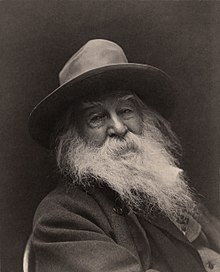
Walt_Whitman_-_.jpgWalt Whitman

Walt Whitman: Leaves of Grass: The First (1855) Edition, Camberwell, Penguin, 1959 [1855]

Walt Whitman (American poet, 1819-1892) may just be the true poet of the post-modern age.  His vast rambling poem Leaves of Grass went through many incantations and revisions throughout his life.  Most scholars seem to agree that he might have done better to leave well alone and that this 1855 first version of the poem is the best.

Leaves of Grass is a vast, rambling, wildly energetic and boisterous paean to America and to American life in the mid nineteenth century. It commences with a substantial prose essay which is equally rambunctious, opinionated and at times difficult to comprehend praise of the American poet. Why do I say the poet of the post-modern age?  Consider this passage from his opening essay (p22) [ Note: the series of ….’s are in the original]

There will soon be no more priests. Their work is done. They may wait awhile…perhaps a generation or two…dropping off by degrees. A superior breed shall take their place…the gangs of kosmos and prophets en masse shall take their place. A new order shall  arise and they shall be the priests of man, and every man shall be  his own priest. The churches built under their umbrage shall be the churches of men and women. Thought the divinity of themselves shall the kosmos and the new breed of poets be interpreters of men and women and of all events and things. They shall find their inspiration in real objects today, symptoms of the past and future…They shall not deign to defend immortality or God or the perfection of things or liberty or the exquisite beauty and reality of the soul. They shall arise in America and be responded to from the remainder of the earth. Hmmm!

Similarly on p 15 I note: Whatever would put God in a poem or system of philosophy as contending against some being or influence is also of no account. The great master has nothing to do with miracles. 

The poem Leaves of Grass, subtitled in later editions, Song of Myself, runs along similar lines and themes as it celebrates the sheer beauty of human life, man, woman, creation, work, sex, breathing, the outdoors, the cities,  every conceivable occupation including prostitution, the lunatic, music, art, sailors, lovers, fighters, martyrs, the dying, everyone and everything. So Whitman writes

I know perfectly well my own egotism,

And know my omnivorous words, and cannot say less, 

And would fetch you whoever you are flush with myself.   [lines 1079-81, p74]

The editor of this Penguin edition, longtime literary editor Malcolm Cowley, compares Whitman’s writing with Hindu philosophy especially as it is found in the Bhagavad-Gita and I agree there are many similarities. There is a strong sense of metempsychosis and what goes around comes around, there is a divination and spiritualization of absolutely everything, even what is evil and cruel, there is a genuine identity of the self  with a universal spirit.  Whitman was not familiar with Hindu or Buddhist philosophy when he wrote this first edition of Leaves of Grass but in later editions he began to use specific terms from Hindu philosophical writings. Cowley is not suggesting  that Whitman was a Hindu devotee ..there is nothing about the Hindu pantheon of gods or indeed of Atman or Brahman in Leaves of Grass but there is plenty of “world soul”.  Consider these lines which would be quite at home in the mouth of Krishna speaking in the Bhagavad-Gita.

Swiftly arose and spread around met the peace and joy and knowledge that will pass all the art and argument of the earth; 

And I know that the hand of God is the elder hand of my own,

And I know that the spirit of God is the eldest brother of my own,

And that all the men ever born are also my brothers…. and the 

women my sisters and lovers,

And that a kelson of the creation is love; 

And limitless are leaves stiff or drooping in the fields,

And brown ants in the little wells beneath them,

And mossy scabs of the worm fence, and heaped stones, and elder 

and mullen and pokeweed.   [lines 82 – 98, p29]

Whitman also reminds us existentially that art and  poetry is only art and  poetry is only poetry when it is read, observed  and thought about.

All doctrines, all politics civilisation exurge from you,

All sculpture and monuments and anything inscribed anywhere

are tallied in you,

The gist of histories and statistics as far back as the records reach is

in you this hour — and myths and tales the same;

If you were not breathing and walking here where would they all be?

The most renowned poems would be ashes…orations and plays 

would be vacuums.   [lines 88-90, p92]

What is slightly less post-modern perhaps is Whitman’s trenchant determinism.

The law of the past cannot be eluded,

The law of the present and future cannot be eluded,

The law of the living cannot be eluded….it is eternal,

The law of promotion and transformation cannot be eluded,

The law of heroes and good-doers cannot be eluded,

The law of drunkards and informers and mean persons cannot be eluded.  

[lines 84 -89, p102]

Whitman had a huge impact on the poets of the beat generation and writers like Hart Crane. It may be that he will find  a vast new crop of readers in the post-modern and world-weary West.   For me there are scattered jewels of brilliant insight but the breath-taking relentless onrush of verbalisation becomes wearying.  He would have done well to be more succinct methinks.  I leave my Whitman analysis with this gem.

Why would I wish to see God better than this day?

I see something of God each hour of the twenty-four,

and each moment then,

In the faces of men and women I see God, and in my own face

in the glass; 

I find letters from God dropped in the street, and every one is 

signed by God’s name,

And I leave them where they are, for I know that others will

punctually come forever and forever.        [lines 1276 – 1280, p83]

Samuel Butler: The Way Of All Flesh, New York, Airmont, 1965  [1903]


Samuel Butler.jpegSamuel Butler was the son and grandson of Anglican clerics and this semi-autobiographical novel tells the story of Earnest Pontifex, child of a strict clerical father and grandfather who rebels against this family tradition at some cost to himself. After graduating impressively from Cambridge Butler  broke completely with his family and left England for New Zealand successfully running a sheep station for five years. Surprisingly successful Butler returned to England independently wealthy and spent his life alternating between painting, extensive travelling in Europe with various close male friends and writing novels, literary and artistic criticism, criticism of traditional Anglican theology and works critical of Darwinian evolution.

Strongly critical of Victorian religion and morality, The Way of All Flesh was published posthumously in 1903 to protect his family. The novel is by degrees funny, sad, clever, tedious, at times horrifying  but  always manages to hold the reader’s interest. Butler’s criticism of Victorian Anglicanism and his account of evangelical/high church divisions demonstrates a detailed knowledge of Biblical narrative and of mid-C19th theological debate especially around Evangelical and High Church Anglicanism as well as varied Christian responses to Darwinian evolution.  Butler also wrote the satirical novel Erewhon, based on his life in NewZealand and on his return to England he wrote works on Italian art, Homer, Shakespeare and music as well as anti Darwinian but not anti evolutionary semi scientific works which attempted to defend a neo-Lamarckian view of evolution going back to Buffon.    This lengthy novel has never been out of print and reflects an agile, multi-layered, well-travelled and intelligent mind. He was effectively a moral philosopher.   4 stars.

Nina Wilner: Forty Autumns, London, Little Brown Book Group 2016

Factual account of a family torn in two by the establishment of a totalitarian Communist State in East Germany following the overthrow of Nazi Germany at the end of World War 11. Germany was partitioned between the Soviets and the Allies. The Soviet Government installed a Communist Government in East Germany led by Walter Ulbricht and later Erich Honnecker. The German Democratic Republic became increasingly isolationist eventually completely closing all foreign borders and isolating Eastern Berlin from West Berlin by a vast concrete wall which became increasingly  protected by lights, barbed wire, inspection towers, guards,  weaponry, tanks and a substantial cleared no-go guarded area on the East German side. Over forty years of isolation, more than one sixth of the East German population fled to the West and some 170 would be “escapees” were shot trying to get into East Berlin. The East German secret service (The Stasi), became increasingly involved in mind control, terror, murder and victimisation, with significant rewards going to those who signed up to become party members and significant persecution and harassment of those who did not.

Hannah Wilner was the second oldest member of 9 children of Opa and Oma Willner and was of an independent mind and spirit. On her third attempt to flee into West Germany she was successful and eventually married a German Jewish Nazi survivor and settled down in the USA seeing her East German family in the flesh only once in those forty years. Hannah’s daughter Nina, also a strongly independent and spirited person grew up in the USA and eventually was accepted into the US Military, and became a spy for the Western powers in Berlin, leading sortées into East Germany on many occasions.

Following the American/Russian détente at the end of the Cold War, much due to the efforts of Gorbachev and Reagan,  Hanna and Nina were reunited with their extended family and a remarkable tale unfolded of forty years of survival of the Willner family who became teachers and office workers,  one an East German cycling olympian, others just quietly surviving and keeping their heads down. Nina Willner’s book is meticulously researched and documented and contains an excellent family photographic record and family tree. It is a heart-warming, at times tragic and always a very tense and exciting account of courage, determination, survival, honesty, idealism and commitment. An absolute page turner proving once again that historical truth is stranger by far than fiction.  5 stars.

Isabel Allende: The House of the Spirits, translated Magda Bogin, London, Black Swan,1986 [1985].

220px-Isabel_Allende_-_001.jpg

A prolific writer Isabel Allende, born 1942, is living an extraordinary life. Allende was  born in Peru, of Chilean parents. Her diplomat father, a cousin of Salvador Allende, mysteriously disappeared when she was three years old and her mother moved to Chile and married Ramón Huidobro, a Chilean diplomat serving in Bolivia, Lebanon, Argentina and Chile thus ensuring that Isabel had a truly international education.


Isabel Allende married engineering student Miguel Frias and worked in Europe, Chile and Venezuela for the United Nations Food and Agricultural Organisation, and as a translator, TV personality, dramatist and journalist.   When Salvador Allende, Chile’s first Socialist President, was murdered in a CIA backed Military Coup in 1973 which installed Army Chief Augusto Pinochet as leader, Isabel, then living in Chile,  assisted her parents in providing safe  passage for opponents of the Coup to safely leave Chile. Eventually her own name was added to the hit list and she fled to Venezuela where she again worked as a journalist. In 1988 she married again , this time to American attorney Willie Gordon and eventually became an American citizen.

The House of Spirits was inspired by the imminent death of her 99 year old grandfather who had lived through a century of both inspiring and tragic Chilean history. In her own words Allende wanted “to exorcize the ghosts of Pinochet’s dictatorship” in Chile. Unable to find a publisher in the United States, the book was eventually published in Spain.

Spanning three generations but never straying far from the patriarch Esteban Trueba, The House of the Spirits is a complex, funny but always compelling tale of love, lust, political intrigue,  history, terror and courage. With much more than a nod to Gabriel Garcia Marquez’s A Hundred Years of Solitude, Allende blends magic realism, historical insight, mystery and a remarkable cast of characters young and old to tell the savage political story of Chile in the second half of the twentieth century. The narrative centres around a rural estate and a classically designed urban mansion which accumulated many additional rooms and corridors over the years and provides a mysterious and fertile mystery house  from which many dramatic events emerge and in which many secrets are hidden. The moving spirit who upheld the spirit of opponents of the Pinochet Coup called simply “The Poet”, is clearly intended to be Pablo Neruda.

How much does a man live, after all?

Does he live a thousand days, or one only?

For a week, or for several centuries?

How long does a man spend dying?

What does it mean to say “for ever”?

Pablo Neruda

The first three quarters of the novel drift along in a somewhat dreamy and mysterious ‘magic realist’ mode which sometimes only barely holds the reader’s interest as the cast of characters mounts throughout the text.  The tension heightens significantly in chapter 12  (”The Conspiracy”)  and the novel assumes more realistic and tragic proportions. The complex politics of late C20th Chile with conservative, left-wing, Marxist, industrial and military factions interacting with sophisticated complexity is deftly described.  Allende’s novel achieves a  profoundly moving expose of the genuine terror of the Pinochet coup. The “disappearance” of many thousands of opponents of the regime has left a permanent mark on the Chilean psyche and joins with the Rwandan, Cambodian, East German, Korean, Balkan and now Afghan and Syrian tragic trajectory of post-world war 11 realpolitik.

Whilst I am not a great fan of magic realism the  brutal scope of the Chilean terror can perhaps only be countenanced and assimilated with a technique such as that mastered first by Marquez.I am surprising myself in giving this novel  5 stars!

Isabel Allende: Eva Luna, translated by Margaret Sayers Peden, Ringwood Au, Penguin, 1989 [1987]

Chilean author, now American citizen, Isabel Allende has written prolifically about fictional characters set in and around political  events in the last half of the C20th in South America and Europe. The major location in this novel is an unknown South American country with elements that fit at times with both Chile and Venezuela in both of which countries Allende lived for many years.

Once again there is to a degree an element of magic realism style in this novel but far less than in The House of the Spirits reviewed above. All sides of the political spectrum are considered …the conservative élite, the Indians, the left, the new rich, the guerrillas and the military and political leaders. Unlike the significantly large cast in The House of the Spirits this novel follows closely the adventurous and at times chaotic life story of Eva Luna from her birth to her mysterious and luminous mother Consuela to her eventual marriage to news cameraman Rolf Carlé.

The themes are more contemporary in this novel including much more racy sexual encounters and a key transgender character as well as characters at home in a modern media world. In general it is fair to say there is a degree of amorality in Eva Luna which is stronger than in The House of the Spirits.  Thus while rape, prostitution and sexual encounters occur in both novels Eva Luna herself seems to manage to have a sexual encounter with just about every major male person that enters her life. In addition the Catholic Church takes a beating in this novel.

Eva Luna is more a “search for love and meaning” story with a political background rather than a coherently historical saga after the style of The House of the Spirits.  Even so, perhaps due to the translation factor, the character of Eva Luna is so multi-faceted that it is hard to close the novel with a total sense of one “mastering” the character of Eva.  Some of the relationships and renewed meetings after many years appear somewhat contrived. In the novel, Eva Luna herself becomes an accomplished and published writer after many struggles and as one reads this novel there is the thought that parts of the narrative may be somewhat autobiographical. 3 stars.

Voltaire  [François-Marie Alouet]: Candide or Optimism, translated by John Butt, Mitcham Au, Penguin Books, 1947 [1759].

Unknown.jpegTranslator John Butt tells us that French philosopher and wit Voltaire wrote Candide at the peak of his career whilst living in Ferney in eastern France near the border with Switzerland , having been twice imprisoned and found unwelcome in Paris. In Ferney, he also wrote his dialogues, various short tales and his Philosophic Dictionary. Voltaire eventually returned in triumph to Paris in 1788 not long before his death.

Candide is an outright philosophical rejection of C18th optimistic philosophy represented in particular by Leibniz, who is mentioned specifically at the end of chapter 28 as one who cannot be wrong (p136).  Optimistic philosophy was also championed in the C18th by German polymath philosopher Christian Wolff and extraordinary C18th English social reformer Anthony Ashley Cooper, the 7th Earl of Shaftesbury.

The key characters in Candide are Candide himself, the luckless son of a German baron of Westphalia, his beloved and very beautiful Cunégonde, whom he tracks all over Europe and South America finally marrying her in her ugly old age, and the irrepressible Dr Pangloss, philosopher extraordinaire representing Leibniz’ eternally optimistic view of life. The long essay satirically describes the fatuousness and brutalising stupidity of internecine warfare, the corruption of European hegemony in South America, the violence and pointlessness of the Franco-Prussian war, the natural? greed and lustfulness of men given the opportunity and, in the perfect hidden community of Eldorado a biting satire on the folly of faith in riches and the impossibility of protecting them from theft and eventual destruction.

One would need to be expert in C18th political life and literature to catch the meaning of all of Voltaire’s satirical barbs but, even in translation, the humour and the clear vitality  of his writing is evident on every page. His attack is not so much directly on Christianity as on man’s innate ability to corrupt the good and the fragility of moral human intention in the face of sexual and monetary temptation. A thoughtful and humorous read even after 250+ years. 4 stars.

Ed Shaw: The Plausibility Problem: the church and same-sex attraction, Nottingham, IVP, 2015

Ed Shaw is an evangelical church leader who is same-sex attracted and celibate. This remarkably honest and carefully written book documents his deep desire to express his same-sex attraction in sexual union with another man which is in conflict with his Christian commitment to what he regards as clear-cut Biblical teaching on this issue.

Shaw writes with a full realisation that some significant evangelical writers have found a way to maintain their evangelical commitment to the authenticity of Scripture and also accept same-sex marriage. These writers include Rob Bell and Steve Chalke (p.30). As Vaughan Roberts writes in his Foreward (p 15) his sights are not set on the predictable target —compromising liberals— but on those who belong to his own evangelical tribe.

The book is called The Plausibility Problem because in the C21st it is so plausible to see same-sex  marriage as the natural outcome of a blossoming of love between two people independent of their gender and this is the way it is seen by an increasing number of church denominations, especially in the United States but increasingly elsewhere. Shaw notes that in the evangelical churches in the 1990s same-sex attraction was a no-go area whereas today many churches are simply arguing that love is what matters, not outmoded Biblical teaching.

The major thrust of Shaw’s argument is that the evangelical church has magnified the problems of same-sex attracted people by nine “missteps” all of which need to be taken very seriously but the church today.   These ‘missteps’ are carefully argued, well documented and provide a very strong critique of the standard evangelical rejection of same-sex attraction. The missteps are as follows:

(i)  ‘Your identity is your sexuality.’  For individuals to call themselves “gay” is to define their identity sexually whereas to call themselves “same-sex attracted” is no different in reality from saying they are attracted to  beautiful women, pyromania or cleptomania. The misstep is the danger that some evangelicals often fall into of more generally defining ourselves as sinners rather than saints; as those in rebellion against God rather than his permanently adopted children. (p40)

(ii) ‘A family is Mum, Dad and 2.4 children.’ Many successful evangelical churches play to families/teenagers/young adults/young marrieds and families. They often struggle with singles especially younger singles who often feel estranged from church programs and proclamation. (p45) The church should rather be a real family…fully embracing all of its members.

(iii) ‘If you’re born gay, it can’t be wrong to be gay.’ Shaw quotes Richard Hayes: the very nature of sin is that it is not freely chosen….we are in bondage to sin but still held accountable to God’s righteous judgment of our actions. ..it cannot be maintained that a homosexual orientation is morally neutral because it is involuntary. [in The Moral Vision of the New Testament: A Contemporary Introduction to New Testament Ethics, New York, HarperOne, 1996, p390] quoted on p.60.  The misstep is not spelt out in this chapter but presumably the Evangelical church has started to give away the doctrine of judgment.

(iv) If it makes you happy, it must be right.’  The misstep here is that the priority of happiness has infiltrated the evangelical church. Whereas three generations ago divorce was unacceptable in the church apart from the extremes of serial adultery or spousal abuse today in many churches it has become routine. Similarly although evangelicals claim to oppose the prosperity gospel we’ve joined the world around us in believing that money buys happiness. So we’ll  give away what we can afford, but only after we’ve paid for what we no longer consider luxuries …the third pair of shoes, the latest phone, the foreign holiday, the private school fees, the safest pension etc. …in many church contexts, the main group who are still being asked to do something that makes them unhappy are the Christians who experience same-sex attraction.(p24)

(v) Sex is found where true intimacy is found’….intimate friendships and relationships do not have to be sexual relationships.

(vi) Men and women are equal and interchangeable’…Shaw argues that men and women are equal but not interchangeable. It is a massive challenge to articulate the equality of the two sexes at the same time as the differences, and then to explain the importance of these differences and why we need to preserve them.

(vii)  Godliness is heterosexuality’….the call to sexual purity is a sub-section of godliness, not “the” defininition…..True, Chriat-like sacrificial love means saying ‘No!’ to any sexual activity outside marriage (p99)….we need to to measure Christianity by Christ-likeness (p100) …a constant recognition that at heterosexual  sexuality does does not guarantee godliness….(p103).  .The evangelical  church largely discounts this idea but goes hard on same-sex attraction….homosexual sex outside marriage is perceive as a much greater sin in our churches that heterosexual sex outside marriage. (p104)

(viii) ‘Celibacy is bad for you.’  Shaw writes: Pastorally, I ‘ve actually discovered more loneliness in marriages than among single people. (p109) Genesis 2:4 is stressing [man and woman’s] permanent (and sexual) union rather than saying they were incomplete beforehand….If we don’t communicate that celibacy is a plausible way of living, we make it almost inevitable for same-sex attracted Christians  (and those who care for them) to embrace ‘gay marriage’). The good sermon we’ve never heard that promotes lifelong singleness is there in 1 Corinthians 7. Paul is the preacher and he manages to promote with the gifts of marriage and singleness at the same time…(p110)…Singleness is a gift you have, unless it is taken away by the gift of marriage. (p110)

(x) ‘Suffering is to be avoided’.  ..following Jesus is no longer about our sacrifice and suffering. Western Christians have, by and large, stopped denying ourselves—we now talk more about our right to be ourselves. (p118)  We should ask What did Jesus do? not what would Jesus do?  (p119) So what have you denied yourself  to follow Jesus? There must be something. If there’s nothing, then you are not really following the Jesus who speaks to you here. (p119)

Conclusion: instead of keeping very silent on the issue of homosexuality, hoping to avoid all of the controversy that it brings us, we should begin to see both the people who experience it and the controversy it brings as a gift to the church. A divine gift, because it’s just what we needed at this time in our history to help us to see the whole series of tragic missteps we have taken, to the detriment of us all, as well as to the detriment of the world we are trying to reach.

Shaw’s book has helpful appendices:

  1. A useful essay on the plausibility of the traditional interpretation of Scripture’s account of human relationships – effectively a very useful summary of the Scriptural story (pp 136-154…very useful for a study group. 

2.  An essay on the implausibility of the New interpretations of Scripture in regard to human relationships.  Shaw suggests these “interpretations” are based on emotion (p156); polarisation (p157) and doubt rather than rejection of traditional biblical interpretation. (p158) In this section he argues that biblical passages are not interpreted in their full biblical context (p160); they rely on extra-biblical sources e.g. suggesting that Romans 1 is a response to Caligula’s excesses (p 161); they pitch scripture against scripture (p162) ..”repugnant” according to Anglican article 20!

Shaw also includes a very useful collection of recommended readings as well as the readings of his opponents. This is a brave,practical and clear book. Evangelicals ignore it at their peril!  5 stars!

BOOKS READ MAY 2018

William Faulkner: As I Lay Dying, London, Vintage, 1996 (1930)

This is the first time I have read a novel by Faulkner, widely regarded as America’s finest novelist of the C20th in the tradition of Hawthorne, Twain, Melville and Henry James.  He is clearly an acquired taste because initially, for the unprepared reader, his writing is disturbing, often obscure, difficult to follow and with a vocabulary regularly made up and unique to the author. Thankfully a Faulkner “dictionary” is available online. The format of the novel is also unusual with some chapters made up of one simple and obscure sentence.

Set in the deep south of Mississippi around the created town of Jefferson the story line is simple. Stubborn, careful and stoic Farmer Anse Bundren’s wife Addie has died and her dying wish was to be buried in Jefferson, normally a three day wagon journey. Anse is a taciturn, ornery, skinflint, determined  and misogynistic old man who is determined that Addie’s dying wish be fulfilled. He sets out with his five children and his wife in a coffin made by one of his sons Cash.  But the gods are against him.  A wild storm has knocked out the only bridge at a major river crossing and in attempting to ford the swollen river the wagon is destroyed and one of the sons breaks his leg as they lose their mules, retrieve the coffin and their tools. One of his sons loses his mind on the journey and burns down a stranger’s barn.  The result is a ten day gruellingly agonising crawl to Jefferson in which the reader gleans a minute and often obscure insight into the inner elements of the lives of and thoughts of various members of the family, only two of whom are the children of Anse and Addie with the younger three being the secret offspring of Addie and the conflicted parson Whitfield.

A pervading sense of poverty, racial anger, sexual oppression, deceit and the iron will power of the very unlikeable Anse Bundren dominate this novel. Harold Bloom describes As I Lay Dying as Faulkner’s greatest novel. I cannot tell not having read any others.  I will need to recover a while before taking on another Faulkner.  To be fair to Harold Bloom, the only comparable impact of a first reading of a novel I can match to Faulkner is the memory of reading my first novels by Joyce and Lawrence, so perhaps  I will eventually become a Faulkner convert. But it is difficult indeed to find redemption in As I Lay Dying.    A preliminary 3 stars with the recognition that its true greatness may eventually reveal itself to me.

Louisa May Alcott: Little Women, Mineola, New York, Dover Publications,2000 (1868-69). [This  unabridged edition was published as a replica of the original, edited by Susan L Rattier and containing Part 1 Little Women, and Part 11, Good Wives.]

I wanted to read this book as background to reading March, by Geraldine Brooks. I was not particularly looking forward to reading a “girls” book published under the heading of Dover Juvenile Classics!   The truth is I found I could not put this book down and read its 548 pages in two days. Louisa May Alcott was the daughter of well connected American educationalist Bronson Alcott, a transcendentalist and friend of both Emerson and Thoreau. Louisa clearly grew up in a rich literary environment. This book apparently is modelled on Louisa May Alcott’s own childhood experiences.

The story of four girls, Meg, Jo, Beth and Amy growing up in straitened circumstances in New England with an absent father away as a chaplain in the American Civil War is written with sensitivity, humour, elegance and insight even if the language and sentiment of some 140 years ago is at times too sententious and saccharine and the mother Marmee too saintly for 2018 readers to stomach.  The adventures of the family of five and their next door neighbour Laurie, also a teenager bring humorous insights and surprising plot lines which preserve the text from mawkish melodrama and although the style has a traditional “feel”, in many ways the novel reads more easily today than say Dickens’ Pickwick Papers from roughly the same period.  There is a direct Christian spirituality throughout the novel but it is not forced or preachy and there are moments of deep sadness in the story line which had a compelling effect on this reader. I cannot recall ever a book producing tears for me as this one did in two places.

What makes this book much more than a child’s story is the extension  into Part 11 ( Good Wives)  in which the young children are found as young adults involved variously in travel in Europe, romance, marriage and in one case facing up to the death of a loved one. In this section Mr March has returned from the war although still playing a completely minor role in the development of the story and about whose character we are, surprisingly perhaps, told virtually nothing. It is a remarkable achievement that Alcott manages to maintain our interest in all four of the girls as individuals as well as Laurie, the boy next door. This novel thoroughly deserves its “classic” status. 5 stars.

Geraldine Brooks: March, Sydney, Fourth Estate, imprint of HarperCollins, 2005.

Australian born Geraldine Brooks lives in the USA with her journalist/historian husband, Tony Horwitz, learned, amongst other things,  in the history of the American Civil War.  Brooks writes both fiction and non-fiction but her  novels are nevertheless meticulously researched with both understanding and passion. I have read People of the Book,  Caleb’s Crossing and The Secret Chord and all bring to the reader a vivid and at times merciless picture of the historical period described and any further research one chooses to explore demonstrates that Brooks has done her work very carefully indeed. An outline of the research for March is found in the Afterword which commences on page 339.

As the reader of Little Women will know, Louisa May Alcott tells us virtually nothing of the life and character of Mr March except that in an unexplained attempt to help a friend he lost the entirety of a considerable fortune, leaving his family in severe poverty. He was of course, the father of Meg, Jo, Beth and Amy and wife of Marmee. In Part 1 he is absent  working as a chaplain in the Yankee army and in Part 11, Good Wives,  he is a warm hearted, somewhat reclusive and scholarly retired clergyman who plays only a very minor role in the family’s adventures.   Geraldine Brooks fills in this gap by creating a complex, and thoroughly human, non-conformist pastor whose self-doubt and overwrought conscience almost lead several times to his destruction.

Brooks based her portrait of March on an amalgam of two people. The first of these was Louisa May Alcot’s father,  A. Bronson Alcot,  an educator, idealist, Utopian radical  and philosopher and personal friend of both Thoreau and Emerson. Like March in Brooks’ novel Alcot began his life as a book peddler to the wealthy and fell in love with the leisured life of the mind. [p341] but he later in life became a passionate supporter of the anti-slavery movement. Alcot’s sixty one journals and his letters fill thirty severn manuscript volumes in the Harvard College Library,  [p340].   Secondly March’s character was based on the celebrated New England clergyman and Army Chaplain Arthur Buckminster Fuller. At the same time Brooks reveals to us a very different ‘Marmee” from Louisa May Alcot’s 1868 novel. Marmee’s fierce temper is just hinted at in Alcot’s Littlee Women. In March her temper is revealed in its full force.

March is revealed to us in Brooks’ imagination as an idealistic and well educated but diffident “progressive” Christian man who volunteers to fight in the Civil War without reference to his wife, who is unsuited either spiritually or physically to the rigours of a vicious and murderous conflict, who is vulnerable to beautiful women and who then idealistically seeks to solve the educational challenges of the Southern slaves who had been “freed” to work on the “contraband” cotton farms. These ventures were set up with limited capital after the abolition of slavery by idealistic and/or opportunistic northern speculators who had little idea how to work with slaves at all let alone recently “freed” slaves who were still vulnerable to occasional destructive waves of white supremacists who had yet to be persuaded that the war was lost. Apart from anything else this story removes any faint suggestion that the American Civil War was a fight between the good and right Yankee north and the evil and callous Southern slave owners. Brooks demonstrates that greed and self-serving opportunism were present on both sides and subsequent history has shown us that the “race problem” remains.

Somehow March does survive all this to be reunited with his family and yes Brooks allows us closure in her final sentence. But both Marmee and March have been through so much in the journey that one wonders for the future. 5 stars

Kevin J. Vanhoozer: Biblical Authority After Babel, Grand Rapids, Brazos, 2016

Vanhoozer is research professor of systematic theology at Trinity Evangelical Divinity School in the USA.  He writes prolifically from a reformed position but with a broad sweep covering theologies, theologians and literature from many fields and approaches. His General Editorship of Dictionary for Theological Interpretation of the Bible is an impressive gift to theological scholarship.

Biblical Authority After Babel takes its title obviously from the Genesis 11 story of the Tower of Babel built by “mankind” to reach up to God. God was not pleased with their arrogance and “came down” and confused their languages so that they could not complete the tower.  Vanhoozer is responding particularly to Alister McGrath’s claim in his recent book Christianity’s Dangerous Idea that the Protestant Reformation’s emphasis on the doctrine of the “priesthood of all believers” led directly to the notion that every Christian has the right and authority in the Spirit to interpret the Bible for themselves. Thus according to one way of reading McGrath, the Reformation set loose interpretive anarchy upon the world,  a “Babel” of scepticism and schism which divides, confuses and continually multiplies into the many thousands of denominations and Protestant ideologies in the world today. At the same time Vanhoozer takes issue with other historians who argue that Protestantism, by its removal of any “magisterial” shared framework for the integration of knowledge, has been responsible for the gradual secularisation of the modern world See Brad Gregory:  The Unintended Reformation: How a Religious Revolution Secularised Society.

Vanhoozer states early on that there is no merit in giving pat answers to complex questions, (p9) and this book is certainly no easy read due both to Vanhoozer’s carefully worded and detailed writing but also to the double layered layout of the book. Thus there are two over-arching themes of the book.

The first is Vanhoozer’s attempt to use “retrieval theology” to analyse again the fundamental theology and thinking of the C16th Reformation. “Retrieval theology” is the name for a mode or style of theological discernment that looks back in order to look forward. (p23). What Vanhoozer seeks to “retrieve” are the four classic Reformation “Solas” and explain their true intention and meaning.  Sola is the Latin for “alone” and Vanhoozer deals with Grace alone; Faith alone; Scripture alone; and In Christ alone.  He adds his own fifth sola ..For the Glory of God alone.  Vanhoozer has a final chapter in which he attempts to synchronise Protestantism with Evangelicalism and in a sense to retrieve Evangelicalism, a term which is increasingly confused and under fire.

The above would be meat enough for one book but on top of this significant retrieval  analysis Vanhoozer details and defends his version of the interpretative practice of “mere” Protestant Christians (p62) channelling C S Lewis at this point.  To do this, Vanhoozer  creates a total of twenty theses  throughout the book to delineate this Protestant interpretative practice sometimes using philosophical/theological terms such as material principle, formal principle, the triune economy of light and so on which are not always clearly enunciated.(to me anyway). The result of these two over-arching themes is that the reader is divided between sorting our the “five” solas at the same time as getting a handle on the “twenty” theses of Protestant interpretative practice and it takes care and patience to push through to the finish line.

In spite of these difficulties Biblical Authority after Babel is a far-reaching and worthwhile read and indeed it provides a program for Protestants and evangelicals to understand what they have in common and to direct their energies towards the unities of Protestant belief and practice rather than concentrating on the relatively minor issues that divide some Protestant believers.

In particular Vanhoozer argues strongly for the necessary existence of the church community as also an interpretive community, creating an essential guard against individual flights of fancy and heresy in personal Biblical interpretation. In other words the worshipping community itself is the  “interpreting community” for each individual Christian. The worshipping community including its eldership/leadership becomes the safeguard agains the “interpretive anarchy” so feared by the modern opponents of the Reformation’s impact. 

On the other hand Vanhoozer has stayed away from any actual issues in this lengthy discussion choosing rather to focus on a theoretical way forward. Much as I admire his attempt it seems to me that the book would have been stronger with at least a chapter on the hard issues. Aside from one indeterminate footnote he has avoided the same-sex attraction issue which, at least in the Anglican Church , has already caused substantial division and heart ache and won’t be going away any time soon. Equally the coherent and jaunty writing and podcasting output of Rob Bell’s influential body of work has a vast world wide following. Bell can still, I believe,  be considered “evangelical” while calling for a radically different approach to many conservative doctrines and earning the ire of hardliners like John Piper. Vanhoozer’s “model” may find a way to deal with issues like these two but it would have been useful to have a chapter with attempts at a practical way forward.

Vanhoozer’s very impressive reading guide alone is one major value of the book. There is enough food for thought here for a solid one year course in Biblical and Theological hermeneutics. An impressive and thoughtful book but only for those who are committed to theological analysis and prepared to stay the distance.   4 stars.

Vaccillating with Vanhoozer on Biblical Authority 500 years after the Reformation.

Notes from Kevin J Vanhoozer: Biblical Authority After Babel: Retrieving the Solas in the Spirit of Mere Protestant Christianity, Grand Rapids, Brazos, 2016.

Kevin Vanhoozer is a Reformed Systematic Theologian and Philosopher and the research professor of systematic theology at the Trinity Evangelical Divinity School in Wisconsin. This book is written largely in response to recent arguments that the C16th Reformation, by its doctrine of the “priesthood of all believers” has introduced a tidal wave of different Christian denominations (about 35 000 at the last count and rising). In addition some Reformation critics argue that not only did the Reformation invite  Biblical interpretational anarchy it also led inexorably to secularisation by calling into question the authority of the one church with its official teaching magisterium. Two books which Vanhoozer  frequently references and seeks to respond to, are:

Alister McGrath: Christianity’s Dangerous Idea: The Protestant Revolution – A History from the Sixteenth Century to the Twenty-First, New York, HarperOne, 2007, [which focuses on the dangers of biblical interpretive anarchy and:

Brad S  Gregory: The Unintended Reformation: How a Religious Revolution Secularised Society, Cambridge MA, Bleknap Press of Harvard University, 2012 [ which led to the loss of any shared framework for the integration of knowledge -> Protestant pluralism -> Post-modernism [Gregory p.327] He also notes as significant Richard Popkin: History of Scepticism: From Savaronola to Bayle, revised and expanded edn,, Oxford, OUP, 2003.

Vanhoozer sets himself the task of using Retrieval Theology to recover and defend the four “solas” of the Reformation. “Retrieval theology” is the name for “a mode or style of theological discernment” that looks back in order to move forward. [quoting W.David Buschart & Kent D.Eilers: Theology as Retrieval: Receiving the Past, Renewing the Church. (Downers Grove Il, IVP Academic, 2015]. The four “solas” are: Grace alone; faith alone; scripture alone; and in Christ alone. Vanhoozer then adds a fifth “sola”, the Glory of God alone.  Finally he concludes with a chapter in which he seeks to establish evangelicalism as the standard bearer of Protestantism.  In addition to the five “solas” Vanhoozer further sets out a series of twenty “theses” which effectively summarise and outline his general defence of Protestantism in regard to the interpretation of the Bible.

The theses are listed without comment below followed by some more general comments and notes from his book. Whilst the theses may sound a little odd at first once you think about them they actually do summarise, in my view, what many Protestant Christians understand about reading the Bible and their relationship with Christians of other denominations. I have bolded some of the theses which I think are important for critics of Protestantism to understand.

  1. Mere Protestant Christians agree that the many forms of biblical discourse together make up a single unified story of God’s gracious communicative initiations. (p62)
  2. Mere Protestant Christians agree that the Bible is fundamentally about grace in Jesus Christ. (p63)
  3. Mere Protestant Christians believe that the Bible, the process of interpretation and the interpreters themselves are all parts of the triune economy of grace. (p64)
  4. Mere Protestant Christians are themselves interpreters who are themselves caught up in the triune economy of light and who therefore read the Bible as children of light (p66)
  5. The authority principle of mere Protestant Christianity is the say-so of the Triune God, a speak-acting that authorizes the created order and  authors the Scriptures, diverse testimonies that make known the created order as it has come to be and to be restored in, through, and for Jesus Christ. (p104)
  6. As persons created in God’s image and destined to be conformed to the image of God’s Son, mere Protestant biblical interpreters believe that the Spirit both summons them to attend and authorizes them to respond to the voice of the Triune God speaking in the Scriptures to present Christ.  (p104)
  7. Mere Protestant biblical interpreters believe that they will have a better understanding of what God is saying in Scripture by attending to the work of other interpreters (and communities of interpreters) as well as their own community’s work. (p105
  8. Mere Protestant Christians believe that faith enables a way of interpreting Scripture that refuses both absolute certainty (idols of the tower) and relativistic scepticism (idols of the maze). (p105)
  9. The mere Protestant pattern of interpretative authority begins with the Trine God in communicative action, accords first place to Scripture interpreting Scripture (the canonic principle), but also acknowledges the appointed role of church tradition (the catholic principle) in the economy of testimony. (p143)
  10. “Sola Scriptura” is not a recipe for sectarianism, much less an excuse for schism, but rather a call to listen for the Holy Spirit speaking in the history of the Scripture’s interpretation in the church. (p145)
  11. “Sola Scriptura”  entails not a naïve but a critical biblicism. (p146)
  12.   A mere Protestant practice of “sola scriptura” constitutes a catholic biblicism. (p146) A mere Protestant practice of “sola scriptura” constitutes a catholic biblicism.  [ie mere Protestant interpreters do well to consult and be guided by the theological judgments of earlier  [and current] generations of Christians and of Christian communities in other parts of the world.
  13. Mere Protestant local churches have the authority to make binding interpretative judgments on matters pertaining to statements of faith and the life of the church members insofar as they concern the integrity of the gospel. [i.e. “the power of the keys”]
  14. Christ authorises both the congregation as a whole and its officers in particular to minister the same word in different ways. [p174]  [eg baptism?]
  15. Christ authorises the local church to be an authoritative interpretive community of the Word of God. [p175]
  16. Mere Protestant local churches have an obligation to read in communion with other local churches. [p176]
  17. Mere Protestant Christianity, far from encouraging individual autonomy and interpretive anarchy, calls individual interpreters to join with other citizens of the gospels as members of a universal royal priesthood and local embassy of Christ’s kingdom in order to represent God’s rule publicly. [p210]
  18. Mere Protestant Christianity is a confederacy of ‘holy nations’  (local churches) united by a single constitution, and committed to reform and renewal through a continued rereading of Scripture.  [p210]
  19. The genius of mere Protestant Christianity is its distinct converse (i.e. conversational “conference” ) generated and governed by Scripture, and guided by a convictional conciliarism that unites diverse churches in a transdenominational communion. [p211]
  20. The glory of mere Protestant Christianity is the conference and communion of ‘holy nations’  [local churches], itself a gift that glorifies God in magnifying Jesus Christ.

The following notes are taken from Vanhoozer’s book with occasional comments from me.


p3. The story of the Reformation and  Protestantism in general  can be told in differerent ways with different emphases, some positive, some negative.   Vanhoozer notes 10 different stories

(1) Ephraim Radner: “The end of the Church”. Vanhoozer notes  the argument  by Radner in The End of the Church: A Pneumatology of Christian Division in the West , Grand Rapids, Eerdmans, 1998 that a divided church is a church without the Holy Spirit, and thus a church that is unable rightly to read Scripture.    Radner’s view it seems to me is at odds with Scripture itself which clearly demonstrates serious division within the New Testament church e.g. between Peter and Paul at Antioch, between Paul and John Mark over the mission of the Church, between Jewish and Gentile Christian churches, between Euodia and Syntyche and so on. It also implies that the Western church was in the past united but that is to ignore the  Nestorian, Arian, Marcionite, Donatist and Pelagian controversies to name a few, let alone the tragic C11th  separation of Eastern Orthodoxy from the West and the Conciliar/Papist debates again just to name a few major divisions. (p4)

(2)  Friedrich Schleirermacher: “the introductionn of academic freedom”.  In an address to the theology faculty of Berlin, on the occasion for the 300th anniversary of the Reformation (November 3, 1817) Scheliermacher praised the Reformers for introducing academic freedom into theology, namely, the critical (i.e. scholarly) principle that is the only antidote to (Roman Catholic) dogmatism. (p5)

(3) Wilhelm de Wette:  “Political Freedom”. The spirit of Protestantism …leads necessarily to political freedom. (p5)  [cited from T A Howard & M A Noll: “The Reformation at Five Hundred: An Outline of the Changing Ways We Remember the Reformation.” in First Things, 247 (November 2014):43-48.

(4) G W Hegel: “The freedom of humanity”  Hegel viewed the Reformation as an essential step in the history of the Geist toward freedom:”This is the essence of the Reformation: Man is in his very nature destined to be free.”  [cited from Hegel: The Philosophy of History, trans. J. Sibree, Mineola,NY, Dover, 1956 p417]  (p5)

(5)  Ernst Troeltsch: “individualism”. Troeltsch argued Protestantism’s progress is a matter of basing beliefs not on an external authority but on inner personal conviction: “Protestantism became the religion of the search for God in one’s own feeling, experience, thought and will.”   (p5) [ cited in Troeltsch: Protestantisim and Progress: The Significance of Protestantism for the Rise of the Modern World, Philadelphia, Fortress, 1986]

(6)  Paul Tillich: depicted the “Protestant principle”  as dialectical: a prophetic “no” to any earthly authoritarianism, and a creative “yes”  to the ground of being (love)  that empowers new shapes of human freedom. (p5) [cited from Tillich: The Protestant Era, Chicago, UCP, 1948]

(7)  H Richard Niebuhr: “Constructive Protestantism”.  Richard Niebuhr’s The Kingdom of God in America, (1939) is an account of the arrival of English Protestants in the USA to form the  Massachusetts Bay Colony. He describes how Protestants confessed the direct rule of God, apart from any institutional mediation, but it was not clear how God’s Word was to order society.  “The new freedom was not self-organising but threatened anarchy in every sphere of life.”  (p6) [cited from H R Niebuhr: The Kingdom of God in America, 1937, repr. Middletown CT, Wesleyan University Press, 1988, p43] The resultant chaos especially following the trial of Mrs Anne Hutchinson for disturbing the peace “ and her subsequent banishment to Rhode Island, almost destroyed the Massachusetts settlement completely.

(8) Alister McGrath: “Christianity’s Dangerous Idea”.  Molecular chemist turned systematic theologian and historian McGrath borrowed his title from Daniel Dennett’s title of his book Darwin’s Dangerous Idea: Evolution and the Meanings of Life, [London, Penguin, 1995] McGrath used the biological idea of mutation to describe Protestantism as a meme: an idea, value, or practice that spreads from person to person, culture to culture, nation to nation,  through not genetic, but cultural replication…[this factor ] ..accounts for the unpredictability of new developments (such as Pentecostalism) and its capacity to adapt to new situations.  [cited from A McGrath: Christianity’s Dangerous Idea, New York, HarperOne, 2007]

(9) Brad Gregory:  “Secularization”   …the unintended consequence of the Reformation’s refusal of the church’s final say-so was the loss of “any shared framework for the integration of knowledge” …leading eventually to religious wars over disagreements as to precisely what Scripture said, and eventually, to the Enlightenment’s elevation of “sola ratio”  (reason alone) to the position of unbiased referee,…demoting faith to the realm of private (subjective) opinion. (p11) [quotation cited from Gregory: The Unintended Reformation: How a Religious Revolution Secularised Society,  Cambridge, MA, Belknap Press of Harvard University Press, 2112.]

(10) Hans Boersma & Peter Leithart:  “Schism”.  Boersma laments the Reformation as “fissiparous”  (inclined to cause or undergo division into separate parts or groups). He regards  the Reformation not as something to be celebrated but as something to be lamented….turning away from the allegorical to the natural and losing the sense of mystery, the supernatural, the sacramental and creating modernity as well as tearing apart the previously seamless body of Christ, the church. [cited from Boersma: Heavenly Participation: The Weaving of a Sacramental Tapestry, Grand Rapids, Eerdmans, 2011, p85;

Leithhart  criticizes Protestantism’s tendency to “just say no”  as simply identifying itself oppositionally, in contrast to the “other “ of Roman Catholicism. He quotes T S Eliot: The life of Protestantism depends on the survival of that against which it protests. [in Notes Towards the Definition of Culture, (London, Faber & Faber, 1949 p75). Protestantism/evangelicalism is always against something. (p13f)  and Peter J Leithart: “The Future of Protestantism: The Churches Must Die to be Raised Anew”, First Things, 245(August/Septmember 2014):p23-27.  Leithart goes on to say we are all in it, not just Protestants,. None of the strategies for building consensus —neither Protestant nor Catholic—-have been successful in uniting the whole church. 

p16  …the distinction between “fundamentals”  and “little things” brings us back to what many consider the Achilles heel of Protestantism: the lack of centralised interpretative authority….the formal problem…the lack of a consensual criterion for discerning whose interpretation of Scripture is right.  

p17….Sociologist Christian Smith, The Bible Made Impossible: Why Biblicism Is Not a Truly Evangelical Reading of Scripture, (Grand Rapids, Brazos, 2011) argues that the problem is not the Bible but biblicism. He  defines “Biblicism” as a theory about the authority of the Bible that posits its clarity, self-sufficiency, self-evident meaning, and universal applicability….Biblicists must be in denial if they cannot see what everyone else sees: on important matters the Bible apparently is not clear, consistent, and univocal enough to enable the best-intentioned, most highly skilled, believing readers to come to agreement as to what it teaches.  (p.ix)  In response Vanhoozer argues the way forward is not to abandon biblicism but to distinguish between a naïve and a critical biblicism, between a pervasive interpretative problem, on the one hand, and a unitive interpretative plurality, on the other. (ie a plural interpretative unity).  I think he means in the end, a unitive and peaceful agreement to differ in interpretation …but who decides which things matter and are critical  and which should not disturb unity??eg the same-sex marriage issue.

cf John Dryden: Religio Laici, 1682

The Book thus put in every vulgar hand,

Which each presumed he best could understand,

The common rule was made the common prey,

And at the mercy of the rabble lay. 

p18. Catholic critics argue against “sola scriptura” on the grounds that Protestants disagree about interpretations. e.g. Devon Rose: If Protestantism is true, all we have is fallible opinions about infallible books. [cited in Rose: The Protestant Dilemma: How the Reformation’s Shocking Consequences Point to the Truth of Catholicism, San Diego, Catholic Answers Press, 2014]

Yet the reality is that Roman Catholic scholars themselves disagree about interpretation (eg Hans Kung) and of course many Roman Catholics ignore “official” Roman Catholic dogmatic pronouncements e.g. on birth control.

p20  A further problem is what theorists have called extreme interpretative egoism…the view that privileges my interpretations simply because they are mine.

p21. Literary critics such as Stanley Fish of course argue that textual meaning [in general, in any literary text] is a function of the interpretive assumptions that happen to be in force in a particular interpretive community. …There is no single way of reading that is correct or natural, only “ways of reading” that are extensions of community perspectves. (p21f)

p25 In defining the purpose of his book Vanhoozer states the following: The present work contends that retrieving the five Reformation solas helps to address the contemporary problem of pervasive interpretive pluralism, and retrieving the priesthood of all believers (ecclesiology) helps to address the problem of the authority of interpretive communities….Together, these two principles will enable us to retrieve a third, what I will call the final principle of the Reformation, namely, catholicity;  a differentiated or “plural”  interpretive community, a rich communion that is both creature of the Word of God and fellowship of the Spirit.

p28. The solas are not a substitute for credal orthodoxy but its servants. The solas do not develop the doctrine they presuppose it….They also provide resources with which to respond to the charge that the Reformation unintentionally loosed interpretive anarchy up.on the world. In subsequent chapters I argue that the solas provide a pattern for reading Scripture theologically that enables Protestant unanimity on theological essentials, and thus the possibility of genuine fellowship in spite of secondary and tertiary doctrinal differences.

p29f.  To put it more provocatively: in retrieving the royal priesthood of all believers, I am pursuing what amounts to a virtual sixth sola : sola ecclesia (church alone)….Church alone what? The short answer: the church alone is the place where Christ rules over his kingdom and gives certain gifts for the building of his living temple.

p30. Philip Schaff shocked his audience when, in an 1844 inaugural address on “The Principle of Protestantism” to the German Reformed Theological Seminary at Mercersburg (Pennsylvania), he declared the Reformation to be the “greatest act” of the catholic church. Schaff judged the Church of Rome to be subcatholic in refusing to acknowledge the Reformation as its legitimate child. This is not to say that he gave Protestant churches a free pass. He identified the great defect of modern Protestantism as its sectarianism. 

p31  Protestantism has always suffered from two dangers identified by Andrew F Walls, The Cross-Cultural Process in Christian History: Studies in the Transmission and Appropriation of Faith, Maryknoll NY, Orbis, Edinburgh, T & T Clark p74….Walls identifies the dangers as pride (the instinctive desire to protect our own version of the Christian faith ) and indifference (the postmodern decision that no one can know for sure, so why bother ruling some versions out). Catholicity is not chaos, however. It is the standing challenge for the church to display its unity in Christ despite its differences. ….however, catholicity need not entail institutional unification.

p32   The problem is that evangelicalism itself has become a fractious, fissiparous …movement that began as a renewal of confessional Protestantism but that now too often attempts to maintain itself by seeking renewal by means other than confessional theology. However renewal without a direct object — the gospel as articulated by the Protestant confessions — is energy poorly spent….Bereft of an institutional means to deal with difference,  evangelical cells simply continue to split : not “divide and conquer” but “divide and rancour”. This is Protestantism’s dangerous idea at work!

p33  Exegesis outside the church will ultimately yield no unity—one must not only be a person of one book but of one church—the unity in diversity that local churches have in Christ…In this book I present the solas as seeds for a perennial reformation of the church. The kind of Protestantism that needs to live on is not the one that encourages individual autonomy or corporate pride but the one that encourages the church to hold fast to the gospel and to one another. The only good Protestant is a catholic Protestant — one who learns from, and bears fruit for,  the whole church. 

p35 ..revelation and redemption precedes the work of interpretation..

p36.  Although all three persons [of the Trinity] are involved in everything that God does, we may assign to the Father the ontology of grace, the giving of the love that creates (originating grace); to the Son the economy of grace, the giving of the life that redeems (saving grace); and to the Spirit the teleology of grace, the giving of the light that sanctifies (illuminating grace). Vanhoozer notes in fn 2 p36 that although everything that God does is the work of all three persons, it is fitting to ascribe certain actions, to particular divine persons on the basis of what we observe in the outworking of God’s plan. (i.e.the economy). The technical term is “appropriation” .   Phew! Not sure about the value of such “separation of functions”!

p38f Vanhoozer quotes  Roland Bainton quoting  Martin Luther’s own words [presumably Bainton translated the German himself]:…then I grasped that the justice of God is that righteousness by which through grace and sheer mercy God justifies [acquits] us through faith[fulness]. Thereupon I felt myself to be reborn and to have gone through open doors into paradise. The whole of Scripture took on a new meaning, and whereas the “justice of God” had filled me with hate, now it became to me inexpressibly sweet in greater love. This passage in Paul became to me a gate to heaven… [Roland H Bainton, Here I Stand: A Life of Martin Luther, New York, Mentor, 1950 p49f] Vanhoozer comments Luther had discovered the passive righteousness, and the freedom of the Christian, in the active righteousness, the effective promise of God. [ I am not sure I understand Vanhoozer’s distinction between passive and active righteousness. Righteousness is after all “acquittal” ..I presume active righteousness is effectively the sanctification that occurs when we accept God’s acquittal through faithfulness. (πιστις  = pistis = faith or faithfulness)

p40 ..Grace contradicts every system of religion precisely because God’s free mercy cannot be predicted, calculated or manipulated.   So also Rob Bell!

p41  Vanhoozer takes a standard Reformed view of natural theology.  Theologians of glory [natural theologians unnamed] extrapolate from what they see in nature to the supernatural being of God. This is natural theology freed from the discipline of revealed theology, an autonomous endeavour who’s principal method is the analogy of being. Natural theologians identify God-like properties in creation  and then extrapolate and inflate them until they reach infinite proportion, at which point they describe God’s being as all-good, all -powerful, together with all the other God-making properties. 

This is harsh in my view and does not take into account Romans 1:19 [What can be known of God, you see, is plain to them. Ever since the world was made, his eternal power and deity have been seen and known in the things he made, since God has made it plain to them. As a result they have no excuse…and then in Romans 2:1 So you have no excuse —anyone, whoever you are, who sits in judgment….[ Translation from Tom Wright: The New Testament for Everyone, London, SPCK, 2011, p 338f]

Vanhoozer does soften his position in fn16 p41 noting Reformed theologians display a certain ambivalence [there was no ambivalence at all with Karl Barth…Nein!] about natural theology. Paul speaks of “what can be known about God (Romans 1:19) in nature. However Calvin insists, first, that such knowledge (i.e. of God’s existence and power) is not saving… With all due respect to Calvin, he seems to have misread Romans 1:19. Paul says “they have no excuse” …according to Paul, God is taking natural theology very seriously…”they have no excuse” …they could have been saved… hmmm…more work to be done on natural theology for those who have not heard the Gospel of Christ or who have heard it poorly delivered methinks!

Vanhoozer goes on to quote Luther at his Heidelberg Disputation:  A theology of glory calls evil good and good evil. A theology of the cross calls the thing what it actually is. [p41] Vanhoozer then quotes Freud: “Religion” —the theology of glory —is indeed what Freud says it is : the future of an illusion, namely the idolatrous preference for one’s own thoughts about God. p41f [Sigmund Freud: The Future of an Illusion, trans. & ed. James Strachey, New York, W W Norton, 1989] …And yet does not Psalm 19 say clearly The Heavens declare the glory of God…much more work to be done here!  Personally I think the future of natural theology is much more positive than the future of Freud!

p43  Luther resists the idea that Christians read the Bible as they would any other text…”there is a priority of Scripture itself over its readers and hearers. Vanhoozer notes For Luther, it is not so much that individuals justify this or that interpretation; rather, a theologian “is a person who is interpreted by Holy Scripture, who lets himself or herself be interpreted by it.” quoted in Oswald Bayer: Theology the Lutheran Way, ed. and trans. Jeffrey G.Silcock and Mark C. Mattes, Grand Rapids, Eerdmans, 2007.  Vanhoozer further notes that Luther points out that the Gospels themselves can be (wrongly) read as law if the interpreter depicts Christ as an example of how to live one’s life. Readers who make this error make a Moses out of Christ. “What would Jesus do?” is  not yet to proclaim the gospel.

p45 – 46 But did the Reformers deny the sacramental -hierarchical picture of the world that went with the authority of the church Magisterium?  Vanhoozer argues that eveything depends, however, on what we mean by “grace” and how it relates to nature in the first place.  It is a significant question, pertaining to what Hans Urs von Balthasar calls “the last essential difference between Catholicism and Protestantism. 

Vanhoozer  quotes Thomas Aquinas: Grace does not destroy nature, but perfects it.

p47   Vanhoozer notes that Scholastics deployed the concept of pure nature to counter the Protestant teaching about the total depravity of human nature….It was Henri de Lubac, one of the important figures influencing Vatican 11, who first called attention to the trajectory that led from pure self-enclosed nature to modern secularism…Several of the leading Catholic theologians involved in Vatican 11 themselves lay at least some of the blame on the scholastic and neo-scholastic misreadings  (on their view) of Aquinas. When nature is viewed as oure or autonomous grace becomes ontologically “second order,” and the result is what Karl Barth rightly described as the “secular misery” of modern theology.  [Dogmatics, 1/1 pxviii]

p48  For de Lubac, the notion of pure nature is a nonstarter, for planted deep in human nature is a desire for God. [Surnaturel: Études historiques, Paris, Aubier, 1946] Vanhoozer quotes Leihthart that Neoscholasticism’s view of a supernatural realm “outside and above” nature actually “contributes to the triumph of atheism by making the supernatural superfluous to man’s existence.” [Peter J. Leithart, Athanasius, Grand Rapids, Baker Academic, 2011.] Vanhoozer continues: In de Lubac’s view, “secular humanism” is a contradiction in terms, for human beings by nature have a desire for God, who transcends nature.  The idea of a closed order of nature is nothing more than a metaphysical fiction….de Lubac  and the nouvelle théologie…held that “natural” being participates in and is oriented toward God, even in its fallenness…..Roman Catholic theologian Karl Rahner, proposes the concept of a “supernatural existential” to signify how human beings are constitutionally open to receiving grace, whether or not faith is present. (fn. 45) [cf Rahner’s idea of “anonymous Christians”?]

p49   Vanhoozer notes that both neb-scholastics and their nouvelle detractors appear to chalk up humanity’s distance form God to their createdness, not fallenness. On the contrary: the problem is not that God (or the supernatural) is “external” to creation but rather that the whole realm of creation has become alienated from God through sin. [and it is, in my view, the Biblical position that this “sin/rebellion” was in the world prior to humanity e.g. the narrative of the bent serpent in Genesis 3 and Paul’s references to the fact that we are not contending against flesh and blood, but against the principalities, against the powers, against the world rulers of this present darkness, against the spiritual hosts of wickedness in the heavenly places.. [Ephesians 6:12].

Vanhoozer and Reformed theology in general distinguishes between the grace of participation in being (created existence) , and from the special grace of participation in Christ (covenant existence), and from the further grace associated with the Spirit’s illumination. My personal view is that what Reformed theology calls “covenant grace” and the further “illumination of the Spirit” is for vocation, not predestination (ie Israel as a “light to the nations”  [Isaiah 49:6] and Christians “called to God’s service in Romans 8:28. Otherwise there is the perennial problem of the billions of individuals who have never heard or did never hear of the loving call of God for their lives to be lived in and with His Spirit.

p50f  Vanhoozer writes: We are not to read the Bible like any other book, as if it were an element in the immanent economy of natural reason, but rather with eyes and ears opened by grace, open and operative in the communicative domain of the Triune God….it is to the praise of God’s glorious grace that he has chosen us in Christ  “before the foundation of the world” .  [Ephesians 1:4] In my view,   for vocation, not for predestination to heaven!

p52  Vanhoozer notes that Theologians do well not to speculate about God’s immanent being…but p52  is a serious discussion about the nature of the interpersonal communications in the Godhead….

p53 …grace is not some third thing between God and human beings, a supernatural substance or power that gets infused into nature to perfect it. Rather, grace is the gift of God’s beneficent presence and activity—that is, the communication of God’s own light, life, and love to those who have neither the right to them nor a claim on God.  All the more reason, in my view, why Christians have a responsibility to use these gifts to reach out to others and play our part in the renewal of the kingdom of God on earth as indeed many selfless men and women are doing in the world today.

p54-5  According to Jonathan Edwards, the end for which God created the world was self-communication. [Edwards, The Works of Jonathan Edwards, vol 13, The “miscellanies,” ed.Thomas A. Schafer, New Haven, Yale University Press, 1994, p277] Vanhoozer continues..Creation is fundamentally a theatre for God’s glory, a place where God can be seen to be God by those who are not God…Again in my view these sentiments are all very fine but can mean nothing to those whose lives have been tortured by murderers, or bombed to bits in war or subjected to bitter slavery, or suffer incurable birth defects or illnesses,  or who have subjected themselves to the slavery of drugs etc. If the world is at present in Edwards’ theory the “theatre of God’s glory” it is in fact a “theatre of terror and horror and starvation” for many in the world today.  We who share in what Vanhoozer calls the mystery of Jesus Christ have vast responsibilities for the use of our time and gifts and resources.  Yes, I agree with Vanhoozer, that we have been transferred into the kingdom of the Son (Col.1:13) but we have been transferred for a very serious vocation indeed which will involve participation in his suffering.

p56 Vanhoozer writes of God’s covenant love and grace towards Abraham and notes This Abrahamic promise lies at the heart of the covenant of grace, and it is associated with a second Hebrew term, חֶסֶד  [hesed] (steadfast love), God’s special covenant kindness.  This is the blessing that is to be the light to the Nations.

p57 God freely sets in motion both creation and redemption, the latter a process of self-communication what would prove to be unsurpassingly costly. For Jesus Christ is the gratutitous promise of God made flesh, the חֶסֶד, the steadfast love, the the shining face  [שְׁכִינָה] and λογος Word of God, up close and personal, “full of grace and truth (John 1:14; Exodus 34:6-7)…What Christ communicates is his filial status and relationship, something that we could never attain by our own dint of effort. [all of this for our vocation, not for our predestination!]

p58 Jesus Christ is the shining face [שְׁכִינָה] of God, in whose light (and through whose Spirit) the church lives, moves and has its being…….the Word , who directs our knowing  and the Spirit, who directs our doing.

p59  Vanhoozer quotes Bonhoeffer: the church is God’s new will and purpose for humanity. [Sanctorum Communio:A Theological Study of the Sociology of the Church, ed. Clifford J Green, trans. Reinhard Krauss & Nancy Lukens, Dietrich Bonhoeffer Works Vol 1, Minneapolis, Fortress, 1998 p466.]….Vanhoozer notes: Alfred Loisy’s famous observation that “Jesus announced the Kingdom and what came was the Church” implies a discrepancy! [Loisy, L’Evangile et l’Elise, 2nd ed., Bellevue, 1903 p155]  Hmmm!

p60  The grace of God’s self-communicative activity results in the grace of communion: a communion of the Trinity, but also of the saints. It is the special task of the Holy Spirit to create a “fellowship of differents”. [taking a phrase from Scot McKnight, A Fellowship of Differents: Showing the World God’s Design for Life Together, Grand Rapids, Eerdmans, 2014.

p61 The teaching ministry of the church is itself a gift of the risen Christ, an important part of the economy of God’s grace…in response to the basic criticism ..that the Reformation’s emphasis on “sola scripture” and the priesthood of all believers desacralized the church…

p62 Christianity is not primarily a system of ideas but an account of how the Creator has reached out with both hands, Son and Spirit, to lift up a fallen world in a loving embrace….Mere Protestant Christians may differ over precisely how to read the story and what it means, but not about the main persons and events.

p63  There is one gospel, but four Gospels, just as there is one mere Protestant Christian understanding of the gospel story but several denominational interpretations as to its precise meaning. Even the New Testament authors tell the story of Jesus in different ways, but they all tell the story of Jesus…..Everything depends on a distinction between doctrines of differing dogmatic rank … In fn 80 Vanhoozer notes: I am aware that one person’s (or denomination’s) second-order doctrine is another’s cherished first-order truth. Interestingly, for Paul the things “of first importance” included Jesus dying for our sins and being raised on the third day (1 Cor.15:3-4)—events in a story rather than particular interpretations of these events.

p64  Vanhoozer quotes Luther: Unless one understands the things [res] under discussion, one cannot make sense of the words {verba]…Vanhoozer then notes: It is worth observing that in viewing the Bible as fundamentally a discourse about the mystery of God’s grace revealed in Christ, we are following the interpretive lead of Jesus himself, who consistently explained his person and work by reference to the Old Testament, as the fulfilment of previous divine communicative initiatives.  “And beginning with Moses and all the Prophets, he interpreted to them in all the Scriptures the things concerning himself.”  (Luke 24:27).

To rely on one’s own native interpretive powers is to succumb to the temptation of a “hermeneutics  of glory” —that is, the expectation that one can discover God’s Word through one’s own natural exegetical abilities…Many in the modern academy read the Bible, in the words of the C19th Oxford  biblical scholar Benjamin Jowett, “like any other book”.  [The Interpretation of Scripture and Other Essays, London, George Roultledge & Sons, 1907 p1-76] ..so much that Michael Legaspi links the modern rise of biblical studies, a specialist discipline, with the “death” of Scripture, [The death of Scripture and the Rise of Biblical Studies, Oxford, OUP. 2010)

p65  To read the Bible through the lens of an interpretive framework derived from elsewhere than Scripture is to insert both text and interpreter into a this-worldly economy of criticism (nature) rather than a triune economy of revelation (grace). Whilst I understand where Vanhoozer is coming from in this statement if needs to be balanced by the importance of understanding the various literary genres of the Biblical text.  Poetry and epic story (eg Genesis 1 – 3) cannot be read as scientific history …to do so leads to misunderstanding. cf Blocher: The interpretation of the Bible must not be overshadowed by the hypotheses current amongst scientists today. Moses knew nothing about them and we must put them out of our minds if we are going to understand his meaning properly without inteference in the meaning of the divine Word. But after that it would be irresponsible to extend this methodical neglect. The universal reign of the one true God forbids such schizophrenic compartmentalisation. The believer can avoid neither cautious critical examination of the theories nor the task of linking his conclusions to the teaching of divine revelation. Everybody, obviously, must do this within the limits of his own calling. [Henri Blocher, In The Beginning: The Opening Chapters of Genesis, Leicester, Downer’s Grove, Inter-Varsity Press, 1984. The quotation is from the Appendix: Scientific hypotheses and the beginning of Genesis, p213]

Vanhoozer notes that grace restores interpretive agents to right-mindedness and right-heartedness and reorients interpretive acts to their proper end: receiving Christ into our hearts and minds. [ it could be argued that Vanhoozer’s remark above can be read as “if you don’t agree with my interpretations (or my interpretive community’s interpretations) you are obviously not grace – filled!“ Hmmm.

p66  …we must give our full attention to what the Lord is saying to us in Scripture rather than try to discover what we wish he had said!  Vanhoozer’s fourth “thesis” states that  Mere Protestant Christians are interpreters who themselves are caught up in the triune economy of light and who therefore read the Bible as children of light. While I agree with this in theory, the reality is that different “children of light” will still interpret biblical words differently e.g. אָדָם = Adam in Genesis 1 – 3.  Does it mean “mankind” or “Adam” the individual historical person.  Many translations mix it up  depending on the context but it is still a matter of significant debate.

p68  Grace is what accounts for the life and light of God ad intra being poured out ad extra on undeserving sinners.   This is an interesting sentence. John 1:9 states that Jesus is the true light, which gives light to everyone.  Indeed, everyone is an “underserving sinner” God’s grace is freely given to all..not just some specially “chosen” ones.

p69 The Spirit illumines the faithful, opening eyes and ears to see and hear the light of the world, the Word of God dazzling in the canonical fabric of the text:  God’s unmerited favour toward us shining in the face of the biblical Jesus.  Not sure about the underlined clause…not all of the fabric of the biblical text dazzles unless with the help of some heavy handed allegorization.

p75  Vanhoozer notes that Luther’s appeal to the original text —an exercise in philology — overturned the tables  of Scripture’s Latin translators. At first, Luther was unaware that he had unleashed a conflict over interpretive authority; he was convinced that his critique of indulgences would receive papal support. His critics quickly disabused him of his notion that philology trumps papal authority, and Luther eventually (and somewhat reluctantly) came to see with increasing clarity that the real issue underlying everything else was the locus of authority — the source of authoritative statements of the truth of the gospel.

p78 Vanhoozer challenges those who justify their scriptural  interpretation by direct appeal to the inspiration of the Holy Spirit. Direct appeal to the Spirit’s authority are shortcuts that lead back to another kind of abbreviated Protestant principle, where Spirit effectively eclipses Word.


p79-83 What authorises mere Protestant Christianity? The answer, I suggested, has something to do with philology and pneumatology —-with the Spirit using words to effect faith.  Vanhoozer proceeds to look at three alternative authorisations:

  1. Mediaeval allegorizing …problematic, because Scripture can be made to mean pretty much anything the interpreter wishes it to mean (p79f)
  1. Modern historical criticism …cf Spinoza: the rule of [biblical] interpretation must be nothing more than the natural light of reason which is common to all men, and not some light above nature or any external authority.  [Theological-Political Treatise, ed. Jonathan Israel, trans. Michael Silverthorne and Jonathan Israel, Cambridge, CUP, 2015, p116]. Cf Rudolf Bultmann [who] believed that he had inherited the Reformer’s exegetical mantle: “ Indeed, de-mythologizing is a task parallel to that performed by Paul and Luther…the radical application of the doctrine of justification by faith to the sphere of knowledge and thought. [Rudolf Bultmann: Jesus Christ and Mythology, New York, Scribner, 1958, p84] Like justification by faith, demythologizing “destroys every longing for security”. [ibid] Bultmann views faith  as radical insecurity, epistemological as well as existential, and thus the demand to abandon every effort to make our existence, or our knowledge of God, secure. Gerhard Ebeling, one of Bultmann’s students, went even furthere, arguing that the historical-critical method is the hermetical counterpart of sola fide, and hence a distinctly Protestant form of biblical interpretation. The reality of all this is that there are “Conservative” and “Liberal” biblical scholars and they come to equally radically different conclusions. (p80f)
  1. Postmodern Pragmatism pp81-83… Christians today inhabit a situation in which there are not only multiple biblical interpretations but also multiple ways of reading the Bible jostling for position in the academy….we live in a time of pervasive intepretive plurality….The one indubitable fact about biblical hermeneutics is that its interpreters do not agree on what the text means. Consequently, what begins as faithful criticism ends in interpretive pride, and often violence: “Anxiety about relativism morphs into arrogance.” [Merold Wesphal, Whose Community? Which Interpretation? Philosophical Hermeneutics for the Church:  The Church and Postmodern Culture, Grand Rapids, Baker Academic, 2009, p47 ]
  1. James K A Smith, a philosopher at Calvin College, agrees; the knee-jerk reaction to relativism is to seek absoluteness, but the claim to have absolute or even objective knowledge comes close to claiming that one knows what God knows. Smith thinks that we need to come clean and acknowledge the finitude and contingency of our creaturehood, and thus the relativity of our perspectives and interpretations, of texts and everything else.
  1. If individual interpreters cannot achieve objectiviy thorough philology, what stops the slide into interpretive relativism? The short answer: faith community traditions. Westphal draws on the philosopher Hans-Georg Gadder to remind us that we are not autonomous but rather traditioned individuals., members of communities that shape the way we see, think, and talk about things. [op.cit.p74] . This position is postmodern because it rejects the autonomy of modern liberal individualism, and pragmatic because what bears authority is not universal reason but community practice. The basic idea is that of the philosopher Ludwig Wittgenstein. Meaning is use, and we learn how to speak about things by participating in language games  associated with a community’s form of life.
  1. There is much to appreciate in this postmodern retrieval of community tradition. Yet the problem—the conflict of interpretations and interpretive communities remains: for if our grasp of meaning and truth, and our sense of what makes for a “good” interpretation, depends on the faith community to which we happen to belong, then for all intents and purposes what bears interpretative authority is the interpretive community.  But which one? It is highly ironic that Protestants, of all people, are now appealing to sola fide in support of the authority of interpretive communities. Moreover, it is far from clear how postmodern pragmatists could explain Martin Luther, or any person who launches a prophetic critique against the tradition of interpretive community that formed him or her.

p84  The principle of authority. he principle of authority… Authority gets little respect.  A 2014 Gallup poll showed that public faith in the US Congress had reached a historic low, with just 6 per cent of Americans approving. I wonder what the percentage is in the Trump era!

p86  Who are the Biblle’s authorised interpreters, and who/what authorizes them?

p88   Adam and Ever were the first heretics (I use the word in the sense of its Greek verbal derivation,  ἁιρεομαι (haireomai) , “to choose for oneself”.

p90f The authority principle in Christianity ..is the triune God in communcative action. Jesus Christ is the Son of God, the Word who was with God and was God, made flesh…Jesus alone is thus both able and authorised to reveal the Father: he is the image of the invisible God…This explains why all authority in heaven and on earth has been given to him. (Matt.28:20)….in the light of this claim, it is easy to understand why some theologians want to locate all authority in Christ. For example, P T Forsyth wants to locate authority not so much in the Bible as in the Gospel, alluding to William Chillingworth’s famous phrase even as he turns it against him: “The Gospel and the Gospel alone, is the religion of Protestants….fn62. Chillingworth wrote: “The Bible, I say the Bible only, is the religion of Protestants.” [Works of William Chillingworth, p46] Perhaps Bernard Ramm had Forsyth in mind when he wrote: “The difficulties of a single principle of authority (rather than a pattern of authority) appear clearly in discussions of the authority of Jesus Christ. Frequently the authority of Christ and the authority of the Scriptures are opposed. [Ramm, The Pattern of Religious Authority, Grand Rapids, Eerdmans, 1957, p46]

Vanhoozer notes: This opposition of sola scripture and sola Christus is deeply to be regretted—and studiouslly to be avoided). The Gospels show Jesus delegating authority to others. The apostles are authorised interpreters of Jesus’s person and work, inscribers of the meaning of the Christ event whose written discourse is part and parcel of the triune economy of communicative action. [fn.65 :Though I cannot argue the point here, I believe that “inspiration” qualifies not the disciples as persons but their written discourse. cf Paul to the Corinthians: Am I not an apostle? Have I not seen Jesus our Lord? [1 Cor.9:1]

p92 Apostolicity is one of the four traditional marks of the church, along with oneness, holiness,  and catholicity. Minimally, apostolicity means that a church in whatever place and time must be in line with the apostles if it is to be considered genuinely Christian.  

p93 …on the other end of the spectrum, is the scholarly option, which locates authority with the expert. We live in an age of specialisation. Does having knowledge —epistemic authority—superior intellectual knowledge —on ancient Near Eastern archaeology, for example, constitute scholars as authorised biblical interpreters?

The third option is fundamentalism. Fundamentalists refuse to bow the knee either to popes or to modern biblical scholarship, emphasizing instead the exclusive authority of the Bible —a read by fundamentalist leaders. Well, they don’t say that exactly, but this is precisely the concern of both evangelicals like Bernard Ramm [The Witness of the Spirit, Grand Rapids, Eerdmans, 1959] and liberals like James Barr, [Fundamenatalism, London, SCM, 1981]. They worry that fundamentalism is an interpretive community that covers its own presuppositional tracks. Their leaders proclaim,”The Bible says,” but then they deliver their own tradition-bound interpretations (of course, fundamentalists are not the only ones guilty of that). “Only by concealing their role as interpreters are fundamentalist authorities able to wield their immense power over ordinary believers. [Kathleen C. Boone: The Bible Tells Them So: The Discourse of Protestant Fundamentalism, Albany, State University of New York Press, 1989, p89]

p95f “Extreme epistemic egoist” … a person who refuses to take anything on authority. [ Linda Zagzebski: Epistemic Authority: A Theory of Trust, Authority, and Autonomy in Belief, Oxford, OUP, 2012]  Interestingly, extreme epistemic egoists can be either rationalists of fideists: they can stubbornly rely either on their own reasoning or on their own believing,  independent of any reasons….Alvin Plantinga defines “fideism” as “the exclusive reliance upon faith alone, accompanied by a disparagement of reason.”  [Ed. Alvin Plantinga & Nicholas Wolterstorff: Faith and Rationality: Reason and Belief in God, Notre Dame IN, UNDP, 1983, p87] Vanhoozer notes; ..it is irrational —less than epistemically conscientious—to trust one’s own epistemic faculties and not those of others. [Richard Foley: Intellectual Trust in Oneself and Others, Cambridge, CUP, 2001]

p98 It is noteworthy that Plantinga identifies the content of faith with “the central teachings of the gospel” rather than with particular doctrinal (and denominational) definitions. He here follows Jonathan Edwards’ emphasis on “the great things of the Gospel”….The emphasis is on the story, not its possible interpretations. fn98 Plantinga insists that Christian belief about the gospel is warranted simply on the basis of hearing/reading the biblical testimony, quite apart from historical evidence or argument.  [A Plantinga: Knowledge and Christian Belief, Grand Rapids, Eerdmans, 2015 p65].

p99 Vanhoozer notes: In the light of the preceding, it therefore seems that the all-too-common tendency to tar Protestant Christianity with the brush of epistemic autonomy is seriously misguided. Sola fide is not a hammer with which to reinforce the authority of one’s own private judgments. It accords better with Zabzebski’s thesis about the importance of trusting others….The pertinent question remains: Which others? The apostles of course, because their testimony is that of Spirit-guided eyewitnesses. But whose interpretation of the apostolic message? No one can serve two martyrs (from Greek  μαρτυς = martus = “witness”). No one can avoid placing one’s faith in some authority whether oneself or another.

p99f An epistemically conscientious person will admit, “Other normal, mature humans have the same natural desire for truth and the same general powers and capacities that I have. [Zabzebski, op.cit p55] When it comes to biblical interpretation, the question is whether other normal, mature humans are also being guided into all truth. Stated differently: Are all interpretive communities created—and redeemed—equally? Obviously, I cannot examine every Christian interpretive community. It will suffice to distinguish those communities that nurture a primary trust in their own authorised interpreters and interpretations and those that nurture a primary trust in Scripture’s self-interpreting authority.

p100-103 All knowing begins with what Michael Polanyi calls a “fiduciary framework” (fiduciary = pertaining to fides, “involving trust”): an interpretive framework that one takes initially on faith until it proves itself by yielding a harvest of understanding. [M. Polanyi: Personal Knowledge: Towards a Post-Critical Philosophy, corrected ed. Chicago, UCP, 1962, p266] …The church is not like other interpretive communities. Its reading must not be a text for its own purposes. For the church is “a creature of the Word”—an interpretive community that exists not to have its own way with the text but to let the Word have its way with the interpreters….What kind of authority does the church have?…the church is a mother that teaches her children to trust the truth.. [Hank van den Belt: The Authority of Scripture in Reformed Theology: Truth and Trust, Leiden, Brill, 2008,p325] “A society which wants to preserve a fund of personal knowledge must submit to tradition.” [M. Polanyi, op.cit. p53]

p105 Biblical study alone can become one more variation on the theme of justification by works—scholarly works. It is equally misguided to appeal to the Holy Spirit as an interpretive shortcut, like some get-out-of-hermeneutical-jail-free card. “Faith alone’” was never meant to encourage epistemic egoism.

p106  Pride in the “assured results” of critical reason is the besetting temptation of modern biblical scholarship.

p110 While it is true that a certain degree of doctrinal chaos came after the Reformation, it is fallacious to argue that sola scriptura  was the primary reason. Vanhoozer has a right to object. There was a high degree of doctrinal chaos well before the Reformation. Consider the Arian, Nestorian, Donates and Pelagian controversies just for starters. Throw in the C11th split with the Eastern Orthodox Church and the authority debate between conciliarists and papal supporters and the Redormation starts to look small in comparison. It was also inevitable with the growth of European nationalism shaking up the basis of the Holy Roman Empire. As Vanhoozer notes: One cannot infer that one event caused another simply because the alleged cause came before the alleged effect. fn 4 the technical term of this logical mistake is post hoc ergo propter hoc (“after this therefore because of this) or to confuse chronology with causality.

p110  Sola Scriptura does not mean Scripture apart from the community of faith or  even Scripture independent of church tradition….it is an element…in the pattern of authority.

p111 The Reformers had Rome to the right of them and enthusiasts to the left of them; they therefore had to hammer out their understanding of Scripture’s authority against those who exaggerated human tradition, on the one hand, and those who exaggerated the immediate revelations of the Spirit, on the other….Luther had a suggestion: the Spirit speaking in the Scriptures is his own interpreter. In addition, the Word is in a certain sense its own best interpreter. “Scripture interprets Scripture.”

p114  Scripture is materially sufficient (“enough”) because God has communicated everything we need to know in order to learn Christ and live the Christian life. 

p116 The Reformers never meant to imply that the Bible does not need human interpreters.

p117 ..it is not that the church interprets Scripture but that Scripture interprets the church….Similarly, “it is the Scripture that comes to interpret the exegete.” [Gerhard O. Forde: A More Radical Gospel: Essays on Eschatology, Authority, Atonement, and Ecumenism, ed Mark C. Mattas and Steven D. Paulson, Grand Rapids, Eerdmans,2004, p71]

p119 The nineteenth century saw an increase in papal authority, marked by lengthy encyclicals and culminating with the dogma of papal infallibility at the First Vatican Council (1869-70)…Nothing essential has therefore changed with regard to Rome’s sola magisterium since the Reformation. 

p120 What Luther protested was not Roman Catholic tradition as such but the departure from received tradition…the notion, common in the church fathers, that the Rule of Faith provided a “single exegetical tradition of interpreted Scripture. 

p121 It may seem as though one is espousing a high view of Scripture, but in fact solo scriptura is not biblical: “Scripture itself indicates that the Scriptures are the possession of the Church and that the interpretation of the Scripture belongs to the Church as a whole, as a community…Solo scriptura is something altogether different from sola scriptura: the latter affirms “that our final authority is Scripture alone, but not a Scripture that is alone. [Keith A Mathison: The Shape of Sola Scriptura, Moscow ID, Canon Press, 2001, p240.]

p122 Vanhoozer quotes Stanley Hauerwas [who] identifies sola scriptura as the “sin of the Reformation” because it is the doctrine that opened up what we have described as the Pandora’s box of Protestantism, namely, the unchecked subjectivism that follows from the assumption  “that the text of the Scripture makes sense separate from the Church that gives it sense. [Hauerwas: Unleashing the Scripture: Freeing the Bible from Captivity to America, Nashville, Abingdon, 1993, p155]   Vanhoozer argues in response that sola scripture  serves the church precisely by preserving intact the distinction between text and interpretation, and thus the possibility that the prevailing cultural practices and linguistic habits may be challenged and corrected by Scripture.

p123 Vanhoozer defines “interpretive authority” as the right to authorise what should be said and done on the basis of Scripture. [p123]

p124 We can all think of examples of theologians who come to the text with a system of conceptual categories already in place and then proceed to bend the text to their wills, forcing it into some procrustean philosophical bed…I condone no approach to interpretation that forces the Bible to conform to a prefabricated ideological mould. On the other hand I don’t think that sola scripture is a general hermeneutical principle..

p124f  Does sola scriptura favour biblical theology over systematic theology?  Vanhoozer says “No!” Don Carson says “Yes!”  Vanhoozer quotes Carson: Systematic theology attempts to organise what the Bible says according to some system..to impose a structure not transparently given in Scripture itself. In contrast, biblical theology works inductively ..to uncover and articulate the unity of all the biblical texts taken together, resorting primarily to the categories of those texts themselves.  [D A Carson, “Systematic Theology and Biblical Theology,” in New Dictionary of the Bible, ed. T. Desmond Alexander and Brian S. Rosner, Downers Grove II, InverVarsity, 2000, p101.] Vanhoozer sees it differently, such that sola scripturea authorises biblical and systematic theology alike…

p127 Sola Scriptura is not simply a principle, but a practice. The practice of using Scripture to interpret Scripture…..Canon is the crucial concept, for it refers to the means by which God rules his people. Canon involves authority (κανων = kanōn = “measuring rod” or “ruler”), interpretation ..and community (i.e. those interpreters fro whom just these books are authoritative scripture.

p128  Paul refers to all who walk by this rule, (Gal. 6:16)…Philip personifies canon  the work of biblical and systematic theology, connecting the dots of redemptive history, explaining how they converge on Christ…and he…personifies canon consciousness and exemplifies “ruled reading” of Scripture when, in imitation of his master, Philip starts with Isaiah and proclaims to the Ethiopian eunuch “the good news about Jesus”. (Acts 8:35)…This is also the purpose of the ancient Rule of Fatih (regula fides): to encourage canon-conscious and Christ-centred reading. [Irenaeus, Against Heresies, 1:8, 10]

p129 The Father works his sovereign, merciful, wise will to reign over his people in Christ through the Spirit by means of the Bible in the church. 

p130 Catholicity (Greek κατα = kata = with respect to + ὁλοσ = holos = the whole) pertains to the church universal, but everything depends on how we construe wholeness.  The Reformers reacted against the narrowing of catholicity to the institution centred on Rome…Mere Protestants are catholic Christians too, though they conceive catholicity differently…the whole in question refers to the communion of those who hear and respond in faith and obedience to their Master’s voice speaking in the Scriptures. [of course those who have never seen or heard of the Scriptures nevertheless have “the heavens declaring the glory of God and also the Holy Spirit speaking in their hearts with their conscience convicting and guiding them about what is right and what is wrong …if they have not bludgeoned it into submission to their will]

p131 Vanhoozer seems to struggle a bit with the Jerusalem Council and James’ words in Acts 15:28 ..” it seemed good to the Holy Spirit and to us…” . Vanhoozer comments: We can infer that this unanimity was a sign of the Spirit’s presence and activity in guiding the community to interpret the acts of God in light of the Scriptures in a way that was consistent with the truth of the Gospel.  Acts also has Peter being taught by a vision of unclean animals rather than “by Scripture” although of course this story is now part of our Scripture.

p133 The Reformation should be seen as at one and the same time a reaction to the failure of the Conciliar Movement and a perpetuation of conciliar ideals by other means.

p134 McNeill points out that the “Protest” of the Diet of Speyer, so often trotted out as clear evidence of the Reformers’ putting all their dogmatic eggs in the basket of individual conscience, is instead “the reiteration by the Lutheran princes and cities of the conciliar principle inculcated by Luther himself. [John T McNeill: Unitive Protestantism : The Ecumenical Spirit and Its Persistent Expression, Richmond, John Knox, 1964, p106]

p136f. A church council is not an individual, as is a conductor, but rather a corporate personality.  This better reflects the Reformers’ belief that the welfare of the whole church resides in the whole church…The Reformers’ main objection to Roman Catholicism was not its catholicity but its centrelines on Rome. The Reformers believed that they were more in line than Rome when it came tradition, for they (the Reformers) believed what the early church believed about tradition, namely, that it was the church’s consensus teaching on Scipture’s fundamental story line. Indeed, the one thing on which patristic and mediaeval theologians were agreed was the notion that doctrine must be grounded in Scripture…Rome is is downright sectarian in its insistence that there were some truths or customs handed on orally to the apostles alongside Scripture.

p139 ..tradition has no independent authority…..Tradition is not the Word of God; it is testimony to that Word…tradition bears the authority of a witness rather than a judge.

p140 If we are epistemically conscientious and spiritually honest, we have to admit that other Spirit -guided believers are seeking to bear faithful witness to Scripture as much as we are. 

p141  Still, the authority of tradition is provisional….like memory, tradition too is a reliable belief-producing mechanism when corporate witnesses are testifying properly in the church, the environment that is not only designed but sustained by the Holy Spirit precisely for the purpose of guiding believers into the truth of Scripture’s own testimony to Christ.

p142. To be a person of good theological judgment is to be a good listerner—above all to the voice of God speaking in the Scriptures, the writings of God’s commissioned witnesses.

p144 Scripture alone is the supreme authority, but God in his grace decided that it was not good for Scripture to be alone. He thus authorised tradition….Not everything is the history of theology is worth preserving, but what we must not neglect are the efforts of those who have gone before us to listen to, and hear, every word that has come out of the mouth of God and was written in Scripture.

p145 Naive biblicism confuses sola scriptura with solo scripture. So do many of its critics. While the Bible is the final and primal authority for making theological judgments, strictly speaking it is not alone. “Critical biblicism” affirms the supreme (magisterial) authority, determinate meaning, and unified truth of Scripture (= biblicism) while acknowledging the secondary (ministerial) authority, plurality, and fallibility of human interpretations (= critical). The critical biblicist appeals to biblical authority in the manner of a critical realist. Scripture interprets itself, but there is no guarantee that one’s grasp of what Scripture says coincides with Scripture itself.

p146 “Catholicity is the only option for a Protestantism that takes Sola Scriptura seriously.” [Peter Leithart, online comment noted in fn128 p146]

p147 “Where Christ is, there is the catholic church”. Ignatius. …those who cherish the gospel must also cherish the church, for the church is an implication of the gospel, a figure of its τελος [ = telos = end, destiny, completion,] giving body to the lordship of Christ.

p148 Christ authorizes a royal priesthood of believers not only to proclaim the gospel but also to put hands and feet on it. I therefore propose to treat solus Christus in connection with corpus Christi: the body of believers in the midst of which the risen Christ exercises his rule on earth…A Protestant ecclesiology [is] rooted in the singular gospel that nevertheless affirms the church’s uniity-in-diversity.

p149 Theology is the joyful science of describing astounding reality that “in Christ God was reconciling the world to himself, not counting their trespasses against them. In fn8 p149 Vanhoozer notes that Goldsworthy focuses on “Christ alone” as providing the interpretive key to Scripture and the whole universe. [Graeme Goldsworthy, Gospel-Centred Hermeneutics: Foundations and Principles of Evangelical Biblical Interpretation, Downers Grove ll, IVP Academic, 2006 p47f.]

p153  fn25 Lesslie Newbigin identifies the “virtual disappearance of the idea of the Church as a visible unity “ as the “second distortion” of Protestant ecclesiology, the first being an overintellectualizing of the content of “faith”. [The Household of God: Lectures on the Nature of the Church, New York, Friendship Press, 1953, pp53 -58]

p154 Vanhoozer notes the danger of radical anti-clericalism and quotes Brown: the danger inherent in sectarian Christianity is that it will assume that the treasure can be possessed apart from earthen vessels, and that therefore the vessels are no longer necessary. [Robert McAfee Brown: The Spirit of Protestantism, Oxford, OUP, 1965]

p155 …Christ’s work had as its aim the establishment of a church….for the church is the concrete social form that one’s personal relationship with Jesus takes…As Luther said: “God’s word cannot be without God’s people and conversely, God’s people cannot be without God’s word. [ Luther: On the Councils and the Church, 1539]

p157 Significantly, the word “priest” is never used to refer to the church’s ministers…. Vanhoozer notes Some Southern Baptists have the priesthood of all believers to the Baptist concept of “soul competency”—that is, “all persons have an inalienable right of direct access to God.”  But as Timothy George rightly points out, soul competence is a “natural” capacity the soul has for God, whereas the priesthood of all believers refers to Christians only. [Timothy George: The Priesthood of all Believers and the Quest for Theological Integrity”, Criswell Theological Review, 3, 1989, p284f.

p158 Vanhoozer notes that in the New Testament, the term is a “priesthood of gathered believers” (plural), never a singular priesthood. The phrase is not a charter for rank individualism.

p159  Vanhoozer notes that every Christian is a priest to every other Christian. The “priesthood of all believers” does not imply individuality; it necessitates community… a congregation …for the building up of the body of Christ…hence the importance of the vernacular translations, sermons, Bible study and reflection.

p160 Vanhoozer notes O’Donovan’s comment that the church is the community that lives under the authority of him to whom the Ancient of Days has entrusted the Kingdom. [Oliver O’Donovan: The Desire of the Nations: Rediscovering the Roots of Political Theology, Cambridge, CUP, 1996, p158] Vanhoozer notes that the church is a political community: Augustine called it the πολις  (polis), or city of God. …the church does not will itself into existence,not does it exist by permission of the state; rather it “exists by the express authorisation of Jesus.” [Jonathan Leeman, Church Membership: How the World Knows Who Represents Jesus, Wheaton, Crossway, 2012, p21]

p163 Vanhoozer notes that the church is made up of those who are both already and not yet seated with Chrsit in the heavenlies, where they are blessed with every heavenly blessing. But to leave the church in heaven is to fall prey to a deceit view, for the church is also a local and historical concrete entity, an earthly embassy of Christ’s heavenly kingdom, a visible gathering…the church on earth is “polity-ized.” 

p167  Vanhoozer writes: What sets the steward or pastor apart is the divine call, which the congregation duly recognises and authorizes: “It is true that all Christians are priests, but not all are pastors. For to be a pastor one must be not only a Christian and a priest but an office and a field of work committed to him. This call and command make pastors and preachers. [Martin Luther: “Sermons on Psalm 82”, 1530]

p168 Vanhoozer notes: As a seventeenth century Reformed theology text puts it: the right of public interpretation of Scripture and of adjudging the truth of interpretation in public do not belong to all, but only to those who have been supplied with both the gifts and the calling to the task.” [ Synopsis purioris theologiae, cited in Richard A Muller: Post-Reformation Reformed Dogmatics: The Rise and Development of Reformed Orthodoxy, ca.1520-to ca.1725, 2nd edn. 4 vols. Grand Rapids, Baker Academic, 2003, vol 2 p469]

p171 Re “the power of the keys”. Vanhoozer quotes Leon Morris: “Jesus meant that the new community would exercise divinely given authority both in regulating its internal affairs and in decided who would be admitted to and who excluded from its membership.” fn101 in Morris: The Gospel According to Matthew, Pillar New Testament Commentary, Grand Rapids, Eerdmans, 1992, p427]

p180 Mere Protestant churches have nothing to do with health-and-wealth gospel that has unfortuntely become one of Nother America’s major exports. 

p183.  Vanhoozer notes: With Calvin, I lament the “unhappy contests” that have divided Christians over the interpretation of Jesus’ words  “This is my body”.

p186-213  Vanhoozer notes that the question has been asked: Can Protestants be Prostestant, and yet also be committed to the unity of the Church? I think the question could also be turned around. Can Roman Catholics be Roman Catholic , and yet be committed to the unity of the catholic church?  Vanhoozer analyses the unity of Protestantism under the headings of Ecumenism (“The One”); Sectarianism (“The many”]; and Denominationalism (“The Fissiparously Many”] All are unsatisfactory. Denominationalism can be “weak”, “radical”,  “strong”. There needs to be communion in the church (and between the churches) …a communion of communions.

p188 Protestant Chrisitianity is not sectarian but there is no adequate definition of ‘sectarian’…one person’s sect is another’s denomination. 

p189 Vanhoozer notes that zeal for the Gospel is more important zeal for the denomination.

p190 Vanhoozer quotes Barry Ensign-George: No denomination is ever the full embodiment of the church universal in this time. [in Denomination: Assessing an Ecclesiological Category: Ed. Paul M Collins & Barry Ensign-George, 1 – 21, London, T & T Clark, 2011, p7]

p191 Where the gospel is, Christ is; where Christ is, there is the church.

p194 Vanhoozer notes: Binding and loosing —otherwise known as fraternal admonition or what the first Anabaptists called “the rule of Christ” — is a central church practice, derived from Matthew’s teaching in Matthew 18:15 – 20 about how the church should deal with a  recalcitrant sinner….John Yoder claims that “the process of binding and loosing in the local community of faith provides the practical and theological foundation for the centrality of the local congregation.  [John Howard Yoder: The Royal Priesthood: Essays Ecclesiological and Ecumenical, Ed. by Michael G. Cartwright, Scottdale PA, Herald, 1994, p352.

This process however can sadly and tragically be misused by sectarian cult and church leaders who set one set of rules for their church members but do not do not apply them to themselves especially in the areas of money and sex.  See especially Morag Zwartz: Apostles of Fear: A Church Cult Exposed, St Mary’s SA, Paranesis Publishing, 2008. Vanhoozer also notes in fn42, p194. “Sadly, it appears that Yoder may not have practised the politics of Jesus consistently. In 2104 the Anabaptist Mennonite Biblical Seminary issued a formal condemnation of Yoder’s sexual victimisation of women. See further Rachel Goosen’s article “The Failure to Bind and Loose: Responses to Yoder’s Sexual Abuse”, The Mennonite Journal, 2 January 2015. [website noted p194fn42]

p195 Vanhoozer notes that church unity is based not only on agreements  but also on the awareness that disagreements need not lead to division but, rather, prove the existence of a reconciling community.

p197f  Vanhoozer challenges the view of D. Broughton Knox and Donald Robinson, that when the New Testament speaks of ἑκκλησια (ekklēsia), it refers to either a local or a heavenly gathering (with an emphasis on the activity or actuality of the gathering). According to Knox and Robinson, there is no evidence of a ‘third place”, an earthly ecclesial entity larger than a local congregation. In fn.63 Vanhoozer notes: Donald Robinson …admits that Acts 9:31 seems to refer to a regional as distinct from a local church. However, “as the context beginning at 8:1 reveals, this is still the Jerusalem church, attenuated or dispersed through persecution. But the conception of a church which extends territorially while remaining the same church, however it may appeal to our modern frame of mind, has no further development in the NT.” [ed. Peter Bolt and Mark Thompson: Donald Robinson: Selected Works, Vol.1, Assembling God’s People, Camperdown NSW, Australian Church Record: Newton NSW, Moore College, 2008,pp 216-17] Vanhoozer rejects this view on the grounds that the textual evidence for Acts 9:31 supports the reading “church” rather than “churches”. Metzger notes: The range and age of the witnesses which read the singular number are superior to those that read the plural. [Bruce M Metzger: A Textual Commentary on the New Testament, London, United Bible Societies, 1971 p367 although his “B” rating for the singular does indicate that there is some degree of doubt concerning the reading selected for the text. [Metzger p.xxviii]. Vanhoozer notes; Might there be biblical support after all for the notion of one, translocal, visible church?

p200 Vanhoozer challenges and “corrects”  McGrath’s mutation analogy for Protestantism in Christianity’s Dangerous Idea. Vanhoozer writes:  Protestantism is not the virus that divides and attacks the body; it is the antibodies that set to work attacking the bodies’ infections. 

p201 Vanhoozer notes the 1973 Leuenberg Agreement in Europe reaffirming the unique mediation of Christ at the heart of the Scriptures and that “the message of justification [acquittal] as the message of God’s free grace is the measure of the Church’s preaching…as of today, [2016?] over one hundred Protestant denominations have signed the Leuenberg Agreement and are now known as the Communion of Protestant Churches in Europe (CPCE). [The Leuenberg Agreement can be found at http://www.leuenberg.net/leuenberg-agreement.

p202. The most difficult challenge for churches not  agreeing to sign up to the Leuenberg Agreement remains the formulation of the doctrine of the Lord’s Supper.

p204 Vanhoozer notes: The telltale sign of Christian unity is our love for Christ and for one another in Christ …not “agreement with them in every matter of theology.”  [W.David Buschart: Exploring Protestant Traditions: An Invitation to Theology Hospitality, Downers Grove Il, IVP Academic, 2006, p260.

p207 Vanhoozer uses the literary critic Mikhail Bakhtin’s concept of reading a text with “outsiders” to assist churches and theologians to achieve conciliarism in biblical interpretation. Vanhoozer notes:There is one gospel, but it takes many voices from various times and places, perhaps even different confessional traditions, to apprehend and comprehend fully its meaning….Christians too are finite and do not know everything at once

p210 Catholicity helps to address, even cure, the problem of pervasive interpretive pluralism by countering it with comprehensive interpretive unity —at least as concerns the economy of the gospel.

p211f. Vanhoozer uses the work of George Steiner, a humanist and author of The Idea of Europe: An Essay, [London, Overlook Duckworth, 2015] to defend Protestant pluralism. Steiner admits that the idea of Europe may have run its cours  (some are saying something similar about Protestantism. He is aware that the Contintent has produced both great poets and terrible dictators, classic works of art and wars of ethnic cleansing..Yet Steiner identifies the real genius of Europe with what William Blake terms, “the holiness of the minute particular”: “It is that of linguistic, cultural, social diversity, of a prodigal mosaic which often makes a trivial distance, twenty kilometres apart, a division between worlds. [ibid. p59]. The genius of mere Protestant Christianity, similarly, is its great unity-in-diversity.

p215f  ..the genius and glory of mere Protestant Christianity —is best realised in the transdenominational movement known as evangelicalism. The true catholicity of the church is a catholicity determined by the gospel….even though critics like Darryl Hart  contend that “evangelicalism is a construction of religious historians…nothing more than a generalization. [Darryl G Hart: Deconstructing Evangelicalism: Conservative Protestantism in the Age of Billy Graham, Grand Rapids, Baker Academic, 2004 p29, 196] Cf Mark Noll: The scandal of the evangelical mind is that there is not much of an evangelical mind. [Mark Noll, The Scandal of the Evangelical Mind, Grand Rapids, Eerdmans, 1994,p3]

p219 Evangelicalism is a booster shot in the arm to a tired and decrepit Protestantism, opening up the possibility of a unity of confession on first-order doctrines but not necessarily on second – and third-order doctrines. At the same time the evangelical movement has become riddled with cultural cancers: that to a doctrinally deprived immune system, it has also caught a social disease, MTD (moralistic therapeutic deism). Protestantism can now return the favour by supplying confessional stem cells to the compromised evangelical body.

p223. fn 24 Many rivulets and tributaries feed into and proceed from the river of Protestant evangelicalism, including Puritanism, Pietism, and, most recently, Pentecostalism.

p224 ..each Protestant church seeks to be faithful to the gospel, but no one form of Protestantism exhausts the gospel’s meaning….There is one gospel, but several interpretive traditions.

p225  …church unity is ultimately eschatological…

p226 ..the Protestant churches must evince the fruits of the Spirit …humility, gentleness and patience.

p227 …until such time of consummated catholicity, however, when God will be all in all, the church must make do with Pentecostal  (i.e. plural) unity.

p229 …Every Protestant evangelical is a martyr to the Word in the double sense of (1) witnessing to what God says rather than one’s own interpretations, and (2) suffering the conflict of interpretations with other Bible-believing Christians. 

p230  Vanhoozer quotes Anthony Thistleton: “if the only viable criterion of meaning is that which coheres with what their reading community regards as conducive to “progress,” all interpretation becomes corporate self-affirmation,” [Anthony Thistleton: Can the Bible Mean Whatever We Want it to Mean? Chester UK, Chester Academic Press, 2005,p18] Vanhoozer comments: wretched interpreter that I am! Who will deliver me from this corporate will to interpretative power?”

p232 Vanhoozer notes that  historian David Bebbington lists four characteristics of Protestant evangelicalism ..crucicentrism, biblicism, conversionism, and activism. [David W Bebbington: Evangelicalism in Modern Britain: A History from the 1730s to the 1980s, London, Unwin Hyman, 1989,pp2-17. Vanhoozer would add multi-denominationalism.

p233 Protestant evangelicals believe that one’s fidelity to the church must be measured by the degree of the church’s fidelity to the gospel.  [Brown, op.cit. p217]

Was Freud a philospher?

Sigmund_Freud_LIFE copy

Photo from Life Magazine.

I note that Frederick Coplestone doesn’t seem to include Freud in his 11 volumes of the History of Western Philosophy and I wondered why.  Here is what the internet tells me.

Sigmund Freud (1856–1939)

Was Freud a Philosopher?

Sigmund Freud and the philosopher’s stone.

Internet Encyclopedia of Philosophy writes:

Sigmund Freud, the father of psychoanalysis, was a physiologist, medical doctor, psychologist and influential thinker of the early twentieth century.

It’s reasonable to equate “thinker” with “philosopher”. Any meaningful and honest pursuit of knowledge requires the ability to discern it.

Ibid:

Freud elaborated the theory that the mind is a complex energy-system, the structural investigation of which is the proper province of psychology. He articulated and refined the concepts of the unconscious.

Freud’s innovative treatment of human actions, dreams, and indeed of cultural artifacts as invariably possessing implicit symbolic significance has proven to be extraordinarily fruitful, and has had massive implications for a wide variety of fields including psychology, anthropology, semiotics, and artistic creativity and appreciation.

[Freud was] a highly original thinker.

[He] was arguably the first thinker to apply deterministic principles systematically to the sphere of the mental.

Deeply associated with this view of the mind is Freud’s account of instincts or drives. Instincts, for Freud, are the principal motivating forces in the mental realm, and as such they ‘energise’ the mind in all of its functions. There are, he held, an indefinitely large number of such instincts, but these can be reduced to a small number of basic ones, which he grouped into two broad generic categories, Eros (the life instinct), which covers all the self-preserving and erotic instincts, and Thanatos (the death instinct), which covers all the instincts towards aggression, self-destruction, and cruelty.

Freud’s account of the unconscious, and the psychoanalytic therapy associated with it, is best illustrated by his famous tripartite model of the structure of the mind or personality… This model has many points of similarity with the account of the mind offered by Plato over 2,000 years earlier. The theory is termed ‘tripartite’ simply because, again like Plato, Freud distinguished three structural elements within the mind, which he called id, ego, and super-ego.

The id is that part of the mind in which are situated the instinctual sexual drives which require satisfaction; the super-ego is that part which contains the “conscience,” namely, socially-acquired control mechanisms which have been internalized, and which are usually imparted in the first instance by the parents; while the ego is the conscious self that is created by the dynamic tensions and interactions between the id and the super-ego and has the task of reconciling their conflicting demands with the requirements of external reality. It is in this sense that the mind is to be understood as a dynamic energy-system.

All objects of consciousness reside in the ego; the contents of the id belong permanently to the unconscious mind; while the super-ego is an unconscious screening-mechanism which seeks to limit the blind pleasure-seeking drives of the id by the imposition of restrictive rules.

Freud also followed Plato in his account of the nature of mental health or psychological well-being, which he saw as the establishment of a harmonious relationship between the three elements which constitute the mind. If the external world offers no scope for the satisfaction of the id’s pleasure drives, or more commonly, if the satisfaction of some or all of these drives would indeed transgress the moral sanctions laid down by the super-ego, then an inner conflict occurs in the mind between its constituent parts or elements. Failure to resolve this can lead to later neurosis. A key concept introduced here by Freud is that the mind possesses a number of ‘defense mechanisms’ to attempt to prevent conflicts from becoming too acute, such as repression (pushing conflicts back into the unconscious), sublimation (channeling the sexual drives into the achievement socially acceptable goals, in art, science, poetry, and so forth), fixation (the failure to progress beyond one of the developmental stages), and regression (a return to the behavior characteristic of one of the stages).


<img class=”progressiveMedia-noscript js-progressiveMedia-inner” src=”https://cdn-images-1.medium.com/max/1600/1*7pb_zpJAgRqj7S0QoaqwkQ.png”&gt;

In a New York Times opinion piece (“Freud as Philosopher”, the following case is made:

Sigmund Freud, that seer of the psyche, taught that you could be angry and not know it. You can also be a philosopher and not know it. And Freud was just that, an unconscious philosopher of the unconscious — one who had nary a positive word to say about philosophy. Just listen to him grouse in 1933:

Philosophy is not opposed to science, it behaves itself as if it were a science, and to a certain extent it makes use of the same methods; but it parts company with science, in that it clings to the illusion that it can produce a complete and coherent picture of the universe. Its methodological error lies in the fact that it over-estimates the epistemological value of our logical operations… But philosophy has no immediate influence on the great majority of mankind; it interests only a small number even of the thin upper stratum of intellectuals, while all the rest find it beyond them. (New Introductory Lectures on Psycho-analysis, Lecture xxxv)

Still, as Philip Rieff observed in his classic 1959 book, “Freud: The Mind of the Moralist,” the father of psychoanalysis was also a moralist, and a conservative one at that — conservative in both his personal mores and in his deep seated conviction that repression and self-restraint are essential to civilization. In his science, Freud prescribed a vision of the good life and in that regard he was, for all his sneering at philosophy, a member of the Socrates guild.

For all his sneering at philosophy, Freud was a member of the Socrates guild.

What is the best knowledge?


My partial answer to Coleridge’s question in aphorism 40.

40.  The worth and value of Knowledge is in proportion to the worth and value of its object. What then is the best knowledge? The exactest knowledge of things, is to know them in their causes; it is  then an excellent thing, and worthy of their endeavours who are most desirous of knowledge, to know the best things in their highest causes; and the happiest way of attaining to this knowledge, is to possess those things, and to know them in experience.    [what things does Coleridge mean? The love and salvation of God? The love and commitment between a man and his wife? being present at the safe birth of your own child?The extraordinary beauty of creation ..the sea in the morning air? snow on the highest mountains? the South Gippsland hills? birdsong in the morning? The singing garden of C J Dennis at Toolangi? Simpson’s Gap at dawn? a Spring garden on the Bell’s Line of Road in the Blue Mountains? Tuscany in late summer?  being lost in Venice? sitting quietly  overlooking the view from the oracle at Delphi? fireflies on a summer’s evening in Champagne Illinois: the power of Niagara Falls? Giraffe grazing in the Akagera Game Park in Rwanda? Gazing for an hour at a huge Constable landscape in London or Rembrandt’s Return of the Prodigal in St Petersburgh? standing still at the  overgrown graves of William and Jane Morris at Kelmscott or the view of the Thames near their house? Stourhead Garden in late afternoon,? standing in the middle of Sherbrooke Forest at daybreak? reading Tolstoy, D H Lawrence, Milton, Wordsworth, Hopkins, Eliot  or Alex Miller? pondering the immensity and deep beauty and wonder of the universe with modern photography? a faithful and loving dog? listening to Bach’s St John Passion?  Lying in the middle of the Eyre Highway on the Nullabor Plain at midnight? watching the moon rise over Mont St Michel in Summer? assimilating the view beside St Biago in Montepulciano in Summer? walking quietly in a temple garden in Kyoto? sitting quietly in a boat on the Gordon River surrounded by 3000 year old rainforest in Tasmania? standing quietly in Bourges Cathedral (or Chartres, or Durham, or St David’s in Wales, or the Hagia Sophia or a mountain peak in Switzerland or on top of the Great Wall of China? a true and lasting friendship? sitting in a library of personally selected books and thinking? being still and knowing that God is God? singing hymns of faith with a huge crowd at Belgrave Heights Keswick Convention? the privilege of being alive? the joy of teaching receptive students?]

Battling with Borg over Meeting Jesus Again for the first time.

QUESTIONS ARISING FROM Marcus J. Borg: Meeting Jesus Again for the First Time, San Francisco, Harper, 1995

American Marcus Borg was brought up in the Lutheran tradition and became an academic and theologian and writer of 28 books on theology, many of them very popular including this one.  He was a leader in the “Progressive Theology” movement and a member of the Jesus Seminar. His influence in the Uniting Church in Australia has been substantial.. In the two books of his I have read I notice the substantial influence of controversial and “out there”  Church historian John Crossan and the early C20th English/American psychologist and philosopher of religion William James.  Borg died in 2015.

CHAPTER 1: MEETING JESUS AGAIN

  1. p1 For many Christians, especially in mainline churches, there came a time when their childhood image of Jesus can become a problem. (p1). Does this resonate with anyone?
  1. Borg argues that our earliest images of Jesus are either fideistic ..it consists primarily of believingor moralistic, it is about being good.  In his view Christianity is about a relationship with God that involves us in a journey of transformation. (pp2-3 and see also p17)  What do you think?
  1. p5 A vivid sense of urgency was taught in Borg’s early church experience,  about mission because of the fate of those who have not heard the Gospel..”haste, thy mission high fulfilling, to tell all the world that God is light, That He who made all nations is not willing, One soul should perish, lost in shades of night, Publish glad tidings, Tidings of peace, Tidings of Jesus, redemption and release.” (p5). Is this still the teaching of the church in our day? Should it be?
  1. Borg’s first academic study of theology was at a liberal theological academy. (p8) Was this a good idea?
  1. Borg’s whole approach assumes a late date for the writing of the Gospels…written in the last third of the first century, they contain the accumulated traditions of early Christian communities  and were put into their present forms by second- (or even third-) generation authors. (p9). This is standard liberal orthodoxy but based on minimal evidence. For example Leon Morris, a careful scholar (he was a scientist before he studied theology), writes in his 824 page Commentary on John’s Gospel, p25: It is hard to understand why there should be such a consensus, for there is very little evidence for it (p25)…in recent years a number of critics have drawn attention to some considerations that favour an early date. (p27). He cites R M Grant, a major historian of C1st Roman history: The only grounds on which [ a late date for John’s Gospel ] can possibly be “proved’  lie in a general theory of the development of early Christian thought, and the chief support of this theory is provided by the Gospel itself. Since the argument is circular we shall do well to neglect it.”  (p27) Morris puts the  date of John around 50 A.D.   Similarly J A T Robinson, outstanding scholar with generally liberal views (of Honest to God fame) wrote a strong defence for dating the whole of the New Testament prior to the fall of Jerusalem in 70A.D. which, to my knowledge, has never been satisfactorily refuted. [John A T Robinson: Redating the New Testament, London, 1975. As we know John, the Son of Zebedee lived to be over 90, there is no reason why he could not have written this Gospel.  As for Mark, we have Papias’s (who knew Polycarp who knew John) 120 A.D. written papyrus  statement that “Mark’s Gospel contained “the reminiscences of Peter”.  My question is: Does it matter to us whether or not Matthew’s and John’s Gospels were written by the disciples who bear those names? (re Luke there is little dispute because of the “we” passages in Acts. Luke was in the early Christian action!  The film Paul the Apostle throws useful light on the possibility that Luke came to Rome to care for and interview? Paul at the end of his life imprisoned in Rome.
  1. p11 The contrast between the synoptic and Johannine images of Jesus is so great that one of them must be nonhistorical…Do you agree with Borg’s verdict. [Borg himself seems aware that Midcentury Jesus scholarship was marked by thoroughgoing skepticism… [p12]
  1. p14 Borg became an atheist after studying theology at a liberal academy at tertiary level… (hmmm)…after about 10 years I had a number of experiences of what I now recognize as “nature mysticism”…experiences that Rudolph Otto described as “experiences of the “numinous” …they gave me a new understanding of the meaning of the word “God”.  [p14]  What weight do you put on such experiences? Have we experienced them ourselves?
  1. p15 Borg distinguishes strongly between the pre-Easter Jesus (he could be known    [p16]  and the post-Easter Jesus [he could only be believed in.] Is this a helpful distinction? What caused the change?
  1. p17 John’s Gospel is “true,” even though its account of Jesus’ life story and sayings is not, by and large, historically factual.  Borg solves this apparent contradiction by comparing John’s Gospel to the “truth” we find in e.g. parables or stories..for example Lewis’s Narnia stories. (my example, not Borg’s). Is this a helpful way of understanding John’s Gospel? Borg says he would have titled his spiritual autobiography “Beyond Belief”.

CHAPTER 2: WHAT MANNER OF MAN? THE PRE-EASTER JESUS

  1. p22. Did Jesus have a wider mission than just reaching out to “the lost sheep of the house of Israel” ? (Matthew 16:25).
  1. p22. ..Christians have frequently been guilty of conscious or unconscious anti-Semitism. The horror of the holocaust has been a major driver of New Testament theology since WW11. Many scholars have deliberately worked to establish the Jewishness of Jesus and to oppose the notion of supersessionism (the idea that Christianity is the logical superseding or replacement of Judaism. The work of E P Sanders (Paul and Palestinian Judaism) has introduced the language of “covenantal nomism” rather than “legalism” to describe C1st Jewish theology and many Christians would argue that the covenant is irrevocable and that it is inappropriate to attempt to evangelise Jewish believers..(not including N T Wright). What do you think?
  1. p24 Borg regards the birth narratives of Matthew and Luke, including the Bethlehem location as rich symbolic affirmations, rather than historically accurate narratives. Borg also believes the story of the boy Jesus debating in the temple is also historically unreliable (p25). What do you think?
  1. p28 The Quest of the Historical Jesus was the title of Albert Schweitzer’s influential analysis of C19th and early C20th studies of the “real” Jesus in which he concluded that scholars usually end up with a view of Jesus very similar to their own views about the Christian faith.  A mid 1960’s second quest fizzled out but in the 1980s a “third quest for the historical Jesus “  has made scholars more confident that we can, with a reasonable degree of probability, know something about the historical Jesus. (E P Sanders). I think this is further evidence that growing up as a Christian in the 60s ->80s  “era of liberal theology” was bad for your theological health!
  1. p29  A degree of contradiction in Borg’s writing:  (a) the self-understanding and message of the pre-Easter Jesus were in all likelihood non-messianic. (b) next sentence: By this I mean simply that we have no way of knowing whether Jesus thought of himself as the Messiah or as the Son of God in some special sense. Question:  If we have no way of knowing, why is Borg so certain that Jesus self-understanding was non-messianic?  I believe a more coherent reason why Jesus was reluctant to use messianic language about himself is because he was introducing a more complex, but still Jewish idea of the Messiah, viz the suffering servant of Isaiah 52 – 53. i.e. a messiah who was not a military leader but rather one who in some mysterious way made atonement for the sins of many…the same prophet who predicted that Israel’s role was to be aa a light to the nations. [Isaiah 49:6]
  1. p29 Borg refers to my research and evaluation of the best Jesus scholarship convince me…sentences like these usually refer to “research and scholarship which thinks like I do!”  (we all tend to do that!)
  1. p30 Borg lists four characteristics of the pre-Easter Jesus: (i) a spirit person; (ii) a teacher of wisdom (iii) a social prophet; (iv) a movement founder.  What do you think of this list? Is anything missing?
  1. pp30-31 Borg’s description of Jesus includes Jesus’ remarkable language ..metaphorical, poetic, imaginative, memorable, compelling. He was clearly exceptionally intelligent…and clever in debate…  He used dramatic public actions e.g. eating meals with untouchables. Did Jesus have a meal with say Zaccheus just to make a teaching point?
  1. p31 Jesus was a remarkable healer. Why does Borg accept Jesus’s healing and exorcism capabilities but denies the nature miracles? [in his book with N T Wright: The Meaning of Jesus.]
  1. pp31-45  What does Borg mean by calling Jesus a “spirit person”..a mediator of the sacred. (p32) ? In fn 27 p42 he writes though “spirit person” sometimes strikes me as an odd phrase, it seems superior to its possible alternatives.. e.g. holy person, sacred person, divine person. …p32 ..the realization came to me initially not from the study of the Bible or the Christian tradition, but from the study of non-Western religions and cultural anthropology….the older technical term is ‘holy man’…someone who has vivid and frequent subjective experiences of another level or dimension. In fn 29p43 Borg agrees with George Lindbeck: The Nature of Doctrine 1984, that each religious tradition is a cultural-linguistic world…Borg writes: thus the religions of the world are clearly not all the same; they are as different as the culture from which they come. Yet I remain convinced that the impetus for creating these cultural-linguistic worlds comes out of certain kinds of extraordinary experiences that are cross-cultural. On p37 he states ..imaging Jesus as a particular instance of a type of religious personality known cross-culturally undermines a widespread Christian belief that Jesus is unique….rather than being the exclusive revelation of God, he is one of many mediators of the sacred. At this point I think Borg has moved to a position which cannot be equated with Christian orthodoxy. Jesus becomes one of a special kind of  person who mediates God for us but is not God incarnate in human flesh as commonly understood in Christian tradition.  What is your view about this?
  1. p33f The experience of spirit persons suggests there is more to reality than …the modern world view, derived from the Enlightenment [that] sees reality in material terms, as constituted by the world of matter and energy within the space-time continuum….a non-material level of reality, actual even though nonmaterial, and charged with energy and power.
  1. p37 the question that surfaces is: Do you believe that Jesus was God? The image of Jesus sketched in this chapter suggests that the answer is “No, the pre-Easter Jesus was not God. In Fn41p44 Borg then writes: this denial does not preclude affirming that Jesus was an epiphany or disclosure of God, or, as I will suggest in Chapter 5, the embodiment or incarnation of the Word and Wisdom of God. (a) Has Borg satisfactorily explicated these two apparently contradictory statements? And (b) if Jesus was the “incarnation of the Word and Wisdom of God” where does this leave all the other Spirit persons he mentioned earlier? 

CHAPTER 3: JESUS, COMPASSION AND POLITICS

  1. p49  Borg sees a conflict between the OT be holy as God is holy (Lev. 11:44) and the NT Be merciful as your heavenly father is merciful (Luke 6:36]  Is there a conflict?
  1. p51 Borg suggests that Christian theology altered the meaning of “sinner” [Greek ἁμαρτωλος = hamartōlos]  from the Jewish understanding of those who do not follow  the purity system…although in the next sentence he says “sinners” had a range of meanings in first century Palestine but did not ever apply the term to everyone. He believes the NT application of the word to apply to everyone has encouraged a view that sin is a matter of being impure or “dirty” and render one “untouchable”.  Yet when I read Romans it seems to be that Paul is simply saying no-one can stand pure before God…all have sinned..Jew and Gentile …all need God’s forgiveness and love. I would have thought Jesus was making the same point in his parable about the Pharisee and the “sinner” in the temple.   Are Christians hung up about “sin” making us dirty or unclean?
  1. p54 Compassion, not holiness, is the dominant quality of God, and is therefore to be the ethos of the  community that mirrors God. Do we agree?
  1. p56 the meals of Jesus are the ancestor of the Christian eucharist. I would have thought that the Passover meal was the ancestor? What do we think?
  1. p59 It seems to me that the shattering of purity boundaries by both Jesus and Paul should also apply to the purity code’s perception of homosexuality. In fn 14 p63 Borg quotes anthropologist Mary Douglas’s view that defines a purity system very broadly as an orderly cultural system of classification…making the terms purity system and culture  virtually synonymous.  Do we agree?

CHAPTER 4: JESUS AND WISDOM: TEACHER OF ALTERNATIVE WISDOM

  1. In general I think chapter 4 is a useful study of subversive wisdom but I think he is too harsh in his condemnation of conventional wisdom. The Bible as Borg says uses both . What do you think? Is subversive wisdom the only useful wisdom? e.g. on p76 Borg writes: Conventional wisdom has both social and psychological consequences. Socially it creates a world of hierarchies and boundaries. Yet in this book Borg, Crossan and the Jesus Seminar are setting  up the harshest of boundaries around the “acceptable” teaching of Jesus (It would seem to me to shore up their own views about all sorts of things!…I guess Borg now knows who is right and who is wrong!
  1. p69 Jesus was a teacher of wisdom. This is the strongest consensus among today’s Jesus scholars.  Once again I suspect these are the “Jesus scholars” Borg used to hang around with.
  1. pp77-78  Borg uses Freudian psychology of the superego and Fowler’s sociology of the stages of life to symbolise the internalised voice of culture. He does not like Western culture, seeing it as grim, in bondage to dominants, all about measuring up, anxious striving, the “performance principle” and the “conformity principle”, the lordship of culture, a life of profound self pre-occupation and limited to Fowler’s “conventional-synthetic” stage..and of course there is an image of God which goes with the world of conventional wisdom…the one whom we must satisfy, the one whose requirements must be met. So the Christian life becomes a life of requirements; indeed..it is the most common form of conventional wisdom….  I have never never liked Freud’s wisdom; Fowler is very helpful but Borg’s combination and interpretation is gloomy, hopeless, desperate and totally negative about society. I don’t see “society” like that amongst my Newhaven millennials who are individualistic, morally active, idealistic and wanting to do things in the world. Likewise the staff. Borg comes across to me in these pages as a “grumpy old man” (though he wasn’t when he wrote this book), tired of life and very superior towards his Christian brothers and sisters (especially I suspect the evangelicals ..who are no doubt his greatest critics!) What do you think?
  1. p79 Borg dislikes the bumper sticker Christians aren’t perfect — they’re just forgiven!  He writes There is a smugness and divisiveness in the statement that comes out of the marriage between conventional wisdom and Christianity. Of course, let it not be said that Borg was ever divisive!   I think the sticker is ok, telling a truth which is “we all need acceptance!”  What do you think (about bumper stickers in general? and about this one?)
  1. p83f Borg has to write about the parable of the Prodigal (it is so powerful) even though it does not pass the Jesus Seminar test because it only occurs in one source!
  1. p85  Borg writes…I think he [Jesus] probably believed in an afterlife.   Phew!!!
  1. p88 Borg distinguishes between first- and secondhand religion…believing what we have heard from others or what the Bible says compared with a relation with..that reality we call God or the Spirit of God. He seems to be putting the experiential ahead of the teaching (verbal or written). He should love the C20th Pentecostal/charismatic explosion although I suspect he didn’t approve..he never mentions it.What do you think of the distinction between first and secondhand religion? Isn’t it a case of both/and?

CHAPTER 5. JESUS, THE WISDOM OF GOD: SOPHIA BECOME FLESH.

  1. p99 Borg in this chapter appears to me to exchange the notion of “Son” (a masculine term)  for the notion of “Sophia/Wisdom” (a feminine term).  Both Borg and Crossan are obsessed with the Wisdom tradition which I think is really important but it is one part of God’s revelation e.g. Borg never mentions prophecy; (it is also, the way he plays it a little skewed towards the highly intelligent and hidden from all the ordinary old conventional types who just don’t get it!)   Is it possible to interpret Sophia (Wisdom) in Proverbs 1 and Genesis 1:1 as the Holy Spirit? I am a little surprised Borg does not consider this possibility. What do you think?
  1. p103  Jesus is the spokesperson for the compassion of Sophia/God.  A rather odd sentence…also Borg seems to have managed the whole book without talking anywhere about the love of God. Why is this so?
  1. p104.  An excellent defence of Paul..next to Jesus, Paul is the most important person in the history of early Christianity.   Go Paul!
  1. p108 Borg creates a functional equivalence between the logos in John 1: 1 -10 and Sophia/Wisdom. I think this is a major category mistake. He loses all the clear hook up between John 1 and Genesis 1 for starters and the gender of nouns in both Greek and Hebrew does not in any way relate to what we consider male and female “words” should be. (I think it is the same in French!) What do you think about the equivalence of logos and sophia? stretching the bow too far??
  1. On the other hand I loved  in fn 52 p117 the quotation from Sandra M Schneider: God is more than two men and a bird!  What do you think?

CHAPTER 6. IMAGES OF JESUS AND IMAGES OF THE CHRISTIAN LIFE

  1. p119 Borg recaps his whole argument with this summary: His [Jesus’s] own self-understanding did not include thinking and speaking of himself as the Son of God whose historical intention or purpose was to die for the sins of the world, and his message was not about believing in him.  I do not believe the argument in this book has in any way established this finding. If it has for some it is because Borg/the Jesus Seminar has systematically removed from the Gospels any material that points in the direction of Jesus’s intention as summarised above.  What do you think?
  1. p120 Borg emphasises the importance of story in the Bible. I agree it is very important. What do you think?  and by the way is there a bit of a problem with systematic theology?
  1. Borg cites three “macro-stories” in the Old Testament.  They are (i) The Exodus Story ( I agree); (ii) The story of Exile and Return ( I agree ..but it is an unfinished story …so NT Wright);  and (iii)  The Priestly story ( I disagree..it is not even a story). What do you think of Borg’s choices? Has he missed some stuff?  For me he needs to consider: the Creation story (Isaiah, Job and Psalms, not just Genesis); the origin of the human separation from God story; the universal blessing of mankind through Abraham and Isaiah 49:6 Israel as a light to the nations story..this is the number 1 story in my view; the Prophets and Kings story; The Psalms story of praise; the Job story of suffering;  and the apocalyptic story  (which Borg had earlier dismissed)
  2. p129 Borg suggests the Priestly story has dominated Christian life to the present day. This might be true of the Lutheran church (I don’t know) and possibly of the Anglo-Catholic church … but it is not my experience of the evangelical Anglican churches and Baptist churches where I have frequently worshipped for many years.  What do you think?
  1. pp 130-131 Borg praises the priestly story for its message of acceptance …just as we are; our assurance that our sinfulness does not stand between us and God and that we no longer need to feel in bondage to our past and any guilt that might constantly hurt us.   But Borg believes the priestly story has many limitations which are: (i) the Christian life becomes a repeated cycle of of sin, guilt and forgiveness, resolved each Sunday then repeated; (ii) it creates a passive understanding of Christian life ..God has already done what needs to be done; and passivity towards culture e.g. the needs of many for liberation (Exodus story) or deliverance (Babylon). (iii) it is primarily a religion of the afterlife. (iv) it images God as law-giver and judge …what did happen to ‘God is love’  in Borg’s life? (v) this story is hard to believe..God’s only son came to this planet to offer his life as a sacrifice for the sins of the world , and God could not forgive us without that happening. (vi) Some people do not feel much guilt.  Borg’s solution is to combine all three stories into the megastory so everything can be covered.  What do you think of these 6  criticisms and the solution?
  1. pp133 – 137 Borg finishes his book with a reminder that the Christian life is a journey …and p135  that journey is in his company, in his presence…and also p135 journeying with Jesus means to be in a community, not on an individual path, and p136 discipleship means becoming compassionate, and, p136 the Christian journey is one of transformation…and finally, p137 believing is of the heart, not the mind..it involves the deeper level of one’s self. What do you think of Borg’s summary of the journey? Has he left anything out?


.

Books read April 2018

BOOKS READ APRIL 2018 

Sarah Krasnostein: The Trauma Cleaner: One Woman’s extraordinary life in death, decay & disaster, Melbourne, Text Publishing, 2017.

This book is strong meat for queasy readers and also several books in one. First it involves the reader in the graphic world of the trauma clean up industry. I had never thought before about the fact that neither the police, firefighters, emergency services, ambulance operators or other emergency services do trauma clean-up.  It is brutal, sickening and physically challenging work and done by specialists. The staff turn-over is frequent and the leadership of such a company needs to be folk with strong stomachs and psychological and physical strength. Sandra Pankhurst is just such a person in spite of her own physical health problems. The story of trauma clean-ups is demanding indeed and yet manages to be in many situations a positive experience!

Secondly the book records the events in the lives of folk who need trauma clean-up.  Of course there are the suicides and murders but perhaps even more desperately there are the hoarders who  are suffocating in their own mess and won’t let go; the older folk whose family have just neglected them and faded away leaving them helpless; those who have suffered severe shock for various reasons and simply cannot cope with “normal” living whatever that is! Finally there are those rejected by society including sex offenders. At times these stories distract and get in the way of the story of Sandra Pankhurst we want to know about but in the end it is one continuing story because Sandra’s traumatized life is somehow mirrored in her customers’ lives and in a way she can do her job because of what she has been through herself.

Thirdly Krasnostein, an American who has also studied and lived in Australia has written a partial sociological history of elements of the past fifty years in Melbourne. In particular we have the beginnings of a history of the developing gay scene in Melbourne from the 1960s and 70’s in particular e.g. p89ff and p93ff and elsewhere especially the developing clubbing and nightclub scene; secondly a potted history of the developing medical approach to sex-change operations (p115f); thirdly a study of prostitution e.g. Kalgoorlie (p121f) and changes to laws relating to prostitution (eg p159f) and especially the appalling and almost too horrific to read rape scene of chapter 10 with a graphic description which defies imagination if it were not true; finally we have, somewhat surprisingly at the end of the book what looks like some findings of  a research program with references regarding the study of vulnerability, shame, hurt etc and how to maintain normal relationships in the face of such traumatic and humiliating experiences. I personally found these pages intrusive and academic and unhelpful to the style and thread of the novel. I would have preferred to see this material in an appendix as it is didactic and pontificating..an unwelcome character summarisation by the author in strangely C19th style when perhaps we would prefer to come to our own mind about how she should react to her reunion with her/his two children.

Fourthly, as if the above were insufficient, we have the unfolding tale of an early applicant for a sex change including the traumatic early life of an unwanted adopted child, the initially happy marriage and children and gradual disintegration, the period of drag-queen excitement and new exploration, the traumatic life of prostitution, and the dawning realisation of the desire of a man to really be a woman including his disinterest in the trans community, his ill-fated attempt to produce a child prior to his sex change and its tragic denouement, his doomed love affair and unlikely happy/successful then unhappy marriage and the final ambiguous reconnection with his first family.

I am not sure that the author has satisfactorily glued all of the above elements together into a satisfying read but it is nevertheless a brave attempt.

I suppose I should also say that this is not the book to read if you are feeling depressed about life, or vulnerable or desperately unhappy for whatever reason. This book will not cheer you up. Nevertheless if there was ever a person who managed to create a successful life from the most exceptional hardships and challenges it is Sarah Pankhurst and once read, I doubt this is a story that could ever be quickly forgotten…and you cannot say that about every book you read!  3 stars!

Morag Zwartz: Apostles of Fear: A Cult Exposed, St Mary’s SA, Parenesis Publishing, 2008

Investigating Christian cults is a tortuous and courageous activity.  Whoever is brave enough to expose well resourced,  controlling and secretive groups runs the risk of vilification and abuse. Moral Swartz is a freelance journalist who has already worked in this area, publishing Fractured Families: The Story of a Melbourne Church Cult, Adelaide, Open Book Publishers, 2005. This is an account of a secretive perfectionist cult labelled “The Fellowship” based in three Victorian Presbyterian churches and centred on the Trinity Presbyterian Church in Camberwell Melbourne.

Labelled “The Fellowship” this group was founded by Ronald Grant and Alan Neil who served as missionaries with the South Seas Evangelical Mission in the Solomon Islands. Ronald Grant’s younger brother Lindsay Grant led a similar perfectionist cult in the 1940’s Sydney which was described in David Millikan’s 1991 book Imperfect Company.  “The Fellowship”  was unusual to the extent that its members were involved in “normal” Presbyterian parishes but accepted the leadership of a secretive group of elders; the “Fellowship” was also largely made up of upper middle class professionals, doctors, lawyers etc who were well connected and respected in Melbourne society. The elders of “The Fellowship” were eventually expelled by the Presbyterian Assembly with legal appeals and actions by the Presbyterian church continuing.

The six elements of the Perfectionist cult which were found to be i. accepting “feelings” as revelation from God equal to the Bible; ii. that contact with non-Fellowship members leads to defilement; iii. that the Fellowship claims higher loyalty than members’ families; iv. that Christians can be controlled by “generational curses’ or evil spirits; and vi. that God’s forgiveness depends on confessing to other people or on personal holiness, the form of which is prescribed by the leaders.

I list the above elements at some length because, from my own experience in cult busting students at School level, these elements are similar in most cults.  Separation from families is a major goal; control of money and work is always present along with a high degree of misogyny and repression of women as well as freedom in both both morals, money and lifestyle for the small group of leaders at the top.

Apostles of Fear is a difficult read..It is heart wrenching in its account of the destruction of generations of families whose only crime was seeking to be faithful to God by being members of a “church’.  It is confronting  because cult beliefs are usually exaggerated or twisted doctrines based loosely on Biblical quotations but slanted and misused out of context. The confrontation occurs for the reader because you start to doubt the meaning of any Biblical text or doctrine.It is frightening because one recognizes the skills of winsome, charismatic leaders and preachers who, on the surface are light bearers but who inside are motivated by greed, power and a desire to control and manipulate, as well of course as a desire to maintain an expensive and often immoral lifestyle.

The cult described by Swartz focusses on two churches, the Immanuel Church which became  The Melbourne Christian Fellowship founded originally by Ray Jackson and the The Brisbane Christian Fellowship founded by Vic and Lorraine Hall which eventually took over the Melbourne Christian Fellowship as well following the expulsion of Ray Jackson for immorality. The churches created The Calvary Bible College which drew students from New Zealand and Australia to train as leaders and these were sent out to start churches both in Australian, New Zealand and elsewhere overseas especially Indonesia. Other branches of the cult were formed in Toowomba, Stanthorpe, Maryborough, Hervey Bay, Sunshine Coast, Forster, Sydney, Shepparton, Nhill, Frankston, Sunbury, Laverton, Seville, Bendigo, Geelong, Portland, Warrnambool, Leongatha, Wangaratta, Adelaide, Perth and Cairns.

The churches were charismatic in flavour, strongly emphasing tithing and double tithing, separation from family members and above all a powerful emphasis on male headship with the deliberate destruction of marriages where there was any detection of a person opposing church doctrine or giving total submission to the husband. Rebaptisms in “the Name” was required as were a requirement to hear and respond to “the messenger” to whose messages one was required to “adjusted” or be “under correction” which was a process of repulsive public confessions and social rejection designed to break completely and control the spirit of the person under correction. There is no way out of the Christian fellowship treadmill of confusion, despair and defeat. A case study of the break up of the marriage of well known doctor and elder Graham Pomeroy and his wife Helen makes for excoriating reading, not for faint hearts. The fact is it is difficult to believe that people could allow themselves to come under the control of such teaching. Meeting an “escapee” from the cult as well as having an aunt, now deceased, who was a member of the Stanthorpe branch of the church has enabled me to see the workings of the cult from the inside.

A key early figure in the original Immanuel church was well known and respected church leader the late Kevin Conner who confronted Ray Jackson about his immorality and tried to assist folk who had been hurt by the church. He eventually left the church with his family to minister in America.  When he returned to Australia Conner became involved with Richard Holland and the Waverley Christian Fellowship and completely separated from the Melbourne Christian Fellowship. Swartz is critical of Conner for not calling out Jackson publicly. Kevin Conner’s son Mark currently is the Senior Minister of CityLife Church which meets in the auditorium of Beaconhills College in Berwick where I was a chaplain for a number of years. As far as I could see this church is quite free of the abuses and weird doctrines of the Melbourne Christian Fellowship although I did not personally attend worship at the church.

Morag Zwartz is to be commended for her commitment to unravelling the tortuous documents, tapes and writings of leaders in this movement which has created untold and irreparable  damage to many well meaning Australian families. Unfortunately the book is out of print and hard to find but well worth the effort. My only criticism is that an annotated bibliography would have been helpful as the collection of books listed is a quite a mixture of resources.  4 stars.

Betty Churcher: Notebooks, Melbourne, The Miegunyah Press, Melbourne University Publishing,  2011,  and The Forgotten Notebook,  as above, 2015.

The late Betty Churcher was the Director of the National Gallery of Australia for eight years and previously the Director of the Western Australian Art Gallery. She was herself a prize winning artist and a teacher of Art for many years.  Towards the end of her career, as she was going blind, she made a final tour of the world’s galleries studying for the final time her favourite paintings. She had special permission at the National Gallery of London to remain after hours to spend lengthy periods analysing paintings, making her own sketches and simply remembering the images.  Her sketches and comments highlight aspects and details of these paintings which, when we look at them we don’t even see until she points them out and the sketches  are works of art in their own right. Churcher often also reproduces paintings from the NGV which have been influenced by the paintings from overseas galleries chosen for her studies.  The Forgotten Notebook was a collection of sketches she had indeed forgotten, found in her belongings when hunting for something else. It is our good fortune because it is a stunning collection of sketches and the paintings are displayed in a larger exercise books size format which is to die for.

The Miegunyah Press was set up and made possible from funds provided by bequests under the will of Mab and Russell Grimwade, Victorian  industrialists and philanthropists. “Miegunyah” was the home of the Grimwades from 1911 to 1955 and is now part of Melbourne Grammar School.  The result of the bequests is publishing of the highest quality and beauty. These are books to savour and keep and articles of beauty in themselves. The paintings and Churcher’s sketches and notes reproduced in both books are of the highest quality and the design and feel of the books is luxurious indeed. If you like books because they are beautiful books then these two books are a must.   Artists discussed and presented in Notebooks are: Titian, Rembrandt, Willem De Kooning, Piero Della Francesca, Piero Di Cosimo, Arthur Boyd,  Cézanne, Manet, Vermeer, Gauguin, Picasso, Courbet, Velázquez Goya, Jeffrey Smart, Botticelli, Francis Bacon.

Artists presented and discussed in The Forgotten Notebook  are Leonardo Da Vinci, Piero Del Pollaiolo and Antonia Pisanello (early Renaissance portraitists), Piero Della Francesca, Bellini, Titian, Michelangelo, Mantegna, Caravaggio, Vermeer, Rubens, Goya, Géricault, David, Manet and Courbet. These are books to treasure.  5 stars

Marcus J Borg & N T Wright: The Meaning of Jesus: Two Visions, New York, HarperOne, 2007 (1999)

Arguably two of the most influential theologians of the twentieth and twenty first centuries hammer out their often opposing view about the historical Jesus. Both studied at doctoral level at Oxford under G B Caird and have remained firm friends since even though their approach to theology differs greatly. Wright has been a pastor and  bishop of the Anglican Church and taught New Testament Studies at McGill, Cambridge and Oxford for twenty years. He is currently Chair of New Testament and Early Christianity at the University of St Andrews and a prolific author focussing on Paul, New Testament history and commentary and popular books on just about every Christian topic except perhaps (so far) on John’s Gospel. His writings have been deeply influential in the lives of many evangelicals seeking a more strongly based historical approach to Christian studies which challenges liberal orthodoxy at many points.

The late Marcus Borg was brought up a conservative Lutheran but after studying theology became disillusioned with the Christian faith and turned to atheism for a period of ten years. Following what in his own words a number of experiences which he called “nature mysticism” he returned to his Christian roots and became a hugely influential theological teacher and prolific writer. Before his death Borg was the Hudere Distinguished Professor of Religion and Culture at Oregon State University. His friendship with Church Historian John Crossan led to both of them becoming influential leaders in the Jesus Seminar. Borg’s work in hammering out a platform for “Progressive Christianity” has been a life-saver for many  Western C21st Christian folk who can no longer believe in traditional Christian orthodoxy.

In this very readable book both authors take up the same central themes and write a response, having read the work of the other.  There is no final resolution. Readers are left to ponder well crafted arguments on both sides. The topics discussed are How do we know about Jesus?  What did Jesus do and teach?  The death of Jesus (why was he killed and what did his death mean for Christian faith); The Resurrection; Was Jesus God? The Birth of Jesus; The Second Coming  and Jesus and Christian Life.   Two very different approaches with perhaps some surprising rapprochement in the final chapter.   A very worthwhile read for thinking Christians and seekers.  5 stars.

Marcus Borg: Meeting Jesus Again for the First Time: The Historical Jesus & The Heart of Contemporary Faith, San Francisco, Harper, 1995.

This is an earlier book than the one discussed above and written just prior to the publication of the controversial findings of the Jesus Seminar. A reader’s reception of this book will depend on the current state of their thinking.  Borg is helpful in tracing his journey from conservative Christian up bringing through to atheism and then returning to Christian faith. He writes persuasively in a way which enables him to maintain much of his liberal scepticism about many aspects of the Jesus story as recorded in the Gospels. This attempt to maintain meaning and passion for Christian belief in the midst of a materialistic and hard boiled Western thought pattern and against vocal and often poorly thought out Christian fundamentalism will be helpful to many C21st seekers after spiritual truth.

On the other hand the overwhelming dominance in this book of the Jesus Seminar findings with its hard and fast rules regarding what should be “in” the “true” text of the Gospel story of Jesus and what is invalidly out because it reflects later Christian tradition puts this book on the edge of Christian orthodoxy. This is not the place to delve into the complexities of New Testament and C1st  church history and C1st Judaism in the Mediterranean. Suffice to say that the radical conclusions of the Jesus Seminar including knocking out the whole of John’s Gospel as late, including elements of the Gospel of Thomas  (thought by many to be C2nd) and strict rules regarding the criterion of needing more than one source for any valid  N T doctrine or teaching and the criterion of dissimilarity from the teaching of Jesus as against early Christian tradition all end up with a very thin volume of authentic Jesus teaching and history in the Jesus Seminar “New Testament”.  This “thinness” is well represented in Borg’s analysis and as such will either delight or infuriate readers depending on their theological  position. I have had discussions with folk on both sides! In general I think this is a book written in the first flush of excitement of the Jesus Seminar. The book reviewed above is perhaps a more nuanced account of Borg’s views.    3 stars.

Jeanette Winterson: The Passion, London, Vintage Books, 2014 (1987)

This is a lightly written text which explores the theme of passion in the lives of two very different people who come together in unlikely circumstances. Set in Napoleonic Europe notably France, Russia and Venice the novel engages the reader more by the thoughtfulness and delight of its prose rather its unusual story line.  Henri, with  a young man’s passion for the power, inventiveness and energy of Napoleon is crushed by service in the traumatically disastrous Russian campaign.  A young woman in Venice, who enjoys dressing as a man, discovers a passion which will not be commanded  for  a married woman. Somewhere between fear and sex passion is, writes Winterson and Villanelle, a boatman’s daughter born with webbed feet will not let her passion go. Passion will not accept another’s left-overs…and the one you fall in love with for the first time, not just love, but be in love with will always make you angry.  The rather sad lives and  unlikely meeting of these two thwarted passions plays out in unexpected ways and drifts to a fairly unsatisfactory end for those who look for resolution.  This is an early work for Winterston who has become extremely popular with her many novels, children’s books, non-fiction and even a screenplay.  3 stars.

More cavorting with Coleridge on aphorisms ..this time on “Sensibility”.

REFLECTIONS INTRODUCTORY TO MORAL AND RELIGIOUS APHORISMS

  1. ON SENSIBILITY.

37.  [This “aphorism” is an extended essay on “Sensibility” in 9 numbered paragraphs with excurses.]


  1. If Prudence, though practically inseparable from Morality, is still not to be confounded with the Moral Principle; still less may Sensibility, that is, a constitutional quickness of Sympathy with Pain and Pleasure, and a keen sense of the gratifications that accompany social intercourse, mutual endearments, and reciprocal preferences, be mistaken, or deemed a substitute for either. Sensibility is not even a sure pledge of a GOOD HEART, though among the most common meanings of that many-meaning and too commonly applied expression.

[Shorter Oxford Dictionary Vol 2. p.1940: 1. the power of sensation or perception; the specific function of the organs of sense.                1b. philosophy: power or faculty of feeling; capacity of sensation and emotion as distinct from cognition and will, 1838.

2.  emotional consciousness; recognition of a person’s conduct, or of a fact or conditions of things 1751.

3. quickness and acuteness  of apprehension or feeling; sensitiveness; keen sense of something.   3b. emotional capacity

3c. liabiity to feel offended by or hurt by unkindness, or lack of respect; susceptibilities.         4. In the C18th and early C19th: capacity for refined emotion; delicate sensitiveness of taste; also, readiness to feel compassion for suffering, and to moved by the pathetic in literature and art. {cf Jane Austen: Sense and Sensibility}]

ii) Sensibility …ought not to be placed in the same rank with Prudence…the Sensibility, I mean, here spoken of, is for the greater part a quality of the nerves, and as a result of individual bodily temperament.

iii) Prudence is an active Principle, and implies a sacrifice of Self, though only to the same Self projected as it were, to a distance. But the very term Sensibility, marks its passive nature; and in its mere self, apart from Choice and Reflection,  it proves little more than the coincidence or contagion of pleasurable or painful sensations in different persons.

 iv) …the occurrence of excessive and unhealthy sensitiveness is so frequent, as even to have reversed the meaning of the word, “nervous”. How many are there whose sensibility prompts them to remove those evils alone, which by hideous spectacle or clamorous outcry are present to their senses and disturb their selfish enjoyments. Provided the dunghill is not before their parlour window, they are well contented to know it exists, and perhaps as the hotbed on which their own luxuries are reared. Sensibility is not necessarily Benevolence. Nay, by rendering us tremblingly alive to trifling misfortunes, it frequently prevents it, and induces an effeminate Selfishness instead. 

[I think this is Coleridge’s version of the current (2018) phrase “first world problem”.]

Coleridge adds [a portion of?] his own poem:

pampering the coward heart,

With feelings all to delicate for use,

Sweet are the Tears, that from a Howard’s eye

Drop on the cheek of one who lifts the earth:

And He, who works me good with unmoved face,

Does it but half. He chills me, while he aids.

My Benefactor, not my Brother Man.

But even this, this cold benevolence,

Seems Worth, seems Manhood, when there rise before me

The sluggard Pity’s vision weaving tribe,

Who sigh for wretchedness yet shun the wretched,

Nursing, in some delicious soilitude,

Their slothful Loves and dainty Sympathies.

  1. “Howard’s eye”  refers to the philanthropist and prison reformer John Howard (1726-90).

v) Lastly, where virtue is, Sensibility is the ornament and becoming Attire of Virtue. On certain occasions it may almost be said to become virtue. But sensibility and all the amiable Qualities may likewise become, and too often have become, the panders of Vice and the instruments of seduction.

vi) So must it needs be with all qualities that have their rise only in parts and fragments of our nature. Sin which at first gratifies only part of our nature, may finally pervade the whole of it. A man of warm passions may sacrifice half his estate to rescue a friend from prison; for he is naturally sympathetic, and the more social part of his nature happened to be uppermost. The same man shall afterwards exhibit the same disregard of money in an attempt to seduce that friend’s wife or daughter. Men sometimes act exceptionally. “Notable virtues are sometimes dashed with notorious vices, and in some vicious tempers have been found illustrious acts of virtue; which makes some observable worth in some actions of Demetrius, Antonius, and Ahab, as are not to be found in Aristides, Numa or David.”  [Sir Thomas Browne: Christians’ Morals.

vii) All the evil achieved by Hobbes and the whole school of Materialists will appear inconsiderable, if it be compared with the mischief effected and occasioned by the sentimental philosophy of STERNE, and his numerous Imitators. The vilest appetites and the most remorseless inconstancy towards their objects acquired the titles of the Heart, the irresistible Feelings, the too tender Sensibility; and if the Frosts of Prudence, the icy chains of Human law, thawed and vanished at the genial warmth of Human Nature, who could help it? It was an amiable weakness?

viii) Abour this time, too, the profanation of the word Love rose to its height. The French Naturalists, Buffon and others, borrowed it from the sentimental Novelists: the Swedish and English philosophers took the contagion; and the Muse of Science condescended to seek admission into the Saloons of Fashion and Frivolity, rouged like a Harlot, and with the Harlot’s wanton leer.

ix) Do you in good earnest aim at Dignity of Character? By all the treasures of a peaceful mind, by all the charms of an open countenance, I conjure you O youth! turn away from those who live in the twilight of Vice and Virtue. Are not Reason, Discrimination, Law, and deliberate Choice, the distinguishing Characters of Humanity? Can aught, then worthy of a human being, proceed from a Habit of Soul which would exclude all these and (to borrow a metaphor from Paganism) prefer the den of Trophonius to the Temple and Oracles of the God of light? Can anything manly, I say, proceed from those who for Law and Light, would substitute shapeless feelings, sentiments, impulses, which, as far as they differ from the vital workings in the brute animals, owe the differences to their former connexion with the proper Virtues of Humanity; Remember, that Love itself, in its highest earthly Bearing, as the ground of the marriage union, becomes Love by an inward FIAT of the Will, by a completing and sealing act of Moral election, and lays claim to permanence, only under the form of DUTY.  [cf Marriage Encounter: Love is a decision!]

[Coleridge adds to this aphorism a note in which he is negative about the English and French decision to have marriages celebrated universally by the Civil Magistrate, and leaving the religious   Covenant and sacramental Pledge to the parties themselves. He believes this decision is not reverential to Christianity. He argues that It might be a means of preventing many unhappy Marriages, if the youth of both sexes had it early impressed on their Minds that Marriage contracted between Christians is a true and perfect Symbol of Mystery…symbolical of the union of the Soul with Christ the Mediator, and with God through Christ…[Marriage] is not retained by the Reformed Churches as one of THE sacraments…Marriage does not contain in itself an open profession of Christ, and it is not a Sacrament of the Church but only of certain individual members of the Church….THIS IS A GREAT MYSTERY …Coleridge goes on to reflect how little claim so large a number of cohabitations have to the name of Christian marriages.]

Pinpointing Protestantism with Alister McGrath: Christianity’s Dangerous Idea

The following quotations and comments come from:

Alister E. McGrath: Christianity’s Dangerous Idea: The Protestant Revolution—A History From the Sixteenth Century to the Twenty-First, New York, HarperOne, 2007. (478 pages + 78 pages of notes, references and index.)

  1. The dangerous new idea, firmly embodied at the heart of the Protestant revolution, was that all Christians have the right to interpret the Bible for themselves. [previously this idea] was associated with individual writers or sectarian groups. The point is that this marginal idea became mainline as it moved from the fringes of respectable church life to take a central place in the major religious transformations of the sixteenth century.   (p2 and fn2 p479)

2. Luther’s radical doctrine of the “priesthood of all believers” empowered individual believers. It was a radical, dangerous idea that bypassed the idea that a centralised authority had the right to interpret the Bible. There was no centralized authority, no clerical monopoly on biblical interpretation. A radical reshaping of Christianity was inevitable, precisely because the restraints on change had suddenly—seemingly irreversibly —been removed.  (p3)

3.  The outbreak of the Peasant’s War in 1525 brought home to Luther that this new approach was dangerous and ultimately uncontrollable…too late Luther tried to rein in the movement by emphasising the importance of religious leaders, such as himself, and institutions in the interpretation of the Bible. (p3)

4.  By its very nature, Protestantism had created space for entrepreneurial individuals to redirect and redefine Christianity….From the outset, Protestantism was a religion designed for global adaptation and transplantation.  (p4).

5. The English Civil War of the C17th was ultimately a battle for the soul of Protestantism, as rival visions of what it meant to be Protestant collided, with disastrous results. (p4)

6.  Whereas many older studies thought of Protestantism as being analogous to a seed, capable of development and growth along predetermined lines, the evidence presented in this analysis suggests that this model is inadequate and misleading. To use an alternative biological imagery, Protestantism turns out to be more like a micro-organism: capable of rapid mutation and adaption in response to changing environments, while still maintaining continuity with its earlier forms.  (p4)

7. Many of the developments that have shaped the modern religious world can be traced back to American influence. Yet a series of recent studies have suggested that the era of the Protestant majority in the United States is coming to an end, possibly within the next few years. (p5)

8.  The use of the term “Protestantism” to refer—somewhat vaguely, it must be said, to this new form of Christianity appears to have been a happenstance of history. Its origins can be traced back to the Diet of Worms (1521) which issued an edict declaring Martin Luther to be a dangerous heretic and a threat to the safety of the Holy Roman Empire.  Luther was given protection by sympathetic Frederick the Wise, Elector of Saxony, in Warburg Castle where he began his great German translation of the Bible. (p5)  …The second Diet of Speyer was hurriedly convened in March 1529..a resolution demanded the rigorous endorsement of the Edict of Worms throughout the Holy Roman Empire….Outraged, yet ultimately powerless to change anything, six German princes and fourteen representatives of imperial cities entered a formal protest against this unexpected curtailment of religious liberty. The Latin term protestantes (“protesters”) was immediately applied to them and the movement they represented….the [name of the] movement rapidly came to be applied to related reforming movements …(p6f)

9.  Protestants, for their part, saw a revitalised Catholic church as posing a serious threat to their continuing existence. Anglican and Lutheran, Reformed and Anabaptist —four main evangelical strands present by the 1560s —saw their antagonisms, divisions, and mutual distaste eclipsed as the need for collaboration against a coordinated and dangerous opponent became clear. (p7)

10. …recent scholarship has moved decisively away from the older tendency …to underplay the social and economic aspects of the emergence of Protestantism in order to emphasize its religious and political elements. (p8)

11. It is unacceptable to determine the state of the pre-Reformation European church through the eyes of its leading critics, such as Luther and Calvin. It is increasingly clear that attempts to depict the late mediaeval church as morally and theologically corrupt, unpopular, and in near-terminal decline cannot be sustained on the basis of the evidence available. (p8)

12.  Protestantism is best thought of as a “movement of movements” that share common aspirations while differing  on how these are, in the first place, to be articulated and, in the second, to be attained.

13.  Protestantism itself has changed, decisively and possible irreversibly, in the last fifty years, in ways that would have astonished an earlier generation of scholars and historians….the astonishingly rapid growth of Pentecostalism.

14.  The church was the only international agency to possess any significant credibility or influence throughout the Middle Ages, and into the end of the Renaissance. It displayed a decisive role in the settling of international disputes. (p18)

15. The Conciliarist movement argued that ecclesiastical power should be decentralized: instead of being in the hands of a single individual. it should be dispersed within the body of the church as a whole, and entrusted to a more representative  and accountable group —namely, “general Councils”.  (p19) But…following “the Great Schism” when there were three popes, the election of just one, Martin V in 1417, Conciliarism was no longer seen as a serious option.  (p21)

16. Sociologists of knowledge argue that in every human society there is what Peter Berger terms a “plausibility structure,” that is, a structure of assumptions and practices, reinforced by institutions and their actions, that determines what beliefs are persuasive. This must not be confused with the pure idealism of a “worldview”. What Berger is referring to is a socially constructed framework that is mediated and supported by social structures.” [Peter L. Berger & Thomas Luckmann, The Social Construction of Reality: A Treatise in the Sociology of Knowledge, (New York, Anchor Books, 1990). In the Middle Ages, the most important such social reality was the church and its rites, from baptism through marriage through funerals; the church mediated and affirmed a view of reality….Salvation had been institutionalized. (p21)

17.  By the end of the fifteenth century, the position of the church within Western society seemed to many to be a permanent fixture of a stable world. Yet..growing pressure for reform developed…abuse and corruption within the church…increased confidence on the part of clergy—and increasingly laity—-to voice their complaints and expect to be heard….there was much to criticize…financial excesses..papal preoccupation with social status and political  power..Pope Alexander VI, a member of the Borgia family bribed his way to victory in the 1492 election despite having several mistresses and at least seven known illegitimate children…influence of wealthy families e.g. Duke Amadeus VIII of Savoy secured the appointment of his eight year old son to the senior position of bishop of the city of Geneva…clergy rarely resided within their diocese regarding their spiritual and temporal charges as little more than sources unearned income…Antoine du Prat (1463-1535), Archbishop of Sens, was so preoccupied with state duties that he found time to attend only one service at his cathedral…it was his funeral…lower clergy were often the butt of crude criticism..reflecting their low social status…chaplains in Milan had incomes lower than those of low-skilled labourers…monasteries were regularly depicted as lice-infected dens of homosexual activity….clergy illiteracy was rife .. (p22f)

18.  Yet it is important not to exaggerate the extent of such anticlericalism….In rural areas, where levels of lay literacy were low, the clergy remained the most highly educated members of the local community. More importantly, many of the great monasteries of Europe were respected on account of their social outreach…but…a rumbling discontent remained, often expressed in what is known as “grievance literature”.  Underlying such criticisms was a significant change taking place within the laity…they demanded a form of Christianity that was relevant to their personal experience and private worlds and capable of being adapted or mastered to meet their personal needs….lay literacy had soared, enabling lay people to be more critical and informed about what they believed and what they expected of their clergy. Studies of inventories of personal libraries of the age show a growing appetite for spiritual reading.With the advent of printing books became more widely available and now lay well within the reach of an economically empowered middle class. (p24f)

19. Erasmus wrote Handbook of the Christian Soldier in 1503…the future of the church, Erasmus argued, rested on the emergence of a biblically literate laity….without the advent of printing, there would have been no Reformation, and there might well have been no Protestantism either. (p25)

20. Reformation was occurring inside church structures prior to “the Reformation” for example the work of the Franciscan provincial of the kingdom of Castille, Spain in the 1480s by Francisco Ximénez de Cisneros, Archbishop of Toledo e.g. the Complutensian Polyglot multilingual version of the Bible….also in the activity of Lyonnais merchant Valdes in 1170 based on injunctions to poverty and biblically based preaching (the Waldensian movement)….this movement survived and allied itself with the Protestant Reformation in 1532. Similarly..the movement often known as “catholic evangelicalism” penetrated the Italian church without being regarded as in any way heretical, schismatic, or even problematic. (p26)

21. ….the most persuasive account of the origins of Protestantism points to a double shift within Western cultures at this time concerning values and ideas, on the one hand, and personal and social aspirations, on the other….The advent of printing allowed both discontentment with existing paradigms and enthusiasm for an alternative to spread with unprecedented rapidity. (p27).  [McGrath does not draw attention to it but there are some similarities with the twenty first century’s love affair with Facebook, Twitter and Instagram with their potential to spread outrage/useful information and damaging misinformation with impunity and extreme rapidity quite apart from its ability to be harnessed for influencing decision-making in purchasing, electoral voting and other more serious forms of criminality ( as well as providing amazing opportunities for evangelism!]

22. Alongside the difficulties an increasingly well educated laity were having with the church McGrath notes that the velvet revolution in the world of ideas …the rise of humanism at the time of the Renaissance [had significant] implications for the transformation of Christianity. (p28)

23.  Regarding Christianity and the Bible at this time, McGrath notes three fundamental questions: How is the most authentic form of [the Bible] to be determined? How is it to be translated? And how is it to be interpreted? [p29]

24. Renaissance humanism called into question the late mediaeval emerging consensus that the church itself was the supreme interpreter of the Bible….Humanists argued for the bypassing of the “Middle Ages”  [being inspired by] the glories of the classical world and their renewal in the Renaissance….(p30)

25. Erasmus’ production of the Greek text of the New Testament caused a change in attitude by challenging the actual Vulgate text of the Bible at several points e.g. replacing “do penance” with “repent” in Matthew 4:17 and removing additions to 1 John 5:7-8 that were added to the Latin Vulgate, probably after 800….The demand that the Bible be read in its original languages found wide acceptance throughout western Europe. (p31f)

26. The rise of the “new learning” promoted an alternative vision of interpretative authority in the church  —that of the scholarly community rather than the church….Without humanism, there would have been no Reformation. (p33)

28. Giovanni Pico della Mirandola (1463 -94), one of the Italian Renaissance delivered his precocious “oration on the dignity of humanity” in 1486 at the age of twenty-four. This “Manifesto”, written in a highly polished and elegant Latin, depicted humanity as a creature with the capacity to determine its own identity, rather than be compelled to receive this in any given form….”you are constrained by no limits, and shall determine the limits of nature for yourself, in accordance with your own free will, in whose hand we have placed you.”…the ideas of this oration proved to be enormously influential in the late Renaissance, and in the longer term they can be seen as setting the scene for the Enlightenment assertion of human autonomy in the eighteenth century. (p.34)

29.  In the short term, however,  it galvanised a new understanding of human nature and capacities. There was no “fixed” order things, everything could be changed. Humanity was mandated by God to change the social and physical world….Yet the mediaeval church was seen to be strongly conservative, lending theological support to the existing social order…the traditional authority of influential families, monarchs, and principalities was not to be challenged. It was a source of frustration for the entrepreneurial middle classes, who were held back by the stifling force of tradition. (p.34)

30. The rise of Protestantism is widely held to be linked with the transition between a medieval notion of worldly order, founded upon an order imagined to be natural and eternal, and a modern order founded upon the acceptance, even encouragement, of change as a means of pursuing the good….Luther’s cardinal doctrine of the “priesthood of all believers” marked a decisive break with the medieval idea of vocation as a calling to a monastic life; Christians were called to serve God actively in the world and its affairs. (p.35)

31. Protestantism thus came to be linked with the longing for social progress and reform. It is not correct to say that Protestantism caused this change, which was already underway at the time of its emergence. e.g. Erasmus’ text of the New Testament was published in 1516. Just one year later Martin Luther nailed a document to a church door! (p36)

32.  Luther’s demands for reform rested on a religious idea, which rapidly became the watchword of reforming movements in the region….the doctrine of justification by faith alone. (p39). …By about 1516, Luther was clear that the primary source of Christian theology was not the scholastic tradition, still less the philosophy of Aristotle. It was the Bible, especially as interpreted through the writings of the early Christian theologian Augustine of Hippo (354 – 430). Luther increasingly came to speak of “the Bible and Augustine” as the sources of his ideas.  (p41) ..Luther wrestled with the text of the Bible, anxiously trying to discern what it really says about salvation. There are few ideas with the capacity to dismantle great institutions  and invert the judgments of previous generationsFor Luther, the great question of life was simple and profound: how could he find a gracious God?  (p42)[actually not unlike Rob Bell in 2018!]

33. When Paul speaks of the “righteousness of God” being revealed in the gospel, he does not mean that we are told what standards of righteousness we must meet in order to be saved. Rather, we are confronted with the stunning, disarming, overwhelming declaration that God himself provides the righteousness  [ie acquittal] required for salvation as a free, unmerited gift. God’s love is not conditional upon transformation; rather, personal transformation follows divine acceptance and affirmation…More radically still, Luther insisted that the believer is “at one and the same time a righteous person and a sinner.  (‘simul justus et peculator)”. While Luther admired Augustine for his emphasis on the unconditional love of God in justification [acquittal], he suggested that Augustine become muddled in relation to the location of righteousness. Augustine located this gift within humanity, as a transforming reality; Luther argued that it is located outside us, being “reckoned” or “imputed” to humanity, not imparted.   (p42f)

33. The most radical element of Luther’s doctrine of justification is its conception of salvation as a matter effecting God and the individual. The individual’s relationship with God is direct, determined by faith[fulness] in God’s promises and the salvation procured by Christ’s death and resurrection There is no longer any need for intermediaries — for the intercession of Mary or the saints. There is no necessary role for the church, its sacraments, or its priests in the dynamic of salvation. (p43f)

34. The evidence suggests that Luther took some time to think through the implications of this idea and was even at times reluctant to accept the inner logic of his own thinking..Luther’s doctrine of justification undermined the credibility of the medieval worldview and put in its place something quite different—a way of thinking that placed the relationship between an individual and his or her God at the centre of all things. This was an idea that made a powerful appeal in an increasingly individualist culture. (p44f)

35.  It was, however, a second fast track through purgatory that aroused Luther’s ire….the church began to finance military campaigns and the construction of cathedrals through the sale of “indulgences” which reduced the amount of time spent in the torment of purgatory…the sale of indulgences seemed to deny the essence of the Christian gospel, as Luther now understood it. And if the church denied the gospel, was it really a Christian church at all? (p47)

36. A surge in German nationalism played no small role in propelling Luther’s protest into the forefront of popular debate and discussion….indignation was directed against the pope, reflecting popular irritation at the manner in which ecclesiastical revenues (including the proceeds of indulgence sales) were destined for Rome and the maintenance of the somewhat extravagant lifestyles, building programs, and political adventures of the Renaissance popes. (p48)

37.  Luther had learned from Erasmus the importance of the printing press in projecting intellectual influence within society. IN 1520 he began to advance the cause of his reformation by appealing directly to the German people, over the heads of clerics and academics, through the medium of print…and Luther would use the vernacular…it made a statement about the inclusive nature of the reformation he proposed to pursue. To publish in Latin was to exclude the ordinary people….From that moment onward, one of the hallmarks of Protestantism would be its use of the vernacular at every level. Most importantly of all, the Bible would also be translated into the language of the people. Luther published three popular works in quick succession in 1520. The Appeal to the Nobility of the German Nation,  The Babylonian Captivity of the Church, and The Freedom of a Christian.   (p50f)

38. Luther opposed the church’s fundamental distinction between the “temporal” and “spiritual” orders — the laity and the clergy as well as the church’s denial of the right of the laity to interpret the Bible. Luther began his critique by setting out one of the greatest themes of the Reformation— the democritization of faith. He used the German word Gemeinde  (“community”) to refer to the church….fundamentally a gathering of believers…Luther noted an important corollary of this doctrine: the clergy should be free to marry, like all other Christians. This right to clerical marriage became a defining characteristic of Protestantism. [p52]

39. Luther insisted that ..there is no “spiritual” authority, distinct from or superior to ordinary Christians..the right to read and interpret the Bible is the birthright of all Christians….Luther insisted that all believers have the right to read the Bible in a language they can understand and to interpret its meaning for themselves. The church is thus held accountable to its members  for its interpretation of its sacred text and is open to challenge at every point…. [p53]

40. Luther denied the doctrine of transubstantiation, which held that the bread and wine of the mass were transformed into the body and blood of Christ…In its place, Luther proposed a doctrine now known as “consubstantiation,” which asserted that Christ’s body and blood were somehow  received alongside the bread and wine in the communion service. [p54f]

41. In 1521 at the Diet of Worms, Luther refused to recant his ideas or promise to conform….”Unless I am convicted by Scripture and plain reason—I do not accept the authority of popes and councils, for they have contradicted each other—my conscience is captive to the Word of God. I cannot and I will not recant anything, for to go against conscience is neither right nor safe. Here I stand, I cannot do otherwise. God help me. Amen.” McGrath notes that the  famous phrase  “Hear I stand, I cannot do otherwise”  is not included in the official transcript of the proceedings at Worms and may have been added to Luther’s words by a printer.  [p55&fn ch2:19]  At this stage, Luther had no intention of breaking away from the church. Nothing, he commented, could be achieved through schism. His hope was to reform the church from within. Yet his excommunication by Leo X in 1520 and his open condemnation by the Edict of Worms the following  year seemed to rule out any such possibility. 

But there was another alternative—a dangerous, radical, and ground-breaking possibility that was open to Luther only on account of the political circumstances of Germany at the time and the cautious support of his local prince. [p55]

42. The fundamental themes of Luther’s reforms:

  1. The Bible is the ultimate foundation of all Christian belief and practice
  2. The text of the Bible, and all preaching based upon it, it should be in the vernacular.
  3. Salvation is a free, unmerited gift of God, received by faith.
  4. There is no fundamental distinction between clergy and laity.
  5. The reform of the church’s life was not about beginning “ab initio” but to reform an existing church…Not every aspect of the church’s life and thought required reform. Renewal, not innovation, was Luther’s watchword…

What requires explanation is why this local reforming movement went on to achieve such significance and to play such a defining role in the shaping of Protestantism. [pp56-59]

43. Other reforming movements were springing up elsewhere in Europe around this time, initially without any knowledge of Luther’s activities or aspirations….Recent scholarship, in stressing the intellectual and sociological heterogeneity of the first phase of the Reformation, has made it virtually impossible to think of it as a single coherent movement. [p61]

44.  The concept of “Protestantism” arose from an attempt to link a series of events in the early sixteenth century to form a common narrative of transformation. For the historian, there has never been a thing called “Protestantism”, rather, there were a number of movements, each with its own distinctive regional, theological, and cultural agendas….Yet that identity was initially conceived primarily in terms of two movements—the Lutheran Reformation in southeastern Germany and the Zwinglian Reformation in eastern Switzerland.  [p62]

45. Even within ‘Lutheranism’ there were alternatives with more radical approaches supported by Andreas Bodenstein von Karlstadt and Thomas Müntzer. [P63]

46. Huldrych Zwingli (1484 – 1531) was  captivated by the humanist vision of ‘Christianismus renascens’ — a Christianity that would be born all over again, restored to the simplicity and vitality of the apostolic age…Zwingli, like so many reformers in eastern Switzerland, did not see any need for fundamental changes in what the church believed. His vision of reform was primarily institutional and moral: the church needed to return to the simple ways of the New Testament and behave according to the moral teachings of Christ. [p67]

47. Zwingli’s reforming program makes no reference to Luther’s core doctrine of ‘justification by faith alone.’…In common with Luther and Erasmus, Zwingli held that the church needed to realign itself with the Bible. Yet Zwingli’s understanding of how that process should happen, and what form it would take, bore little relation to Luther’s and was much closer to Erasmus’s vision for institutional and moral reform based on an educational program grounded in the classics and the New Testament. [p69]

48. Luther and Zwingli differed on the meaning of Jesus’ statement, “this is my body”…Luther’s interpretation was much more traditional, Zwingli’s more radical…The question was not simply whether Luther or Zwingli was right: it was whether the emerging Protestant movement possessed the means to resolve such questions of biblical interpretation. If the Bible had ultimate authority, who had the right to interpret the Bible? [p70]

49. Zwingli was confronted with the growing threat from more radical reformers in Zurich, and was personally involved in their suppression and execution, including the 1527 execution of Felix Manz..formerly one of Zwingli’s closest allies, who held that there was no biblical warrant for infant baptism. Refusing to recant his views, he was tied up and drowned in the River Limmat. [p71]

50.  The five Catholic cantons of Switzerland, increasingly alarmed at the rise of Protestantism in the region, declared war on Zurich in October 1531….Zwingli served as chaplain to the Zurich army, inexpertly led by Georg Göldli at the critical battle of Kappel…the Protestants were ambushed while withdrawing, and many more dead and wounded were left on the battlefield including the mortally wounded Zwingli. [p72 ]  Zwingli was replaced by Bullinger.

51. The Reformation also led, perhaps without anyone realizing it, to diversification. The emerging Protestant movement simply included too many variables to remain tightly defined…Furthermore each city had its own resident reformer—in several places, groups of reformers—and each possessed a somewhat different version of the nature of the gospel and its implications for individual and corporate life. [p73]

52.  Strasbourg had Hebrew scholar Wolfgang Capito; Matthew Zell;   humanist Caspar Hedio and Martin Bucer, who established a Europe-wide reputation as a scholar, theologian and skilled ecclesiastical diplomat. Basel had Oecolampadius; Zurich Heinrich Bullinger; [p74]

53, ..the Colloquy of Marburg (1529), convened by Phillip of Hesse [was] attended by such Protestant luminaries as Bucer, Luther, Philip Melanchthon, Oecolampadius, and Zwingli…yet Luther and Zwingli failed to resolve their disagreements.  When the Emperor Charles V convened the Diet of Augsburg in 1530 he was presented with no less than three quite different proposals for restoring unity including famous Lutheran “Augsberg Confession” of Melanchthon. [p75]

54. Charles V’s refusal to take up any of these confessions as the basis for reunification of the German church did more that place clear blue water between Catholics and Protestants: it also exposed the emerging differences among the latter….Within a decade the Reformation had split into two. The wounds would never heal; indeed, within decades they would become worse when Lutherans discovered to their horror that their rivals were gaining a foothold in the German territories. [p76]

55. But worse disunity was to come! An emerging ‘third way” was threatening to destabilise western European society …Anabaptism! Although Luther’s reforming program is often referred to as “radical” and “revolutionary,” these are relative, not absolute terms. We have already noted how Luther’s proposals were considered rather tame and conservative by writers such as Bucer and Zwingli. To others they were reactionary. Luther had betrayed the movement that he initiated. It was time for others to take control. The debate centred around the term “biblical”.

  1. Biblical means whatever is explicitly and unequivocally stated in the Bible.  [Anabaptism]
  2. Biblical means whatever is explicitly stated in the Bible or is consistent with this.  [Luther and Zwingli]  [p77]


56. The thought and life of the church was to be grounded in scripture, but interpreted in the dialogue with leading,  reliable biblical interpreters of the past. As it happened Luther turned to Augustine for an interpretative guide, and Zwingli turned to Origen but both argued for continuity with the past. 

Anabaptists on the other hand [like Conrad Grebel at Zurich; Simon Stumpf at Hongg and Wilhelm Reublen at Wittikon] wanted a revolution, not a reformation.  [p78]

57.  Anabaptists opposed traditional doctrines such as infant baptism, swearing oaths to secular authorities, any use of or involvement in or with violence, weapons or warfare, the death penalty and private property. They opposed justification by faith alone as incompatible with moral regeneration, and called into question traditional doctrines such as the trinity, the two natures of Christ, and in some cases moved towards an apocalyptic frenzy based on the imminent millennial return of Christ including taking over the city of Münster causing its inhabitants to flee.  [p79-81]

58.  The historian can only conclude that Protestantism designated a spectrum of possibilities so diverse that we must perhaps speak of “Protestantisms”. [p82]

59. Lutheranism’s battle with Emperor Charles V waxed and waned especially after the death of Martin Luther himself. At times it appeared that Lutheranism would be completely overwhelmed by political and military force but eventually in 1555 Charles V was forced to accept the “Peace of Augsburg” which allowed each territory to follow the religion of its ruler. Lutheranism became effectively landlocked in Germany. Those who disagreed were free to migrate to other territories. Switzerland’s reformed cantons also looked like finishing up as small surrounded Protestant territories but by 1560 the consolidation of reformed Protestantism under John Calvin in Geneva had created a form of Protestantism capable of crossing political and social frontiers with ease. [pp83 – 87]

60. Calvin studied civil law at Orléans and in Paris encountered Lutheran ideas  and associated with reforming groups. When Francis 1 turned against Protestantism Calvin fled to Basle and with time on his hands penned a little book that set out the basic elements of the Reformed view of the Christian faith that he personally espoused. In addition to setting out his views on the Creed and the Lord’s Prayer, Calvin wrote a preface, addressed to Francis 1, pleading for toleration of this moderate evangelical form of Christianity and distinguishing it from the excesses and violence of Anabaptism. The Institutes of the Christian Religion, first published in 1536, would eventually become one of the most influential publications of the sixteenth century…because of its lucid, systematic, and persuasive account of the basic elements of Reformed Christianity. [p89]

61. Calvin eventually achieved success in Geneva after a rocky start and his revised and expanded edition of the Institutes as well as a French translation became a best-seller and went through five expanded editions in Latin and four in French….the work’s seventeen chapters set out a clear, accessible account of the basics of Christian belief, including the doctrine of God, the Trinity, the relation of the Old and New Testaments, penitence, justification by faith, the nature and relation of the Old and New Testaments, the nature and relation of providence and predestination, human nature, and the nature of the Christian life….It addressed head-on the central weakness of Protestantism up to this point: the problem of the multiplicity of interpretations of the Bible….the definitive edition of 1559, consisting of eighty chapters arranged in four books was five times larger than the first. Translations into Dutch, English, German and Spanish soon followed. [pp90-96]

63. Calvin’s growing influence led to Geneva becoming the epicentre of the Reformed world during the second phase of Protestant development….The “Genevan Company of Pastors” secretly supplied reformed pastors and preachers to congregations throughout France. Heidelberg in the German Palatinate became a centre of reformed church in the 1560s and Calvin’s ideas were aggressively propagated in Scotland by John Knox, who had fled to Geneva during the reign of Mary Tudor…Calvin’s form of Protestantism also became a significant movement in the Netherlands, at that time a Spanish province, supported by French Protestant — or “Huguenot” —militias as well as a force of 4000 from England. By 1591, Calvinism seemed to have made irreversible gains throughout western Europe, distinguished from Lutheranism in particular by differences regarding the doctrines of predestination and the “real presence”.  [pp96-104]

64. A mass of local factors shaped the Reformation, giving rise to patterns of reform that defied the simplifications of its more uncritical supporters and opponents alike. While shared beliefs and attitudes enabled local reformations to enjoy at least a degree of unity and direction with the larger movement, each of these smaller groups also pursued its own interests, whether subtly or more emphatically, and thus the movement’s fragmentation remained a constant threat.  [p105]

65. Careful historical analysis of the origins and development of Anglicanism has been hindered to no small extent by the lingering agendas of religiously biased writers who, in attempting to perpetuate their own accounts of the English Reformation, have been primarily motivated by vested interests over what Anglicanism ought to be. [See Diamaid McCullough, “The Myth of the English Reformation”, Journal of British Studies 30 (1999): 1-19. Many nineteenth-century Anglican writers sympathetic to the High Church revival movement often known as the “Tractarianism” or the “Oxford Movment” were dismissive of any suggestion that this most English form of Christianity could be called “Protestant” and pointed to the roots of their “Anglo-Catholicism” in the early seventeenth century….Whereas for earlier conformists the Church of England was a champion of true religion against anti-Christian Rome, the latter Jacobean and Caroline ecclesiastical establishment sought to extricate itself from the confessional struggles of European Protestantism, seeing these struggles as a liability rather than an asset. Under Charles 1, this group began to gain the ascendancy; William Laud became Archbishop of Canterbury and Richard Neile became Archbishop of York.  Yet such figures cannot for that reason be designated “Catholics,” partly because they were generally so affirmative of their Protestant credentials, and partly because their sacramental views could easily be accommodated within the spectrum of Protestant possibilities. [pp105 – 107]

66.  One of the most remarkable developments in the recent historiography of the English Reformation under HenryVIII is the general abandonment of the term “Protestant” to refer to its leading reforming representatives. [eg Alec Ryrie: The Gospel and Henry VIII: Evangelicals in the Early English Reformation, Cambridge, CUP, 2003, ppxv-xvi]  English reformers simply did not refer to themselves by this term, which they tended to use instead to refer to German Lutheranism, especially seen from a political perspective. The term “evangelical” is increasingly being used to designate the English reformers of the 1520s and 1530s, who did not regard themselves as confessionally “Protestant” but rather saw themselves as “Catholics” who believed their church required reform and renewal from within. [Peter Marshall: Religious Identities in Henry V111’s England, Aldershot, UK, Ashgate, 2006 pp4 – 8.] The perception that England’s religious reformers were Protestant dates from the reign of Edward VI and marks a significant shift of understanding in the transformation the under way within the English church. [p107f].

67.  English church life on the eve of the Reformation was not moribund  and yearning for reform. Indeed studies can demonstrate vitality and diversity although there was hostility over the quality of the clergy in urban contexts.  Studies from local contexts have shown that the English Reformation was largely, from its outset, imposed “from above’ by successive governments on the English people, who were generally unsympathetic to the official “new religion”. [Norman L Jones: The English Reformation: Religion and Cultural Adaptation, Oxford, Blackwell, 2002] [p108]

68.  Luther’s ideas began to be imported into England in the early 1520’s via Antwerp….Perhaps the greatest interest in his writings as this stage was among academics, particularly at Cambridge University..The ‘White-Horse group’, named after a long-vanished inn where Paul’s doctrine of justification by faith was a lively topic of conversation. Luther’s appeal to the English church may have been enhanced through the influence of Lollardy, a pre-Reformation indigenous movement that was associated with activists such as John Wycliffe and was severely critical of many aspects of church life. McGrath notes that role of Lollardy is contested. [p108]

69.  The causes of the English Reformation, though complex and various, are widely held to be linked primarily to Henry’s attempt to set up a smooth transition of power after his death by ensuring that he had a son as an undisputed legitimate heir to the English throne. [p109]

70.  It is impossible to speak of any coherent English “Protestantism” at any point during Henry’s reign, in that Henry appears to have had no interest in adopting either Lutheranism or Zwinglianism. Nor did evangelicals use the term “Protestant” to refer to each other. Rather, we may identify a variety of evangelical factions, which became radicalized as Henry’s religious policies seemed increasingly erratic in their direction and inconsistent in their application. [p110]

71. Henry moved: the Succession Act ..(the crown would pass to Henry’s children);  the Supremacy Act.. (Henry would be recognised as the “supreme head” of the English church.)and The Treasons Act: (denial of Henry’s Supremacy Act an act of Treason, punishable by death.).  This act led to the execution of both Thomas More and John Fisher. (p111)

72. Henry tracked both ways, Catholic and Protestant to avoid offending Catholic beliefs….there are reasons for supposing that Henry’s agenda was political, dominated by his desire to safeguard his succession and secure his own authority throughout his kingdom. (p112)

73.  On Henry’s death, England changed direction significantly. The word “Protestant” now finally became entirely appropriate to describe the new religious situation….The religious changes unleashed during Edward V1’s brief reign would have a formative impact on the shaping of the Church of England, and through it, on determining the contours of the English-speaking Protestant world.  [p113]

74. In England…sovereign power had to be exercised collaboratively, in the light of rival Protestant visions and aspirations associated with those who advised the new Josiah. Of these aspirations, the most important is thought to have been the revision of the Book of Common Prayer in 1549 and again in 1552. The use of an “authorized” prayer book for public worship proved to be a significant method of social and intellectual control.  [p114]

75. …by 1552, [Thomas Cranmer, Archbishop of Canterbury] had shifted his position and now identified with Zwingli’s  doctrine of the eucharist..that it represents a memorial of Christ’s saving death in which believers “do spiritually eat his body, and [are] spiritually fed, and nourished by him….Recognizing that the reforms introduced to date needed firmer theological grounding, Cranmer invited leading established Protestant theologians from continental Europe to settle  in England and lead a new theological direction and foundation to the English Reformation.  [Peter Martyr Vermigli to Oxford and Martin Bucer to Cambridge. [p115]

76.  …there was little open public criticism of the reform measures apart from the forced suppression of the “Western” or  “Prayer Book” rebellion of 1549  [which had to be put down with the use of foreign mercenaries].  Yet signs of discontent were nevertheless evident. Non-attendance at church became a problem; some of those who did attend public worship were known to shun their own Reformed parishes and to frequent those offering more traditionalist forms of worship.

Edward’s early death in 1553 put an abrupt end to this State sponsored Protestantization of the English national church. To bring about a total religious conversion of England was the work of a generation, not a mere seven years….Mary Tudor, who succeeded to the throne, immediately began to put in place a series of measures designed to bring about a restoration of Catholicism in England… In 1554 Parliament agreed to declare void all religious legislation passed over 1529…Protestant bishops were arrested and deposed….Cranmer, Latimer and Ridley were arrested… and eventually burned at the stake…with relations with the papacy now restored, Reginald Pole…was installed as Archbishop of Canterbury. England was once more a Catholic nation. The clock had been turned back by twenty-five years. [p117f]

77.  Yet Mary’s attempt to reimpose the traditional religion suffered a series of setbacks. In 1556 Pole became embroiled in controversy, souring relations between England and the papacy. The revisionary measures became particularly unpopular when Cranmer, Latimer and Ridley were publicly burned at Oxford. Mary’s diplomatic relations with Spain created the impression that Catholicism was a foreign religion, imposed by foreign influence….It was no longer safe to be a committed Protestant in England. By early 1554, realising the gravity of their situation, most Protestants with the ability and means to do so had fled England to seek refuge in Europe. The new era of Protestant renewal and reform in England sustained the English Protestants during their exile..that time came unexpectedly and suddenly, on November 17,1558, Mary Tudor and Reginald Pole died within hours of each other. [p117]

78.  Elizabeth 1st’s own inclinations were unquestionably Protestant and returning Marian exiles became Protestant leaders; bishops and vestments however were retained. (p119)

79. The Elizabethan Settlement proved to be a seedbed of discontent, catalysing growing discontent within Protestantism that subsequently led to the emergence of the Puritan party…the term “Puritan” is problematic for the historian though it accurately denotes…a passionate, occasionally obsessive quest for further reformation…the Spanish defeat of 1588 reinforced Protestantism in England whilst the appointment of John Whitgift as Archbishop of Canterbury showed the Puritan party that they would never achieve their goals. (p120)

80. Under Sir Walter Raleigh, a Protestant colony was established at Roanoke Island, eventually to be known as “Virginia”….Elizabeth desired to create a sustainable form of Protestantism, adapted to the realities of the English situation, which would represent a “middle way” between the religious extremes of her day. This “via media” nevertheless demonstrated her desire to have clear points of contact with Lutheranism and Calvinism (p121)

81. Elizabeth adopted a religion which included all the cardinal beliefs and practices of Protestantism including:

  • rejection of papal authority
  • the insistence that preaching and all public worship should be in the vernacular
  • the insistence upon communion in both kinds for the laity
  • the affirmation of the clergy’s right to marry,
  • a set of official pronouncements of faith – 39 Articles, prayer book which included an affirmation of core Protestant beliefs of justification by faith, the sufficiency of scripture and the rejection of purgatory.

NB: RIchard Hooker’s (1554-1600) attempt to replace the “word-centred” piety characteristic of this age with one that was more ‘sacrament-centred” was not typical of the era….Some Anglo-Catholic apologists of the nineteenth century tried to portray Elizabeth as constructing a reformed Catholicism at this time, which is simply historical nonsense. By every criterion of her age, Elizabeth implanted a form of Protestantism in England —and was universally recognised at the time as having done so. (p122)

82. When James VI of Scotland succeeded Elizabeth as James 1 of England English puritans thought their day had come but this was not to be. (p123)

83.  James 1 took a middle ground and produced the King James Version of the Bible and also promoted the “Book of Sports” to allow Sunday games.  The result was the emigration of many Puritans to America (p125-6)

84.  The Catholic Counter-Reformation resulted in a  unifying of forces on both Catholic and Protestant sides. John Foxe’s Book of Martyrs made a strong impact not the Protestant side, especially the murders of Cranmer, Ridley and Latimer. Some 30,000 French Protestants were massacred in the St Bartholomew’s Day Massacre of 1572, resulting in the radicalisation of many Protestants. Pope Gregory X111’s celebration of the massacre was as jubilant as it was undiplomaticic : the bells of Rome rang out to mark a public day of thanksgiving, the guns of the Castel Sant’ Angelo were fired in salute, and a special commemorative medal was struck to honour the occasion. Gregory even commissioned Georgio Vasari to paint a mural depicting the massacre. Such tactless actions could not fail to produce a total distaste and disgust, and the “anti-popery” that subsequently spread throughout Protestant regions of Europe remained a persistent element of Protestant definition until very recently. (p130f)

85. The essential dynamic of Protestant identity, as disclosed by the events of the second half of the sixteenth century, was that of a fragmented and largely disunited movement that was able to set its internal divisions in their proper perspective by the very real threat of being overwhelmed by Catholicism…Historically, Protestantism has always needed an “other,” an external threat or enemy, imagined or real, to hold itself together as a movement.  (p131)

86. These tensions between different understandings of Protestantism finally erupted openly in the English Civil War (1642 – 51)….Puritan and Anglican battled for the soul of England.. (p132)

87. James 1 supported the divine right of kings. The English establishment led by Sir Edward Coke argued that the king should be under the law not above it. The Geneva Bible of 1560 had marginal notes critical of the divine right of kings theology. Charles 1 was more pro-Catholic and anti-Puritan. Charles 1 appointed high churchman William Laud as Archbishop of Canterbury in 1633.

Under Charles 1 Parliament resolved that anyone who brought religious innovations into the country was to be regarded as an enemy of the State…the king dissolved Parliament and ruled directly.  The “Court of the Star Chamber” was used to dispense legal judgments, without any recourse to appeal. Puritans got around the banning of the Geneva Bible by printing the King James Verson with Genevan notes! Wars began in Ireland and Scotland and in 1641 in England. Once Oliver Cromwell took over in 1645 with his “new model army”  Charles 1 was done for and gave himself up in 1646. He was eventually tried for murder in 1649, found guilty and beheaded.

Under Cromwell’s republic the Church of England was systematically dismantled including the proscribing of bishops, the Book of Common Prayer, Christmas celebrations. (pp133-141)

88. Yet disenchantment and disillusion soon set in. The religious ideas might have changed, but in just about every other respect England seemed to have swapped one rather oppressive regime for another.  Even the Puritan poet John Milton wrote “On the New Forces of Conscience Under the Long Parliament” In 1646 arguing that those who had overthrown Archbishop Laud were subverting Christian freedom, declaring the orthodox to be heretics for their own ends, and setting up a dogmatic religious institution that rivaled anything produced by the Council of Trent.  The closing words of that poem were:…”The New Presbyter is but the old Priest writ large.”  ( p140)

89. In the end, the Puritan Commonwealth died of exhaustion, infighting, disillusionment, and lack of vision. The decision to invite Charles 11 to return from exile was ultimately a counsel of despair, reflecting a wish to avoid anarchy rather than any firm conviction that it was right in itself. The Puritan Revolution lasted ten years (1646 -1660).  Having been suppressed for more than a decade, the Church of England was put back in place with surprising ease,…By 1662 a new prayer book was in place, and bishops, deans, and the clergy were back in their places in restored cathedrals, dioceses, and parishes. The King James Bible, which had languished in earlier generations  on account of its association with an unpopular monarch, became a potent symbol of a new ecclesiastical stability. (p142).

90. Satirical Puritan poet Andrew Marvell helped shape Restoration attitudes to Charles 1; by the time Marvell had finished with it, the image of Charles had been refashioned from that of “icon” to “sentimental story.” ….Radical Protestantism would never again be a serious presence in England. Even when, for a brief period, it seemed as if Catholicism might be imposed on the nation during the short and difficult reign of James 11, none seem to have entertained even the possibility of restoring Puritanism….The Toleration Act of 1690 gave the successors of the Puritans the right to worship ..it also made possible another alternative…not to worship anywhere at all. (p143)

91. By 1700 western Europe was exhausted by seemingly endless wars of religion that had caused social disintegration and economic hardship. Religious idealisms…had run riot.  e.g. The Thirty Years War (1618 – 48), a German civil war involving Lutheran, Reformed, and Catholic regions and nations….the scene was set for the Enlightenment insistence that religion was to be matter of private belief, rather than State policy. In both intellectual and political circles, religion came to be viewed as a source of international and national conflict, as a burden rather than a blessing. The emerging dislike of religious fanaticism was easily transmuted into dislike of religion itself. [p143f]. [NB, So also today in the C21st with the new atheist view that religion is responsible for international warfare and tension. cf Dawkins: The God Delusion, etc.]

92. The scene was set for the rise of a secular Europe…In England, Just 40 years after the failed Puritan social experiment, John Locke argued that the “great and chief end of men uniting into governments  and putting themselves under government is the preservation of their property. However McGrath also notes that Jeremy Waldron’s recent study argues that a Christian, rather than a secular agenda underlined Locke’s thought. See Jeremy Waldron: God, Locke, and Equality: Christian Foundations of Locke’s Political Thought,  Cambridge, CUP, 1991.  (p144 and fn31)

93. The crisis in England over the unpopular reign of Catholic James 11,  was solved by the secret invitation to Protestant William 111 of Orange and his wife Mary (daughter of James 11) to “invade” England which he promptly did to popular acclaim. William arrived in 1688 and James 11 fled to France!  (p144f). William and Mary were declared king and queen of England after agreeing to sign a “Bill of Rights” that guaranteed free elections and freedom of speech. The ‘glorious revolution ‘ had averted another civil war and neutralized the power of religion in English public life.   Reason and Deism were on the march in England following Newton’s amazing analysis of a mechanical universe. (p145)

94. In the C18th Calvin and Knox gave way to Rousseau and David Hume. The appeal of the Enlightenment proved greatest in Reformed circles. For reasons that remain unclear, rationalism gained acceptance in many Calvinist strongholds….In marked contrast, the Enlightenment had relatively little impact on Catholicism during the C18th—unless of course, the French Revolution (1789) is seen as a political extension of the ideas of the Enlightenment. On the other hand in Germany, Pietism grew after the disaster of the Thirty Years War led by Philip Jakob Spener (1675); Nikolaus Ludwig Graf von Zinzendorf  1700-1760) founded the Pietist community the “Herrnhuter”, named after the German village Herrnut. In England John Wesley (1703-91) founded the Methodist movement within the Church of England, joined by the hymns of his brother Charles and his fellow spruiker George Whitefield. With their passionate pleas for conversion they had to hold off the criticism of undue “enthusiasm”.  Methodism itself displayed the innate tendency to fragmentation that is characteristic of Protestantism, dividing into “The Methodist New Connection”; “Primitive Methodists”; Wesleyans and “United Methodists..an amalgamation.  (pp146-149)

96. In America, the first English-speaking Protestant Colony was established in Virginia—named after the “virgin queen” (Elizabeth 1) – in 1585. The fate of this “lost colony” remains unclear. (A settlement of French Huguenots Protestant refugees at Fort Caroline in Florida in 1562 was quickly wiped out by Spanish forces.) Jamestown, an Anglican colony was founded in Virginia in 1607. One early convert was Pocahontas, daughter of the great chief Powhatan, who died during a subsequent trip to England. (p153-4).

97. Due to a navigation error, “the Pilgrim Fathers”  arrived at Cape Cod, Massachusetts, in November 1620…a month later, they finally landed at Plymouth Rock and established a community there…Between 1627 and 1640, some four thousand individuals made the hazardous crossing of the Atlantic Ocean and settled on the coastline at Massachusetts Bay. Most of these Puritan separatists whose beliefs were more characteristic of the Anabaptists than of Calvin …were convinced that each congregation had the democratic right to determine its own beliefs and choose its own ministers….Further south a more Anglican form of Protestantism developed amongst the “planting colonies” from Delaware to Georgia. (pp152 – 154)

98. Three “Great Awakenings” occurred in North America. The first in 1734 following the Salem witch trials of 1693. Jonathan Edwards, son of a local pastor was a leader in a massive spiritual revival which took place in New England in 1734-5.  From England George Whitfield and John and Charles Wesley joined in and personal spiritual conversion became central to Protestant faith. The American Revolution was opposed by southern Anglicans but supported by a variety of northern Congregationalists although Anabaptists and Quakers refused to be involved.  Unlike the French Revolution the American Revolution was not hostile to Christianity but fought to remove the excesses and privileges of the English ruling class. They had no intention of eliminating Anglicanism. The “Protestant Episcopal Church” was reconstituted in 1789 at Philadelphia. No Protestant denomination was designated as the “established church” in its place….In 1786 Thomas Jefferson’s “Virginia Statute for Religious Freedom” set out the separation of church and state and ended any legal oversight or enforcement of religious belief. (pp155-162)

99. Between 1800 and the eve of the Civil War, the population of the United States expanded from about 5 million to 30 million. Immigration brought large numbers of Irish and Italian Catholics and German refugees. Nevertheless Protestant church attendance rose by a factor of ten per cent over the period 1800 to 1860 largely due to the Second Awakening led by Charles Finney (1792-1875) who introduced many of the standard features of revivalist preaching including the altar call. The technique was picked up by Dwight L Moody, the greatest revivalist preacher in the second half of the nineteenth-century, and thus passed into virtually all of nineteenth- and twentieth-century revivalist preaching from Billy Sunday through to Billy Graham…

The emergence of the “holiness” movement is often seen as a response to the ideas and values of revivalism…and ..came to be linked with support for the abolition of slavery especially through Finney’s role as professor of Theology in Oberlin College which also promoted advocates of radical feminism. The impact of music through the teamwork of Moody and musician Ira Sankey was also a big factor in the growth of Protestantism. In this period distinct differences emerged between the conservative “Bible belt”  in the Southern States led by Baptists  (in particular  the Southern Baptist Convention founded in 1845) and Methodists and the more personal and individualistic Presbyterian and Congregationalist dominated North Eastern States. Black Protestantism was also on the march in the South…If any one factor can be identified as sharpening up a sense of shared Protestant identity, it is “oppositionalism” — the belief that an outside agency threatened the future of all Protestants in America…Catholicism was regularly and aggressively portrayed as “the other” or “the threat” , and as fundamentally at odds with libertarian and republican principles of the United States….By about 1910  the role of Government was in transition: it was turning form the enforcement of a particular moral or religious order to …a new set of tensions as American culture appeared to move in a more progressive, secular direction. [pp162-172]

100. Protestantism and Mission: By the end of the nineteenth century, Protestantism was well on its way to becoming a global faith. In terms of landmass in Europe Protestantism had collapsed from roughly 50% in 1690 to 20% 1900….Yet Protestantism would soon make up for its losses as it underwent global expansion…as Great Britain became a global power…Early Protestant views that the Great Commission of Matthew 28 was limited to the first apostles  (eg Theodore Beza and Johann Gerhard) and that the end of all things was close at hand gave way to the missionary zeal of the likes of William Carey, Adrian Saravia, Rufus T. Anderson in the US, John Ryland, German Moravian Pietists, the rise of voluntary Missionary societies, slave captain John Newton’s conversion (and his amazing hymn Amazing Grace), William Wilberforce and the anti-slavery movement, John Wesley, the Dutch Reformed church in South Africa, David Livingstone, the London and Norwegian Missionary Societies, chaplains to the English East India Company, Humphrey Prideaux, Dean of Norwich (1684-1724), James Hudson Taylor, Francis Xavier, Captain Cook, Samuel Marsden, Bishop George Selwyn, Silas T. Rand, Asher Wright, Franz Michael Zahn (Bremen Mission), Adoniram Judson, George Müller, C T Studd, Eric Liddell, Nate Saint, Amy Carmichael, Jim Elliot, Albert Schweitzer, the World Missionary Conference held in Edinburgh 1910.

The great era of Protestant missions came to an end in 1914 with the outbreak of the Great War…many of the tentative patterns of collaboration between missionaries across national and denominational boundaries were overwhelmed by a tidal wave of nationalism unleashed by the war and the economic and political uncertainties that ensued. [pp173-196]

101. Protestantism and the Bible: 

William Chillingworth (1602 – 44) in The Religion of Protestants the Safe Way to Salvation, (1637) famously declared that “the Bible, the Bible alone, is the religion of Protestants.”  …The Latin phrase sola Scriptura (“by Scripture alone”) is characteristic of Protestantism as a whole…At its heart, Protestantism represents a constant return to the Bible to revalidate and where necessary restate its beliefs and values, refusing to allow any one generation or individual to determine what is definitive for Protestantism as a whole. This might suggest that Protestantism is a text-centred religion like Islam. There are indeed parallels between the two, particularly in relation to how texts are interpreted  [hermeneutics] and the problems that arise through an absence of centralised authority figures and structures. While some conservative Protestants do treat the Bible as if it were the Christian Qu’ran, the majority are clear that the Bible has a special place in the Christian life on account of its witness to Jesus Christ rather than its identity as a text….the real contrast is thus actually between the Qu’ran and Jesus Christ, not the Qu’ran and the Bible.

cf Stephen Neill: The historical figure of Jesus of Nazareth is the criterion by which every Christian affirmation has to be judged, and in the light of which it stands or falls. [Crises of Belief, London, Hodder & Stoughton,1984, p23] For Protestantism, Christ is both the focus and foundation of the Bible.

cf Karl Barth: From first to last, the Bible directs us to the name of Jesus Christ. [Church Dogmatics, Vol 11/2:52-54] See also: N T Wright: Scripture and the Authority of God, London, SPCK, 2005, p17-25]   [pp199-201]

102. The first generation of Protestants regarded an appeal to the supreme authority of the Bible as both theologically correct and ecclesiastically liberating. The authority of the pope could be resisted…the slogan Verbum Domini manet in eternal (“the Word of the Lord abides in eternity”) became emblematic for Lutheranism in the 1520s. Important tools became: Biblical translations; Biblical Commentaries; Lectionaries; Works of Biblical Theology e.g. Calvin’s Institutes of the Christian Religion. 

Two subsidiary ideas…(i) the sufficiency of Scripture…no doctrines other than those clearly set out in the Bible are necessary for salvation.  [cf The Anglican 39 Articles (1571) article 8]

(ii) the clarity/perspicuity of Scripture…the basic meaning of the Bible can be ascertained by ordinary Christians.    [pp201-202]

103. It is a simple fact of Protestant history that in four major areas of biblical interpretation, the consensus of has shifted between 1500 and 2000. 

  • the changed understanding of Matthew 28:19 re world mission limited to the age of the apostles.
  • ‘adiaphora’ = “matters of indifference” [Melanchthon] …sometimes the interpretation or application of the Bible is not clear. e.g. clergy outfits; forms of worship; should hymns be sung in church; etc..cf Richard Baxter, (1615-91): “In necessary things, unity; in doubtful things, liberty; in all things, charity. “
  • the role of Mary, the mother of Jesus..a cautious yet decisive willingness to give Mary a place in Christian devotion—above all, at Christmas, Good Friday and Easter; + in many Protestant churches a place for the role of women in leadership.
  • the role of the Holy Spirit and spiritual gifts (not limited to the apostolic age).  [pp203f]

104…the proclamation of the dogma of papal infallibility in 1870 put Protestants under pressure to clarify their understanding of authority..

  1. the idea of Inspiration: eg Warfield …infallibility of the words of the writers of the Bible. [although Warfield also allowed for their humanity and individuality and he also found room for Darwinian evolution in his understanding of Genesis 1- 3…McGrath can identify 19 distinct Protestant answers to this question! (p208)
  1. canon of Scripture..Protestants rejected as “apocryphal” those texts found in the Septuagint but not in the Hebrew text.  [pp205-7]

105.  The problem of the Protestant interpretation of Scripture: 

Since every Protestant has the right to interpret the Bible, a wide range of interpretations cannot be avoided. And since there is no centralized authority within Protestantism, this proliferation of options cannot be controlled. Who has the right to decide what is orthodox and what is heretical? For many Protestants, this was a dangerous idea that opened the floodgates to a torrent of distortion, misunderstanding, and confusion.

cf. Dryden: “The Hind and the Panther”, part 2, lines 150-55

For did not Arius first, Socinus now

The Son’s eternal Godhead disavow?

And did not these by Gospel texts alone

Condemn our doctrine and maintain their own?

Have not all the heretics the same pretence,

To plead the Scriptures in their own defence?

Over the years each strand of Protestantism developed its own way of understanding and implementing the Sola Scriptura principle..such as tradition, reason, and experience….two approaches, both affirming the role of the Christian community in interpreting scripture, proved to be of particular importance.

  1. the community’s synchronic role: i.e. the role of the present-day community of believers in seeking to understand a text.
  2. the community’s diachronic role: i.e. looking to the testimony of believers in the past as an aid to the present-day task of interpretion. (of particular value in the diachronic role of past communities are at the ecumenical creeds although the Anabaptists would not accept these. cf William Whitaker (1547-95) For we also say that the church is the interpreter of Scripture, and that the gift of interpretation resides only in the church: but we deny that it pertains to particular persons, or is tied to any particular see or succession of men.” [William Whitaker: A Disputation on Holy Scripture, Cambridge, CUP, 1849, P411]   [pp208-211]

106. The Bible and Tradition: 

..there is genuine disagreement within Protestantism over the relation of the Bible and tradition…the Anabaptist wing of the Reformation argued, not entirely without justification, that the only consistent way in which the “sola scriptura” principle could be applied was to limit Protestant belief and practice to what was explicitly taught in the Bible. Since the practice of infant baptism was not mentioned in the Bible, it was therefore to be rejected as unbiblical. The Roman Catholic Council of Trent developed a “two-source” theory of tradition that regarded the Bible and unwritten tradition as sources of equal value for doctrine and morals. To a degree this depends on whether Protestantism is regarded as a purified and renewed vision of Christian identity  So Lutheran/Anglican/Reformed traditions; or, as in the Anabaptist tradition, a re-creation of the church from its very foundations. (so the Baptist tradition in some cases and some cases of the Pentecostal tradition).  [pp211-213]

107. The Bible and Translation: Unlike the Qu’ran which must be read in its original Arabic, there is no requirement in the Bible that it be read, other than for reason of scholarly accuracy, in its original languages….During the Middle Ages, the laity was largely disconnected from the Bible. Important figures were John Wycliffe, Erasmus of Rotterdam, Martin Luther, William Tyndale….The English Bible, above all, the King James Bible, has shaped “the common code of the English-speaking world,” almost as if it were some kind of linguistic DNA. [p214-218]

108. Issues in Biblical Interpretation: …at any given point in the church’s history, scripture is both clear and sufficient in all things that are necessary for salvation…[is this the case today in 2018?]…before the first world war {most Americans] defined themselves in terms of their own denominations rather than the overarching notion of “Protestantism”. Such limited diversity has been present from the outset within Protestantism and is arguably the inevitable outcome of its shared commitment to the authority of the Bible and its special place in Christian life and thought….

One strategy of particular interest emerged during the 1980s, when some conservative Protestants, particularly in the United States, began increasingly to characterise the Bible as “infallible” or “inerrant.”…Yet this claim did not, as some had hoped, solve the problem of multiple interpretations. It is perfectly possible for an inerrant text to be interpreted incorrectly. Asserting the infallibility of a text merely accentuates the importance of the interpreter of that text. Unless the interpreter is also to be thought of as infallible— a view that Protestantism has rejected, associating it with Catholic views of the church or papacy….what distinguishes Protestantism at this point is its principled refusal to allow any authority above scripture, such as a pope or a council. This principle is often affirmed using the Latin slogan “Scriptura apses interprets” (“Scripture is its own interpreter”).

J. I. Packer argues that the following principles apply to Biblical interpretation: i. the proper, natural sense of each passage (i.e. the intended sense of the writer.  ii. the meaning of texts in their own contexts. iii. Scripture must interpret Scripture; iv. the literary style of the text e.g. parable, genealogy, myth, poetry, proverb, history etc….but who decides? Is Genesis 1 to be understood as history, myth or poetry?

In regard to the Old Testament, virtually every Christian community, including Protestantism, insists that a distinction must be made between the “cultic” and the “moral” commandments. This is a key debate in the question of the prohibition in the Old Testament regarding homosexuality ..is it cultic or moral? …

Another category is “accommodation”. Calvin argued that God adapts or accommodates revelation to the abilities of those toward whom it is directed. e.g. the phrase “the arm of the Lord”.

A third problem concerns the intended audience of a biblical passage..eg is a command universal or specific to the original audience?…eg the debate about “women should be silent in church…”  Is it a universal command or an issue about women asking noisy questions of their husbands in church when they could ask them when they get home? are tongues for all Christians or only those with the spiritual gift?

a fourth problem is whether Biblical values or ethics are culturally contingent or universal e.g. slavery …homosexuality…polygamy? [pp218-227]

109. The problem of heresy for Protestantism….heresies were ultimately unacceptable interpretations of the Bible e.g. Arianism ..Jesus was not the Son of God. But who decides which biblical interpretations are flawed and which are orthodox if all Christians have the right to interpret the Bible as they see fit? …from its outset Protestantism itself was branded as a heresy by the Catholic church…later a major controversy arose over the doctrine of predestination leading to a fundamental bifurcation between Calvinism and Arminianism. Yet in reality, each was a coherent interpretation of the Bible that happened to differ substantially from the other, both in terms of basic ideas and implications for the Christian life…the only means of deciding the question was a vote within a constituency in question, as for example, the Synod of Dort. The poet Dryden suggested in Religio Laici (1682) …that the great Protestant emphasis on the Bible has merely led to the proliferation of heresy…

The book thus put in every vulgar hand,

Which each presumed he best could understand,

The common rule was made the common prey,

And at the mercy of the rabble lay.  (lines 400 -403, 406)

We hold, and say we prove from Scripture plain,

That Christ is God; the bold Sicilian

From the same Scripture urges he’s but man.

Now what appeal can end h’important suit;

Both parts talk loudly, but the Rule is mute? (311-15)

..What place is there within Protestantism for “authority” figures who claim to offer definitive, orthodox, or reliable interpretations of the Bible when many feel overwhelmed  by “option overload”? …Any movement—whether religious, political or cultural —has both its “standard bearers”  (maintaining traditional values and ideas) and “scouts”  (exploring and developing new ideas). Martin Kähler has described this as “no papacy of the professors”.  This approach is subversive of the authority of individual preachers and theologians, no matter how venerable, in that their views must be judged in the light of the Bible…but In reality, authority figures play an important role in Protestantism ( with the possible exception of the “Open Brethren”.

111. Instruments of Authority: the Bible, creeds, confessions; then theologians and preachers…in the formative phase theologians such as Martin Luther, Huldrych Zwingli, Philip Melanchthon, John Calvin, Theodore Beza, Thomas Cranmer, Balthasar Hübmaier, Menno Simmons.  The rise of new forms of Protestantism in the C17th and early C18th brought Puritan writers such as John Owen, Richard Baxter and Jonathan Edwards to prominence alongside Pietist thinkers such as John Wesley….More recent Protestant theologians to have exercised significant influence within Protestantism as a whole have included F. D. E. Scheliermacher, Karl Barth, Emil Brunner, Wolfhart Pannenburg, and Jurgen Moltmann ..and William Barclay.[I would add Warfield, P T Forsyth, C S Lewis, Leon Morris, Marcus Loane, Leslie Newbigin, John Stott, John Packer, N T Wright, Alister McGrath, Don Carson, Rob Bell] Influential preachers have included Charles Haddon Spurgeon, Billy Graham and Peter Adam.]

The best theoretical model to account for this development —which remains fundamental to Protestantism —is Antonio Gramsci’s idea of the “organic individual”.

Protestant preaching of the form we have noted in this section owes some of its power to the force of the conviction…the conviction and authority with which the views held are preached…this sort of preaching is clearly open to abuse, running the risk of becoming manipulative and exploitative…eg the popular image of TV evangelists hat become a cultural cliché of our time. Protestantism as a whole is vulnerable at this point, needing to ensure accountability on the part of its authority figures so that such influence is always exercised responsibly and carefully.  [In my view this is a particular problem for C21st non-denominational megachurches e.g. John Piper, John Driscoll as well as independent Pentecostal megachurches of a cultic nature ..See Morag Swartz: Apostles of Fear, St Mary’s SA, Paranesis Publishing, 2008]

Yet Protestantism already possesses the resources it needs to deal with this difficulty, which is bound to arrive from time to time given Protestantism’s loosened fluid authority structures.The problems really arise when such “guardians”  see themselves as the masters, rather than the servants, of the people of God and come to regard themselves as divinely appointed judges in matters of doctrine and morality….Fortunately, there have always been pastors who have understood more about theology than most professors. Nor is theology a private subject for pastors. Fortunately, there have repeatedly been congregation members, and often whole congregations, who have pursued theology energetically while their pastors were theological infants or barbarians. Theology is a matter for the Church. The “voluntary society” is very important e.g. John Dixon: The Centre for Public Christianity. [pp234-241]

112. Some distinctive Protestant Beliefs: In one sense, “Protestantism” designates a way of doing theology rather than and given set of possible or specific outcomes… The category “radical Protestant” is more than a little problematic, its legitimacy depending on whose perspective is taken.  Some distinctive beliefs include: the supremacy of Scripture; the core beliefs of Christianity as set out in the Council of Chalcedon (451) e.g. belief in God; heaven; the “two natures” of Christ, the doctrine of the Trinity; justification by faith alone/salvation by grace alone/salvation; the church as the bearer of the Word; two sacraments (baptism and eucharist); predestination/Arminianism; the last things (contested severely). [pp243-276]

113. The Structures of Faith: Jean Monnet: “Rien n’est possible sans les hommes, rien n’est durable sans les institutions. The major structures are episcopal, presbyterian and congregational…also world alliances eg the Geneva-based World Alliance of Reformed Churches. The reunification of Protestantism is often discussed e.g. The World Council of Churches and Protestant/Catholic dialogue. Styles of Protestant worship vary enormously from Anglo-Catholic liturgical Anglicanism to Pentecostal mayhem; preaching is more significant in Protestantism than Catholicism. Music and hymn singing has been problematic in the past, now generally accepted with huge variation in style; use of visual images also varies enormously. [pp277-310]

114. Protestantism and the shaping of Western Culture: Protestantism did not introduce any new models for understanding its interaction with culture; it worked within existing paradigms. Richard Niebuhr (1894-1962) Christ and Culture…five models: (i) Christ against culture (Tertullian: What has Athens to do with Jerusalem?/Radical Reformation/Amish/Plymouth Brethren. (ii) The Christ of Culture: (Christianity represents what the world values/accommodates to culture e.g. liberal Protestantism ..Schleiermacher/Ritschl; positive response to Darwinism/Jesus as moral example).  (iii) Christ above culture (synthesizing Protestant faith with contemporary cultural norms …as Aquinas did in Catholicism. Tillich does this in Protestantism. (iv) Christ and Culture in Paradox (Luther – two spheres of authority; (v) Christ the Transformer of Culture (Niebuhr/Augustine/Calvin/Wesley/Edwards/Puritans/Barth/Newbigin. [pp311-319]

115. Protestantism and Social Engagement: most of the intellectual and spiritual leaders of mediaeval Christianity were monastic, isolated from the many harsh realities of everyday life…Protestantism chose to inhabit the more dangerous world of the city and the marketplace…[the early leaders] producing theology that possesses a refreshingly earthy quality.  Yet the transition was dangerous..cf Roland Bainton: when Christianity takes itself seriously, it must either renounce or master the world. [R H Bainton: The Mediaeval Church, Princeton NJ, PUP, 1962, p42]…unlike Islam, Christianity never achieved mastery of the secular but was obliged to work with more or less sympathetic secular rulers. Calvin’s “theocracy” in Geneva …remained firmly in the hands of the city council throughout his lifetime…Calvin knew perfectly well from his New Testament that God was prepared to work through secular rulers then, as now. Christians were to be the “salt of the world” and must not lose their saltiness;

but how to operate?  (i) The Anabaptists and some forms of Pietism..a continuation of the monastic model..rejecting the coercive structures of contemporary society e.g. magisterial office,  bearing arms, swearing oaths. This approach has enormous potential for the life and thought of the church. e.g.. John Howard Yoder: The Priestly Kingdom, Notre Dame In, UNDP, 1988 and Stanley Hauerwas: The Peacable Kingdom: A Primer in Christian Ethics, Notre Dame,In., NDUP, 1983.

(ii) Engagement with the world. Carl Henry argues that fundamentalism was too otherworldly and anti-intellectual to gain a hearing among the educated public, and that it was unwilling to concern itself with exploring how Christianity related to culture and social life. [Carl F. H. Henry: The Uneasy Conscience of Modern Fundamentalism, Grand Rapids, MI, Eerdmans, 1947. Cf.Millard J.: Erickson…it had become increasingly clear that fundamentalism totally failed to turn back the rising tide of modernism, that it had not achieved any significant impact upon the thought-world of its day, and that it had spurned the social problems of its day. [The New Evangelical Theology, Westwood, NJ, Revell, 1968] The watchword of the “new evangelicalism” would be “engagement”…contributing to the rise of the religious right in America …[leading to Trump???]..a turning back to Calvin’s 1540’s sophisticated dialectic between faith and the world that allowed scope for positive action in the world.

Yet the weakness of this strategy is clear and cannot be evaded. Those who seem to master the world are often those who have actually been mastered by it. Those who are counted successes in the world are often those who have capitulated to its norms. Latent within Calvinism is a purely profane approach to life, in that the failure to maintaina proper dialectic between God and the world leads to the collapse of the divine into the secular.  [cf the collapse of Protestantism in Western Europe and Canada and even to a degree in the USA.]

Examples of Protestant Christian engagement with the world include (i) the two sides to the abolition of slavery; (ii) the question of Christianity and capitalism /health and wealth movement/prosperity theology etc. (iii) the Salvation Army/revivalism and social work/Social Gospel movement etc (iv) Pentecostal liberation theology in the developing world and urban America.  [pp311-326]

116. Protestantism on Church and State. The early Protestants displayed political realism..giving legitimacy to existing authorities. Atheism tends to thrive when there is a perception that the Protestant churches enjoy a disproportionate status and influence e.g. in Lutheran Germany.  The US Revolution of 1776 separated church and state as in Australia. Ambivalent relationships with power had serious consequences in Germany during the rise of Nazism. Some Protestant Christians saw Nazism as a bulwark against Soviet Communism and supported Hitler e.g. Paul Althaus, Emanuel Hirsch,and Gerhard Kittel. Conservative Protestants led by Karl Bart and Dietrich Bonhoeffer in Germany and John Bell in England opposed liberal Protestant support for Nazism and provided an inspiration for later C20th fights agains tyranny e.g. in apartheid South Africa. The growth of the religious right in the US is seen as representing a Faustian pact between faith and politics by many.  [pp326-329]

117. Protestantism and Economics: Max Weber  (1864-1926) associated the “new spirit of Capitalism” with Calvinism whereas Karl Marx argued that the emergence of modern capitalism brought Protestantism into being! Calvin’s acceptance of usury made an impact on the growth of the free market. Protestant jurists such as Hugo Grotius and Samuel Pufendorf supplemented Calvin’s theological analysis. The “Protestant work ethic”  (‘Post-Prostestant work ethic?) would continue to influence Western culture…albeit in a largely secularised form. Protestantism rejected the critical mediaeval distinction between the “sacred” and “secular’ orders. Following Luther, all Christians were called to be priests  serving God in the world. Yet work led to workaholism and negative outcomes for social, family and personal relationships. [pp330-338]

118. Protestantism and Education:  As it began to gain influence in western Europe, Protestantism discovered the importance of education…as time passed and Protestantism became more securely established the home began to emerge as the primary focus of intergenerational transmission of faith….Family Bible reading and prayer became an important daily routine …the emergence of the Family Bible with notes…the rise of the Sunday School in the late C19th…the founding of colleges, seminaries, and universities…these institutions now vulnerable in the late C20th and  C21st as they fear their Protestant commitment will deter potential applicants or funding. Important new C20th foundations include Fuller Theological Seminary in Pasadena California, Regent College in Vancouver,  Ridley College in Melbourne and Moore College in Sydney. [pp339-343]

119.  Protestantism and Women: All male historians of the church have minimised the role of women which is now being rediscovered and celebrated. The emergence of Protestantism was of considerable significance for women in spite of the closure of the monasteries limiting opportunities for women’s ministries.  Protestantism played a large role in the establishment of the nuclear family.

Ann Bradstreet, Puritan poet, was very influential; Phoebe Palmer  at the centre of Methodist revivalism in the USA. Elizabeth Cady Stanton and others produced The Women’s Bible (1895).  Significant female hymn writers include Cecil Francis Alexander  (There is a Green Hill; Once in Royal David’s City; All Things Bright and Beautiful);  and Fanny Cosby (Blessed Assurance; To God be the Glory).  In the end, the radical changes in Protestant attitudes toward women in the twentieth century must be judged to be primarily the result of the greater acceptance of women’s roles in society as a whole, rather than the outcomes of a theologically driven agenda.

..denominations ordaining women to full leadership positions have seen their numbers mushrooming.  [pp343-347]

120. Beyond the West: New Cultural Concerns:In the C20th  Protestantism found itself caught up in the “clash of civilizations”. See Samuel P. Huntingdon: The Clash of Civilisations and the Remaking of the World Order, NewYork, Free Press, 2002…To put it bluntly, Protestantism is no longer a “Western” religion…There are more Anglicans in the West African State of Nigeria than in the United Kingdom, the United States, Canada, Australia, and New Zealand put together.  Nigerian Anglicans see no need whatsoever to endorse what they see as intrusion of liberal American cultural values into the church….The tensions over [the ordination of homosexuals] is now so great that it is difficult to see how these two churches can remain in the same denomination.  The only realistic outcome is for Anglicanism to follow the trend already established by Presbyterians, Baptists, and Methodists and recognise a “denominational family” with tensions and fissures over significant issues.

Global Protestantism is leaving the traditional agenda of the West behind as it reflects on its engagement with Islam, its relationship to traditional Chinese religion and customs (such as “grave sweeping”), its attitude toward indigenous tribal practice in the Amazonian rain forests (or Australian deserts), and the use of Taoist or Hindu ideas as points of contact for the proclamation of the Gospel.

Protestantism…is above all a method rather than a fixed set of outcomes, and it is capable of rapid and extensive adaptation to new situations without loss of its core vision….What of Matthew Arnold’s famous definition of culture as “the best which has been thought and said in the world”? [pp347-350]

121. Protestantism and the Arts:  It is impossible to ignore the brute historical fact that, virtually form the inception of the movement, certain sections of Protestantism unleashed a wave of destruction of religious art. cf R S Thomas, Welsh poet who castigated Protestantism as “the adroit castrator of art.”  On the other hand there is no single, definitive Protestant attitude to the Arts, or science or sport!

Lutheran and Anglican Protestants objected to Catholic images, statues, relics, altars, paintings in churches, and vestments. Underlying the Reformation reaction against images was a new theology that demanded the resignification of the world. The attitude of early Christianity to images is contested and Lutheran approaches in the 1500s were more limited than Calvinistic, Zwinglian and Puritan English approaches.  As this early period of destruction passed into memory attitudes changed especially in relation to art outside the ornamentation of worship centres but the Reformed tradition is still ambivalent toward visual art which is viewed as something that can mislead as much as it can serve as an aid to piety.

Sixteenth century Protestant antipathy to poetry mirrored that of Plato and Tatian especially under the influence  of Puritan Stephen Gosson’s Schools of Abuse, (1579). Samuel Mather criticised poetry for encouraging “our own fancies and imaginations”  rather than the divine “types” revealed in scripture or in the created order. Richard Baxter argued that literature actively promoted a culture of falsehood that “dangerously bewitcheth and corrupteth the minds of young and empty people.  Sir Philip Sydney responded with an argument that the pleasure offered by poetry was actually profit and improvement.

Yet..more and more Protestants broke ranks and wrote poetry that was well received within their communites. These  poets included American Puritan Anne Bradstreet and in England Anglicans like John Donne and George Herbert were trailblazers and Puritans Andrew Marvell and John Milton both demonstrated that Puritans could write poetry just as good as anyone else’s.

Early Protestants were hostile to the theatre (eg critics like Northbrooke, Gosson, Stubbes, Rainold, Crashaw and Prynne,  upset about both the fictionality of drama and the implied deception on the part of the actors, as well as depictions of evil.  This reaction was not uniform. Ben Jonson became a Catholic, Christopher Marlowe dabbled in Protestantism and Shakespeare was ambivalent…was he a papist?

Protestant ambivalence towards the novel was saved by Bunyan’s landmark Pilgrim’s Progress, followed by Defoe’s Robinson Crusoe as well as Charles Sheldon’s In His Steps. Twentieth century Christian novelists have been strongly influenced by C S Lewis, George MacDonald, Tolkien and in the latter years Frank Peretti and Tim La Haye’s “left behind” series!

In relation to Protestantism and sport, Puritan objections to the triviality of games were overcome by the  Victorian desire for “muscular Christianity” and early Cambridge athletes like C T Studd and Eric Liddell lead the way as well as the American YMCA invention of basketball to keep lads busy inside during the winter months! Nowadays the problem is that sport has become more a religion than religion! [pp351-372]

122. Protestantism and the emergence of the Natural Sciences: In spite of the common view of all media outlets and many educators that science and faith have always been in conflict a growing body of scholarly work has emerged arguing that the decisive contribution to the emergence of the natural sciences came not from Christianity in general but from Protestantism in particular….particularly due to Protestantism’s insistence on accurately interpreting the text either of the Bible or the Book of Nature, not just treating their meanings as symbolic. [see especially the work of Australian  Peter Harrison: The Bible, Protestantism, and the Rise of Modern Science, Cambridge, CUP, 1998]  For sociologist Peter Berger, Protestantism can be thought of as having caused “an immense shrinkage in the scope of the sacred in reality.”…without realising what it was doing, Protestantism, for Berger, opened the floodgates of the forces that would shape modernity and ultimately cause Protestantism such grief in its heartlands. [Peter Berger: The Sacred Canopy: Elements of a Sociological Theory of Religion, Garden City, NY, Doubleday, 1967 pp111-13]

Sociologist Robert Merton’s thesis about Protestantism’s significant role in consolidating a scientific culture in the seventeenth century remains valid even though some of the scientific ‘heroes’ had heterodox Christian views including Sir Isaac Newton.

There is no truth in the commonly held view that Calvin refused to accept the heliocentric model of the solar system because it allegedly contradicted the Bible. The source of this idea is Bertrand Russell’s hastily written “History of Western Philosophy”, in which he declared that Calvin “demolished Copernicus with the text: ‘The world also is stablished, that it cannot be moved.’ (Psalm 103:1) and exclaimed: ‘Who will venture to place the authority of Copernicus above that of the Holy Spirit? [Bertrand Russell: History of Western Philosophy, 22edn. London, George Allen & Unwin, 196, p515

This statement has been widely cited ever since, often without acknowledgement and usually without any critical investigation.  Which is a pity. The “quotation” is a complete fabrication whose true source has yet to be identified with certainty. Calvin wrote no such words, which are in any case, inconsistent with his approach to theology. Russell appears to have borrowed the passage from Andrew Dickson-White’s hopelessly inaccurate work ‘History of the  Warfare of Science with Theology in Christendom (1896) without bothering to check White’s sources.

A similar mythology surrounds the first reactions of Protestantism to Darwinism. Early American Fundamentalists including Warfield had no problem with Darwinism and neither do the majority of British and American evangelical theologians including John Packer. The noisy C20th six day creationist debates are a re-run of C18th ideas with C20th clothing; a phenomenon kick-started by the celebrated Scopes ‘monkey’ trial of 1925 and promoted by a new breed of southern States American  Young earth creationists led by Henry Morris thereafter. Much more nuanced are those who argue for some form of intelligent design or evolutionary theism e.g. Polkinghorne, McGrath, Alexander, Collins, Blocher, Conway Morris and many more. [pp372-386]

123. The Changing Shape of American Protestantism..the C20th

A major reaction of Protestantism to the increasing secularization of the United States in the C20th was a retreat to Fundamentalism. e.g. The Fundamentals: A Testimony to the Truth, 4 volumes, drawn from a range of conservative Protestant writers…Since then, fundamentalism has regularly been presented as an unthinking, uncritical, highly dogmatic form of Protestantism. While there is some truth in this generalisation, it fails to penetrate to the heart of the matter.The essence of all forms of religious fundamentalism is an oppositionalist mentality arising in response to a major threat….In this case, the threat did not come from Catholicism, as in the past, but from secularizing forces within American society at large.

Key ideas of this fundamentalist reaction entailing a separation from modern secularism include certain central doctrines —most notably, the absolutely literal authority of scripture [except when it comes to ‘sell all that you have and give to the poor’], and the idea of the premilennial return of Christ. These ideas have been treated as barriers; they are intended as much to alienate secular culture as to give fundamentalists a sense of identity and purpose.

Controversies broke out within many American denominations over the issues raised by fundamentalism. The debate within Presbyterianism was particularly painful and divisive, and it seriously wounded the denomination.  Presbyterians were forced to decide whether they were “unbelieving liberals” or “reactionary fundamentalists.”  [Henry Emerson Fosdick vs Clarence Edward McCartney] Fundamentalism continued to splinter over various divisions and also committed a fundamental  strategic error by breaking away from mainline denominations and …disconnecting itself form any positions of power or influence.

It was only a matter of time before another strategy would emerge and it came following the Second World War, with new voices beginning to emerge….The emergence of evangelicalism as a distinctive Protestant position dates to 1942 and the formation of the National Association of Evangelicals with its principled attempt to distinguish evangelicalism from fundamentalism. [See George M Marsden: Understanding Fundamentalism and Evangelicalism, Grand Rapids MI, Eerdmans, 1991] In contrast to the dogmatic, fundamentalist insistence on separation from modern culture, the new ‘evangelicals’—led by E J Carnell, Harold Ockenga, Carl Henry, and Billy Graham—were committed to a  positive reengagement with culture in an attempt to transform it through the gospel. The growing alienation of Graham from fundamentalism was publicly demonstrated when he accepted an invitation in 1955 to hold a crusade in New York City. The invitation came from a coalition of Christian churches, many of which were not in any way fundamental.

Carl Henry (1913-2003) illustrates the character of the new movement particularly well, especially its attitude towards culture at large. In his Uneasy Conscience of Modern Fundamentalism (1947) the “manifesto of neb-evangelicalism” (Dirk Jellaba)— Henry argued that fundamentalism presented and proclaimed an impoverished and reduced gospel that was radically defective in its social vision. Fundamentalism, he said, was too otherworldly and anti-intellectual to gain a hearing with the educated public. It showed no interest in exploring the relationship between Christianity and culture and social life….in 1947 ..the Fuller Theological Seminary…quickly and controversially aligned itself with the “new” evangelicalism….as Editor-in-chief of Christianity Today from 1956 until 1968, Henry did much to establish the profile, concerns, and credibility of the “new evangelicalism”. [This period was also the heyday of the Biblical Archeology of the Old Testament  period ..Albright, John Bright and G E Wright etc.] [pp391-397]

124. A New Reformation: Revisionist Protestantism, 1960 -1990.

During the 1960s, Western society underwent a series of convulsions that called the settled assumptions of the past into question with unprecedented visor. It was as if there was an unrelenting impatience with the ways of the past, a sense of dissatisfaction with existing ideas and values, and a strong belief that a new beginning lay just around the corner. Demands for a “new reformation” came from radicals like John Shelby Spong, the Episcopal Bishop of Newark…secular Christianity/“God is dead” movement (Altizer); Secular City (Cox); Honest to God (Robinson); Religionless Christianity (Bonhoeffer); Don Cupitt (the world of signs is endlessly transient).. 

Modernism proved to be a temporary phenomenon soon giving way to Post-Modernism. Protestantism is not a static entity, but a living entity whose identity mutates over time. Cox …argued in 1985 that religion is—and would continue to be — a significant force in society….the long predicted triumph of secularism was simply not going to happen. In 1995  he published Fire from Heaven…the twenty first century will belong to Pentecostalism!

Future trends for Protestantism include a reduction in the significance of denominationalism as a badge of identity; church giving will be more local than to the central bureaucracy; the rise of evangelicalism and the charismatic movement are trans-denominational and cross para-church boundaries; the rise of “lay-liberalism” erases the clear boundaries separating believers from unbelievers…laid back lay liberalism feels able to negotiate  Christian moral and theological principles in the light of prevailing social norms. This has led to an erosion of the boundary between “church’ and the “world”. [pp401-405]

125. New Models of Church:  Denominations came to be regarded as unresponsive bureaucracies that were uninterested in local initiatives or innovations. Youth trends like the Jesus movement began to morph into huge inter-denominational megachurch formation e.g. Calvary Chapel/Vineyard Churches/Willow Creek Community Church (Bill Hybels)/Saddleback Valley (Rick Warren) which included an explosion of worship songs, a new concern about the dynamics of worship and an increasing dislike of the traditionalism of formal liturgical worship, especially the cumbersome use of hymn books and service books….The megachurches are, in effect, becoming the new dioceses.

In addition “the other” is increasingly defined, not as Catholicism which has been replaced by the perceived secularism and incipient atheism of America’s cultural opinion makers. Liberal Protestants are tending to move away from Protestantism against the new evangelicalism and perhaps turning to Catholicism, Celtic spirituality or even Orthodoxy disliking the megachurch lack of historical roots and institutional continuity with the New Testament.  [pp405-413]

126. The Pentecostal Revolution in Protestantism.

The charismatic movement is the most rapidly growing element of Christianity today. Pentecostalism in all its various forms is now the largest single Christian group apart from Catholicism and outnumbers the sum total of all other forms of Protestantism. Although numerical estimates of its strength are unreliable, the movement grew from ground zero in 1900 to at least half a billion in 2000. Its historical origins and fundamental beliefs locate it firmly within the bounds of Protestantism…The numerical growth of Pentecostalism, primarily among the urban poor and the socially marginalised of Asia, Africa and South America, is transforming Protestantism…Korea (Paul Yonggi Cho)/USA/Argentina/Chile/Ghana/Philippines/South Africa/South India/Manchuria/Ivory Coast/Gold Coast/Liberia//Norway/China/Venezuela. Studies have shown that American origins cannot be seen to be the cause of the world wide Pentecostal movement.

The emphasis on the continuation of New Testament spiritual gifts, speaking in tongues, healing, apostleship, prophecy, music, transformative experience, baptism in the Spirit, an appeal to those on the margins, the poor and the dispossessed, non-denominational, non-academic, not about doctrinal rectitude or theological precision, a direct response to widespread Marxism in Africa, Asia and South America.

There are tensions between some “Oneness” anti-trinitarian groups and traditional Assemblies of God Pentecostals. Also the tension of the prosperity gospel. A post-modern form of Protestantism? [pp414-438]

127. The New Frontiers of Protestantism: A global move away from the West to the global South; the Western recognition of the need for indigenisation of the Christian faith;  the need to engage with traditional religions and cultures; the possibility of a Protestant Latin America; a Protestant Philippines? [PP439-459]

128. Protestantism: the Next Generation: new developments cannot be predicted; the mutation model links survival with a capacity to change! there is an ongoing problem with Protestant identity..what is it? There must be a refusal to regard any past expression of Protestantism as normative. Protestantism has always been capable of handling changing and fresh interpretations of Scripture and must continue to do so…(Protestantism stated its identity in terms of a method rather than its outcome); a key question is: what are the acceptable limits of diversity within Protestantism. ..it is important to note that biblical interpretation is partly a socially constructed  enterprise  that rests on inherited assumptions concerning what is “natural” or “obvious” within a community…the prevailing consensus within a community may change…Protestantism has come to different conclusions over the years about many key issues e.g.  Is usury allowed?/ Are Christians meant to evangelise?/ Will there be a millennium at the end of time?/do charismatic phenomena happen today? …there may/will be other changes to come.  

Denominations will decentralize and come and go and may disappear…there is no necessity for an institutional component of “church”. The different forms of Protestantism can be compared with the four different schools of Qu’ranic interpretation in Islam. 

Religion is still a force in world affairs. Democratic and Republican administrations alike have seriously misread the growing importance of religion as a global force, transcending national and cultural barriers.

Protestantism possesses a unique and innate capacity for innovation, renewal, and reform based on its own internal resources  [and determined by the power of God!] The future of Protestantism lies precisely in Protestantism being what Protestantism actually is! [pp461-478]