Andrew R Prideaux: Job, Enduring Hope, Sydney, Aquila Press, Reading the Bible Today series, 2024

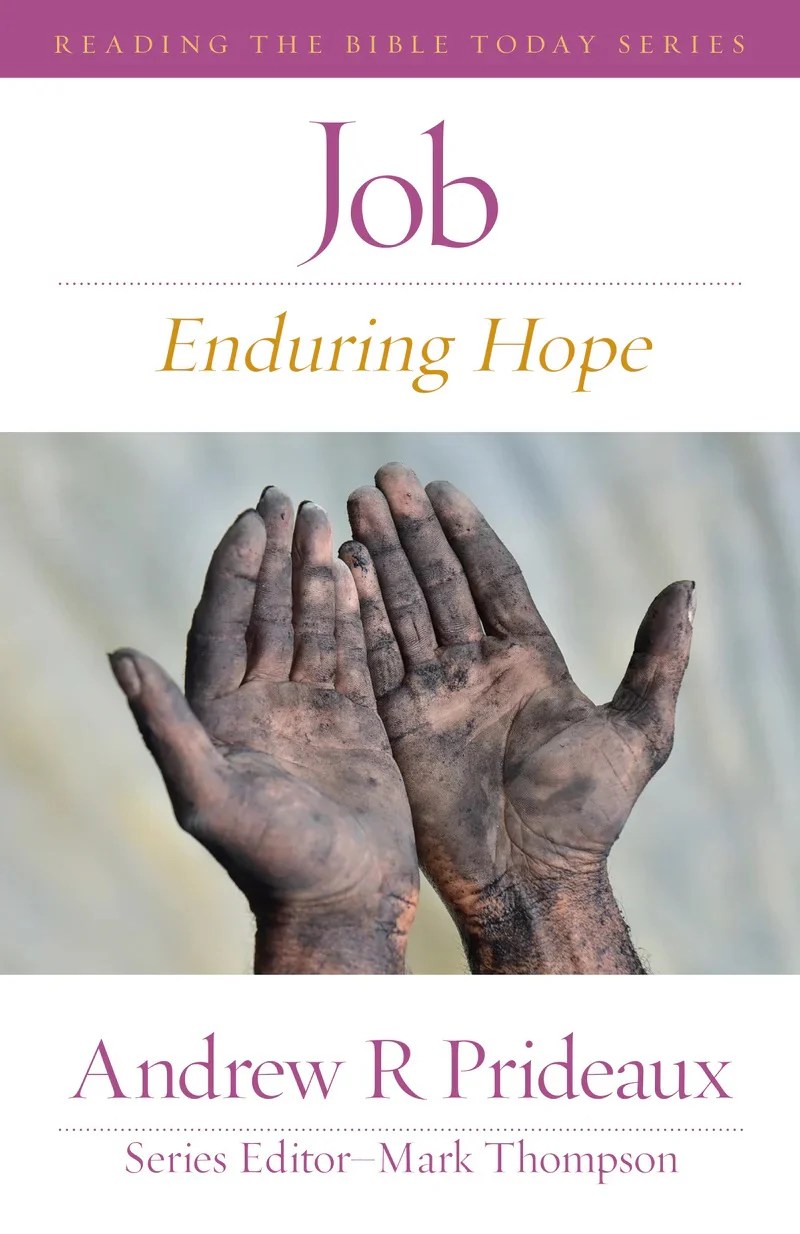
The Reading the Bible Today series has been built around Australian theologians presenting their wealth of Biblical insight on paper. Andrew Prideaux’s commentary on the Old Testament book of Job is the latest in this series. Covering 382 pages Enduring Hope is no small read and his 390 footnotes demonstrate Andrew’s careful attention to the Hebrew text and his interaction with a remarkable number of modern and ancient scholars who have written on the Book of Job.
The story of Job is unique in the Bible since the key character, Job, comes from the land of Uz, outside God’s covenant people of Israel but nevertheless remains a God-fearing man whose life and commitment have constantly been given over to the worship and service of the God of Israel. In the opening chapter Satan challenges God with the idea that Job only serves and worships God because of his comfortable and wealthy lifestyle. Satan suggests that if these things were taken away Job would no longer worship or be committed to God but would reject him in his misery.
As the story unfolds Job loses his family, his home and his wealth and he himself suffers a horrifying destructive skin disease which makes him an outcast of society and a horror to behold. Even the his wife turns against him.
Job is supported in his despair by three well meaning friends who offer him plenty of advice which turns out to be meaningless in Job’s search for at least a word or a conversation with the Lord God. After the failure of the three friends to persuade Job that he should repent of his sinfulness Job is confronted by the words of the young Elihu whose confident rebuking of Job’s desire to speak with God humiliates Job even further. Elihu does not even achieve a response from Job.
Finally through a raging storm God does address Job directly with a powerful account of his creation of the universe in all its complexity and Job is abashed. Job quickly learns to accept that, difficult though his situation is, he must accept that God has a purpose for his world and his people. Job also learns that he has been wrong to accuse God in spite of his difficult situation.
God opens Job’s eyes to the wonder of God and his own smallness which enables him to understand the power and majesty of God in a new way. In return God vents his anger on the three friends who have spoken so wrongly of Job and who are only restored by Job’s plea for mercy for them. God also restores Job’s health and his place in the world a hundred fold.
The story of Job requires careful reading and deep thinking. Readers of this commentary will find many useful insights and a thoughtful and fresh understanding of this remarkable and hugely significant component of Scripture. This is a commentary to read carefully and thoughtfully and it will return rich spiritual encouragement.
Patrick O’Brian, author of 20 volumes of the Aubrey-Maturin novels.
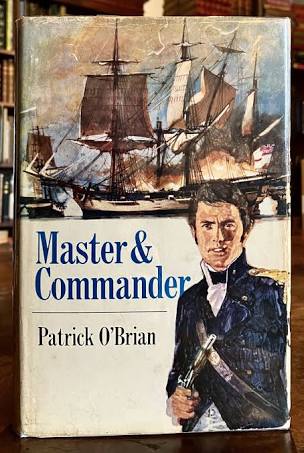
Patrick O’Brien was a distinguished and prolific English writer, fluent in French, Spanish and Catalan. Married to Mary, mother of Count Nikolai Tolstoy, O’Brien was an autodidact and wrote many short stories, reviews, translations and novels. He translated Papillon from French to English, wrote biographies of Picasso and Sir Joseph Banks and wrote twenty novels about the Royal Navy during the Napoleonic wars.
In brief, Master and Commander, the first of his naval novels, tells the story of the impoverished Lieutenant Jack Aubrey who gains his first command, the sloop Sophie. This was a small but highly manoeuvrable ship and he persuades his newly found friend Doctor Maturin to join him. Together they go to battle against their French and Spanish opponents during the C18th Napoleonic wars.
Not being a lover of boats, ships or maritime warfare of any sort I found the first three chapters of this book demanding to say the least and unreadable to say the truth! His key character, Jack Aubrey is clever at sea but makes himself ridiculous on land. His friend Maturin is thankfully, an excellent support in both situations.
Gradually and unwillingly I began to make sense of the story and to endure it rather than enjoy it. In my edition, the author’s notes indicate that the military and seaborne battles and skirmishes are taken directly from the Naval Chronicle, and the Admiralty papers in the British Public Record Office. I found this at least encouraging! I did note that O’Brien makes no attempt at all to lionise his hero and Jack Aubrey’s ineptitude in public events and willingness to be the wives of his superiors I am guessing is simply to demonstrating the normal routines of C18th British sea-going morality!
I love to read but I have to say I will not live long enough to read the other nineteen or so volumes in this series. Just finally, towards the end, I did find myself identifying with what C18th warfare in the world’s oceans might have been like and what a debt is owned to those who lived that life. 4 stars but never again!
 Theological, Cultural and Educational Reflections