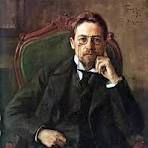
Anto Chekhov. The Cherry Orchard

Anton Chekhov: The Cherry Orchard, Translated, Constance Garnett; Intro. A.B. McMillin,
h/b, Geneva, Heron Books, original frontispiece by Went Strauchmann, 1969 (1903).
Russian playwright Anton Chekhov’s most popular play has a gay and happy feel which covers the sadness of the key figure in the narrative, Madame Ranevsky (Lyubov Andreyevna), the owner of the Cherry Orchard. Lyubov has just returned from France to her failing estate in Russia, having spent many years in a flawed relationship following her husband’s death through alcohol abuse. Lyubov had originally escaped from the Cherry Orchard property after the drowning of her son in the deep river alongside the Cherry Orchard. The merchant Lopahin, a friend of the family, works very hard to persuade Lyubov to sell the orchard to pay off their serious debts.
Whilst all this sadness and negotiation takes place a whole happy merry go round of light hearted love affairs and romance dances across the stage with Lyubov’s 17 year old daughter Anya, her 24 year old adopted daughter Varya, Dunyasha the maid and Charlotta the Governess mixing things up with the eternal student Trofimov and Epiphodon a clerk.
The pray draws to a climax with the selling of the Cherry Orchard for a vast sum thanks to the skills of Lopahin the merchant and we are left in the dark about the future of the romances. Chekhov’s skill in challenging the reader to worry about who should love who and what should be done with the cherry orchard keeps the audience alert and awake and highlights the skilled uncertainties and doubts that emerge from his earlier classic plays Uncle Vanya and The Seagull.
Chekhov remains a star… his gifts lie in the play of uncertainties leaving the reader always on edge to find the usually uncertain finale. How will this outcome be received? We will never know! 5 stars and rising.
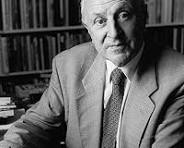
Review of Albert Hourani: A History of the Arab Peoples: Intro and Afterword by Malise Ruthven, London, The Folio Society, 2009.
Hourani went to Magdalen College, Oxford where he studied philosophy, politics and economics and he became more and more absorbed in History, particularly the history of the Middle East. He travelled to Beirut, taught himself Arabic and studied under Qustantyn Zurich, a lecturer in Islamic History. During the second World War Hourani worked as an analyst in these British Foreign Office’s Research Department and eventually followed Hamilton Gibb at the new Centre for Middle Eastern Studies Gibb had established after the war at St Antony’s College Oxford.
In 1942 Hourani was offered a position in the office of the British minister in Cairo where he remained until 1945. He met some of the leading personalities of the day including Glubb Pasha, the British Officer who commanded the Bedouin Arab Legion in Transjordan and David Ben Gurion the Zionist leader who would become Israel’s first Prime Minister. Hourani eventually published books on Syria and Lebanon, Great Britain and the Arab World and Minorities in the Arab World.
Later Hourani joined the Arab Office in Jerusalem, an organisation aimed at countering Zionist propaganda by explaining the Arab case. Hourani returned to Oxford during the Arab-Israeli war where he remained until his retirement in 1984. Hourani’s earlier works include his History of the Arab Peoples and Arabic Thought in the Liberal Age 1798-1939. This current work was also influenced by French historian André Raymond and American Quaker historian Marshall Hodgson as well as the Arab savant and philosopher of history Ibn Khaaldin (1332-1406).
Hourani’s magnificent work covers vast tracts of Arab and Islamic issues including early Arabic life and learning, Muhammad’s call of Arabs in the early seventh century to a religious movement from Mecca, the impact on the Byzantines and Sasanians, the actual appearance of Islam, the hijra, Medina, The formation of an Islamic Empire and the formation of a vast Islamic society, the articulation of Islam, Arab Muslim societies in the (C11th-C15th), the Arab Muslim world..states and dynasties, The land, countryside and its use, the life of Arabic cities, their rulers, clients and dynasties, the ways of Islam, the culture of the ‘Ulama (religious scholars), divergent paths of thought..Islamic philosophers, the development of Shi’ism, the cultures of courts and people, the Ottoman Empire and its limits, Ottoman societies, the changing balance of power in the C18th, European power and reforming governments (1800-1860), European empires and dominant elites, the culture of Imperialism and Reform, The Climax of European power (1914-1939), life in the new cities, The end of the Empires (1939-1962), The second world war, Changing societies 1940s and 1950s, the climax of Arabism (1950s and 1960s), Arab Unity and Disunity since 1967, A Disturbance of Spirits since 1967.
Malise Ruthven’s Afterword 2009 covers the 1990 Iraqui invasion of Kuwait, Desert Storm and the liberation of Kuwait, the fall of Saddam Husayn, the American invasion and false nuclear weapons, the unification of the two Yemens, creation of the Palestinian National Authority, Israeli occupation of the West Bank, the Assassination of Rabin by Jewish extremists, the Second Palestine intifada November 1995, Islamic attacks on New York and Washington (over 3000 deaths) – Osama Bin Laden, the death of Arafat in 2004, Civil wars in Algeria in 1990s, new Shi’i strength in Iraq and Syria, and Lebanon.
It is difficult to comprehend the complexity of the Arabic peoples, the power of Islam, and the interactions between the Arabic world and the West. Hourani’s work is an excellent place to start and his even, carefully selected analysis makes for straightforward reading and, as always, a desire for further information. This Folio presentation with its vast collection of coloured photographs is an absolute treat to read Of course while we read, we now also see the dreadful war between Hamas and Israel every day on our TV screens, reminding us that the tension between the West and the Arab/Islamist world is not going to go away in a hurry. We will need a new Hourani to cover the next stage! 5 stars and rising.
 Theological, Cultural and Educational Reflections