Salman Rushdie: The Satanic Verses: A Novel; Henry Holt, New York, 1997 (1988).

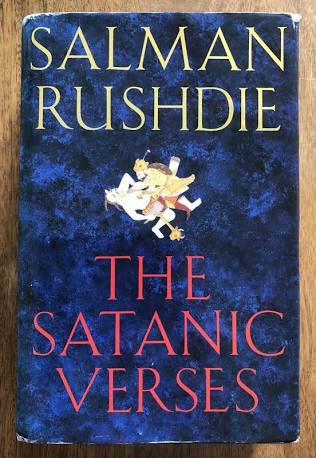
Complex high octane novel which almost cost Rushdie his life on three separate occasions and did cost the life of his Japanese translator. The attacks were due to the fatwa declared against Rushdie in February 1989 by the late Shia Muslim Iranian President the Ayaotollah Khomeini. The reason for the fatwa was that Khomeini believed that the novel contained blasphemous material about Islam and the prophet Muhammad. Although the President eventually distanced himself from the fatwa it has never been lifted.
Rushdie’s novel centres on two humans with angelic powers both of whom were the only survivors of a major aircraft explosion. The two characters were both Indian born but spent most of their lives after childhood as British citizens. Gibreel Farishta was an Indian superstar actor and allegedly the “good” angel. Saladin Chamcha also worked in the film industry in the technical area and was allegedly the “bad” angel.
The novel centres on the lives and loves of these two characters including their personal interactions with each other. The novel paints a rather unhappy picture of the lives of Indian nationals trying to make a go of life in late C20th London alongside the historical material on Islam.
Rushdie clearly has a wide grasp of Indian and British society and a far-reaching knowledge of English literature which he makes use of on a regular basis. There are passages in the novel which could almost be regarded as lists of things literary, social behaviour, gang behaviour and several other political, artistic and humorous happenings. These events are too numerous and complex for the reader to spend much time trying to sort out what is happening. I think Rushdie wants us to move on and generally just get the gist of each situation. Someone who has lived on the darker side of British Indian relations might have more clues about what is happening.
I read and enjoyed Rushdie’s powerful prizewinning Midnight’s Children some years ago but I cannot recommend this novel. The high powered sexual imagery is, I believe, unnecessary for his purpose. Some of the complexity of his “lists” and crazy event images looks more like “see how much I know about literature, London’s underground and Indian behaviour in Britain”. The Islamic history is powerfully written and interesting in its own right but doesn’t seem to have any clear link with the rest of the narrative. There is an important story about religion hidden in this book but in my view Rushdie has wasted a good opportunity. 3 Stars.
Review of A.J. Mackinnon: The Unlikely Voyage of Jack de Crowe, p/b, Melbourne, Black Inc., 2009

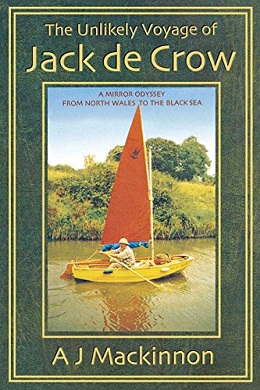
A.J. Mackinnon is a multi-talented school master, raconteur, world traveller, poet, mathematician , tin whistler, magician and courageous sailor. The Jack de Crowe was a small dinghy Mackinnon sailed through most of the canals in England and then sailed single handed across the English Channel to France and on through Germany, Austria, Slovakia, Romania, the former Yugoslavia, Bulgaria and all the way to the Black Sea. This novel is the story of his adventures and is a remarkable read.
Mackinnon tells of back-breaking rowing, literally hundreds of locks, near shipwrecks and collisions, storms and pirates, generous hosts, hunger and near starvation, beautiful sites and unpleasant and dangerous muddy boat traps. That’s just to name a few of the adventures in this novel.
Assisting him in these heroics come along a vast array of generous folk unknown to him who supply warm beds where needed, copious amounts of food and wine, helpful repair work after much damage to his boat from time to time and many other folk who simply came into his life or offered sage advice.
Mackinnon’s story is written with deep humour, but also demonstrates the frequent challenges to life and limb he endured through his determination to take such a journey unaided. For readers who love boats and understand the rigours and mechanics of dinghy sailing this book will provide a feast of interest and ingenuity. For those of us who like a good yarn there are stretches in the book which are quite technical and at times test the reader’s patience. Nevertheless Mackinnon’s achievement is so amazingly breathtaking that the book is hard to put down in spite of the occasional technicalities. 5 stars.
 Theological, Cultural and Educational Reflections