Alister McGrath: Richard Dawkins, C.S. Lewis and the Meaning of Life, p/b, London, SPCK, 2019
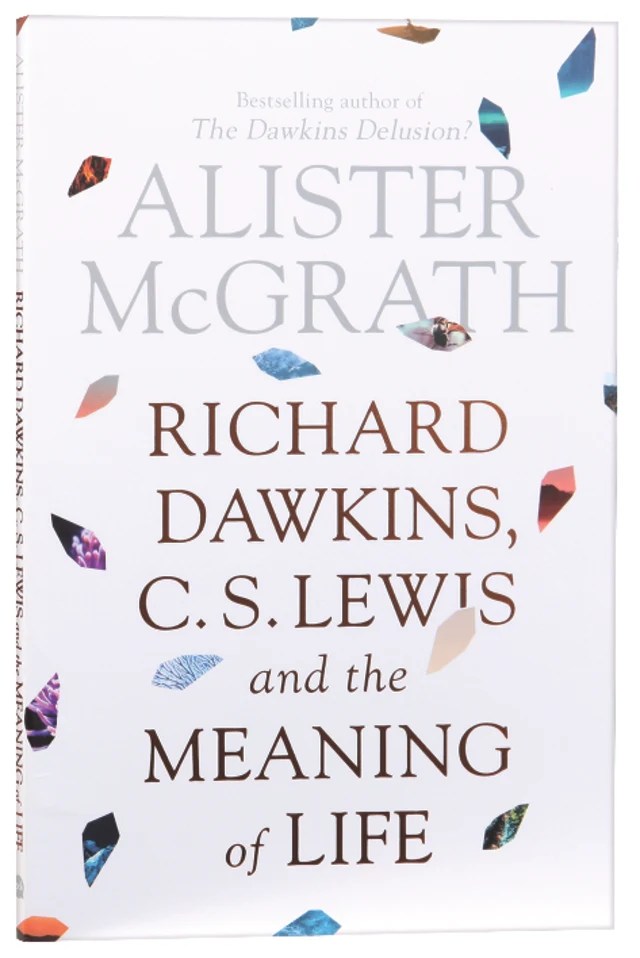

Alister McGrath is the Andreas Idreos Professor of Science and Religion at Oxford University and Director of the Ian Ramsey Centre for Science and Religion. He has written a vast array of outstanding books on Christian Theology, Church History and the relationship between Christian Faith and Science. His output includes his monumental three volume A Scientific Theology, his Doctoral Thesis A History of the Doctrine of Justification, his outstanding must read Christianity’s Dangerous Idea on the Reformation, and his very helpful The Christian Theology Reader in which he provides substantial readings from every major theologian from Justin Martyr to the present day along with a thorough analysis of their key ideas and useful questions for study.
Alongside these massive theological tomes McGrath’s little (70 page) paperback on Dawkins, Lewis and the Meaning of Life seemed to me a bit trivial after some years of crunching through his heavyweight thought. On the contrary I found the four chapters of this little book demanding, thought provoking and at times unsettling. At the outset a reader might assume that McGrath would be very critical of Dawkins’ outspoken critique of Christian faith and very praiseworthy of Lewis’s well known and very popular Christian books. This is not the case as McGrath puts some tough questions and criticisms to both these writers and challenges the reader to think deeply about what we really do believe about our lives, their future and purpose and what is the meaning of our existence on this tiny planet hidden in the maelstrom of billions of other stars and planets.
McGrath demonstrates that both writers are men of faith holding committed positions that cannot be proved right, but which they clearly regard as justified and reasonable. (p.19) McGrath also points out that both psychology and philosophy show that human beings have a tendency to believe more than the evidence actually warrants. (pp38-40). McGrath challenges us to think through just how we can show our beliefs to be justified. Don’t read this book if you don’t like your Christian faith being challenged. Read the book if you want to consider deeply the meaning of your life and faith. 5 stars.
Colson Whitehead: Harlem Shuffle, p/b, London, Fleet, 2022


Colson Whitehead is a popular American writer especially well known for his story of The Underground Railway involving black Americans escaping from Southern USA before the American Civil War.
Harlem Shuffle is a rollicking story of crime and criminality in Harlem New York. Family man Ray Carney runs a highly successful furniture shop in Harlem but was not immune from accepting the odd bits and pieces of stolen property and moving them on at a profit. Whitehead’s novel is in some respects a difficult read as the terminology is unique to an urban underground of criminality. I did find this material difficult at first but the reader gradually gets used to the language and style.
Harlem Shuffle does not hide the brutality and easy death involved in the Harlem underground but also manages to inject a degree of humour into the narrative. The reader soon identifies with Carney given that the behaviour of some of his contacts is completely ruthless and outrageous. The book is a hefty read and not for the faint-hearted. It certainly shines a light on a whole underground most of us know exists but have little interest in interrogating too deeply. In many ways it is quite a disturbing read. 4 stars
E. M. Blaiklock: The Authority and Relevance of the Bible in the Modern World: The Olivier Beguin Memorial Lecture 1975, p/b. Bible Society, Melbourne, 1975

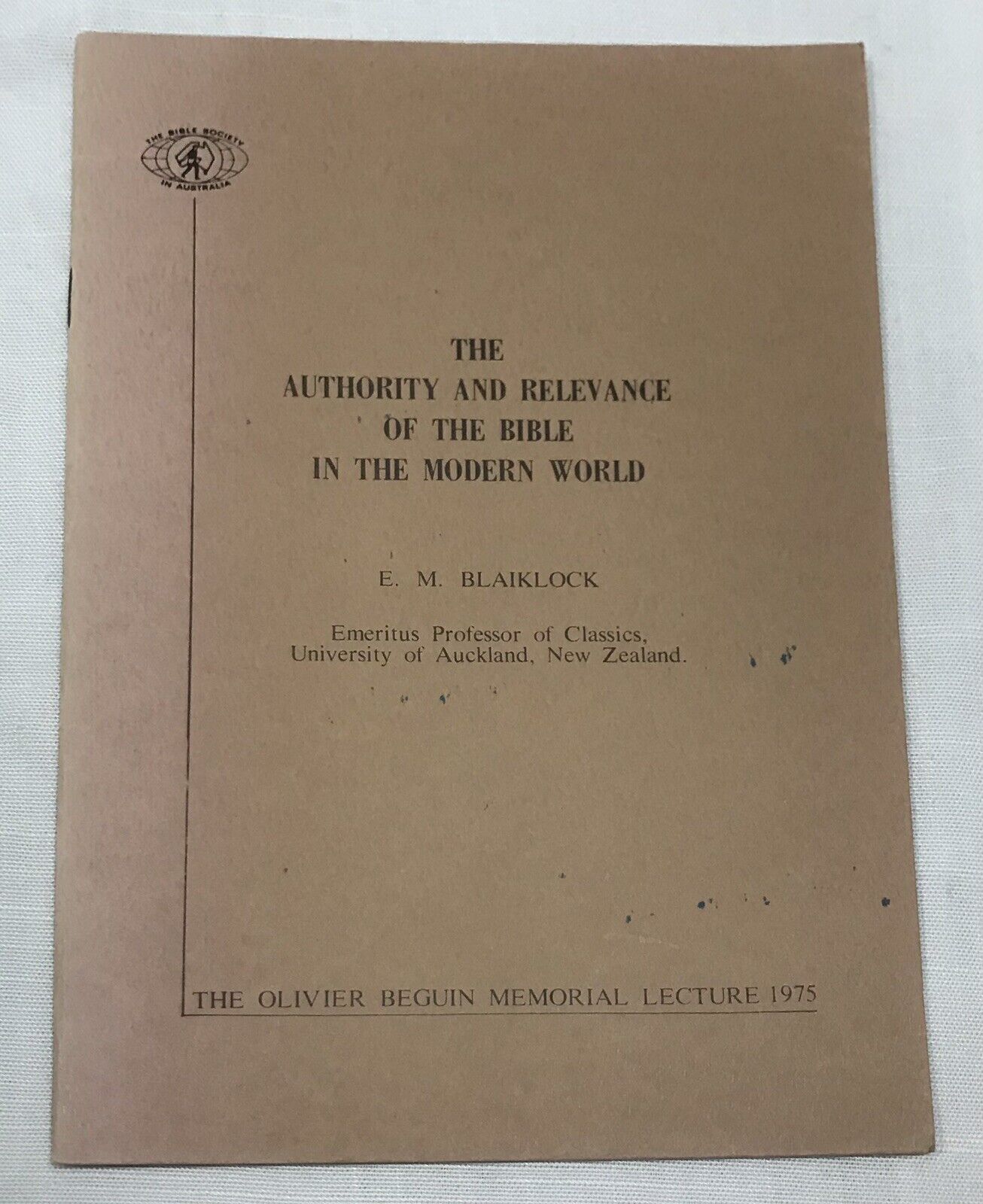
Edward Musgrave Blaiklock lectured in Latin, Greek and Biblical History for 42 years at the University of Auckland and for 21 of those years he held the Chair of Classics. Having emigrated to New Zealand with his family when he was six years old. Blaiklock was highly regarded as one of Auckland’s greatest sons and became the first Public Orator of Auckland, a post he held for ten years. Writing under the name of Grammaticus for the Weekly News, the Sunday Herald and the New Zealand Herald for over forty years without missing an edition. His list of academic publications is vast and his knowledge of Latin, Greek, Biblical History and Archaeology has few peers. Blaiklock died in 1983 but his many academic works are still widely sort after.
Blaiklock’s major essay The Authority and Relevance of the Bible in the Modern World was given in 1975 but its cutting analysis is still frequently sought after as are many of his books and articles including his Commentary on Acts and his works on The Century of the New Testament , The Male Characters of Euripides and Biblical Archaeology are widely sort after, fifty years after his death. Blaiklock’s writing, on the surface silky smooth and easy to read, amazes the reader with his depth of knowledge and his ability to make quite difficult concepts very accessible to the reader. Anyone who in the C21st is thinking that the Bible is completely irrelevant to our daily pre-occupations would I believe be forced to think again if they were to read this extraordinary essay.
It is rare to find an academic with the communication skills to maintain a post in a national daily for forty years at the same time being quite at ease with ancient history, Greek and Latin authors and an exceptional understanding of New Testament Greek and Ancient History. This remarkable piece of historical analysis is readily available online and will richly repay anyone who takes the time to read it, especially if they were previously an atheist! 5 stars.
 Theological, Cultural and Educational Reflections