
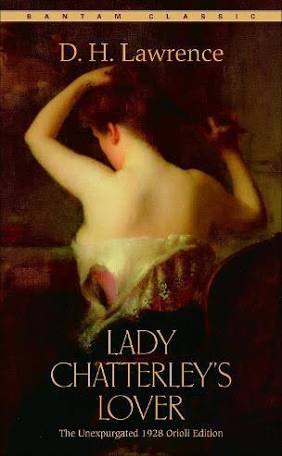
D.H. Lawrence: Lady Chatterley’s Lover: The unexpurgated 1928 Orioli Edition; Preface, Lawrence Durrell; Intro. Ronald Friesland. This edition includes Lawrence’s extended essay, A Propos of Lady Chatterley’s Lover. p/b, New York, Bantam Books,1982, (1928).
I was too young and inexperienced when I read Lawrence’s The Rainbow in my first year of Melbourne Uni Arts, aged 17. I understood little of the novel and was very critical of it. Later in life, married with two children, I read Sons and Lovers and Women in Love and found the latter especially to be one of the most powerful, sensuous and meaningful novels I have ever read and rate it certainly in my top five novels of all time.
It has taken me to the ripe old age of 74 to read Lady Chatterley’s Lover, not because of any objection, but simply the vast catalogue of reading material that comes along with teaching for fifty years and so many new books to savour.
I enjoyed Lady Chatterley very much and the key characters, Connie, Sir Clifford, Mrs Bolton and the magisterial game-keeper Mellors will stay with me for a long time. The famous naughty words, as Durrell’s essay notes, have lost much of their power to horrify since 1928. This enables a reader to enjoy the gradual unfolding of the relationship between the keeper and the Lady of the House with its emergent romance, halting arguments, powerful passion, and thought provoking realism about their situation.
The novel is also an account of a struggling England after World War 1, with the coal industry exploding but also in trouble, the tension between aristocrat and the majority poor, and the gradual unfolding of a more modern world with sporty cars and new inventions daily. Some of this material, although historically interesting, tends to turn the novel in places into a cultural analysis.
The descriptive power of the summer holiday in Paris and Venice with its catalogue of misbehaviour, ennui, torturous heat and languid nothingness is depicted with all Lawrence’s insight and picture writing. Lawrences’s extended essay about the book and its scandals and his view of the short comings of the English, makes interesting reading. Today’s modern England with cultures from all the world have no doubt done a lot to enlarge the emotional and romantic world of England in 2023. I would give this novel 4 stars.
F. Scott Fitzgerald: The Great Gatsby: London,Vintage Books, 1910 (1925).

F Scott Fitzgerald
Undoubtedly the best of F. Scott Fitzgerald’s four novels set in the nineteen twenties, Fitzgerald has left us a never to be forgotten masterpiece. I have read this book three times and watched Baz Lurman’s amazing movie the same number of times.
The book is better than the movie with the powerful scene of Gatsby’s funeral,one of the triumphs of literature omitted from Lurman’s film.
In one sense the story is just about the fraught and uncertain wealth of the Anglo-American twenties, with its charleston, devil may care postwar freedom, money and eventually bust. In another sense it is a delicately sensuous love story.
The narrator Nick Caraway takes us on his own journey from the relatively safe and secure West to the fast moving and chaotic reality of life in New York. The magical story of James Gatz from the West who became Jay Gatsby, arguably the richest man in the East based on cleverly marketed illegal bonds, becomes a strangely heroic tale of poor boy makes good and gets the girl of his dreams (almost!)
Gatsby falls in love with upper class Daisy Duckman in his youth before being called to the war. When he returns with no money or prospects she turns to safer shores and marries the unfaithful Tom Buchanan. Nick Carraway, who happens to rent a small house right next door to Gatsby’s mansion, gets to know Gatsby and tells his story at the same time as (almost) falling in love with Daisy’s friend Jordan Baker.
Fitzgerald and his wife Zelda lived this 1920’s life itself and and Fitzgerald creates the power and danger of it with imperious skill, joy and terror. The Great Gatsby is one of the truely great works of English Literature. 5 stars and rising.
James Baldwin: Go Tell it on the Mountain, p/b, London, Corgi, 1968 (1954).

I read Go Tell it on the Mountain as a teenager and never forgot the mix of African American spirituality, vigorous worship and a degree of hypocrisy alongside commitment.The story is set against an American world which though freed from slavery was still mired in racial anger, disadvantage and division. Fifty six years later I wanted to read this powerful story again in 2023, still disturbed by racial divisions in both the USA and Australia. The book has lost none of its power. I was unaware of its semi-autobiographical nature until reading more about the author very recently.
There are several strong characters in this novel, none more so than successful preacher Gabriel Grimes whose powerful message gained admiration but whose manic behaviour towards his own family brought only anger and disarray. Gabriel, in spite of his holy name, was brutally vicious with his male children and seems unable to find any genuine repentance at any point in the novel. His first wife, Deborah had been gang raped as a teenager and was unable to bear children, dying childless.
His marriage to Elizabeth was almost accidental. She had escaped the rigidity of her powerful aunt who had looked after her after the death of her mother. She travelled north to start a new life and fell in love with a young poverty stricken Richard. They lived happily together in unmarried poverty, until Richard was tangled up in a false accusation of robbery and imprisoned. Although found to be innocent the trauma destroyed him and he suicided before Elizabeth could tell him they were pregnant. Gabriel had also travelled north for a new start and they met through Gabriel’s sister Florence and soon after were married.
The basis of the novel is the story of their family life totally dominated by the church. The children consisted of John (who was of course Richard’s son and the key player in the narrative); Roy, a rebel, both loved and persecuted by his father and a sister who does not appear in the narrative. The tension between John and his father is the central story of the novel.
Baldwin writes with impressive power and vigour and the narrative remains in the mind after many years. His writings have earned him many significant awards. He died in 1987. 5 stars.
Austin Farrer: Saving Belief: A Discussion of Essentials: h/b,London, Hodder & Stoughton, 1964

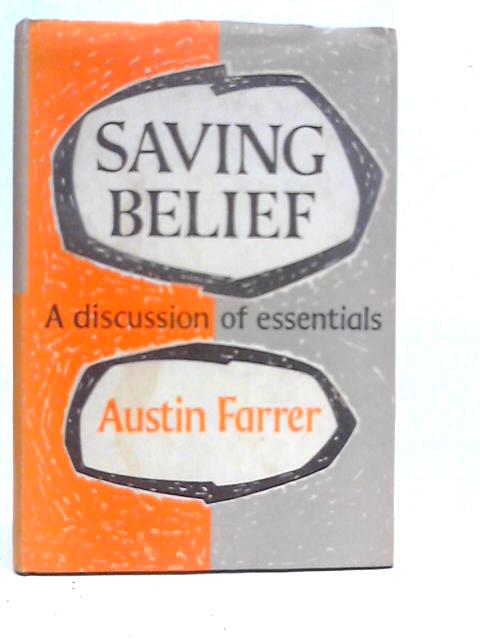
Austin Farrer was a major C20th English theologian and philosopher in the high church Anglo-Catholic tradition, in spite of being the son of a Baptist Minister. He was for twenty five years the Warden of Keble College in Oxford and wrote a large number of philosophical and theological works. His closest friend was C S Lewis and he ministered to Lewis at his death bed. Saving Belief was his most accessible work but still demands hard thinking from his readers. No longer in print, Saving Belief is readily accessible second hand on line.
Farrer suggests that Christian faith can only come from hearing about God underlying the importance of Christians reaching out to others about their Christian faith. Farrer suggests that a virtuous and dutiful lifestyle, thinking about faith and/or considering the beauty of creation and the universe might move a person towards faith but that the scandal of faith is that belief in God must be personal. “God” as an explanation or a hypothesis to be tested will not work. There needs to be an openness, acceptance and sympathy towards faith for belief to be formed in a person.
Farrer argues that the basis of theology comes down to a belief that human existence demands a superhuman creator. Acknowledging God’s existence is not the faith that saves. It is not enough to believe in the existence of God. The Devil believes and trembles he argues, citing the Epistle of James.
Farrer’s helpful book has chapters on Providence and Evil (the world is not created perfect, p47), Creed and History, Sin and Redemption, Law and Spirit and a very helpful final chapter on Heaven and Hell. Saving Belief is a small, neat and thoroughly demanding read which will encourage and help believers, make seekers want to know more and might even challenge unbelievers to give faith a second thought. 5 stars.
 Theological, Cultural and Educational Reflections